
AI Agent vs. Chatbot vs. Copilot in 2026
I’ve spent over three decades in IT, and if there’s one recurring pattern I’ve watched play out across every hype cycle, it’s this: vendors race to attach the most impressive-sounding label to whatever they’re selling, and buyers pay the price later when the label doesn’t match the actual capability. AI Agent vs. Chatbot vs. Copilot: Understanding the Differences is exactly this problem playing out right now, and I want to walk through it the way I’d walk a colleague through it before a purchase decision, not the way a glossary would.
AI Agent vs. Chatbot vs. Copilot: Understanding the Differences means distinguishing three tools by their actual level of autonomy and their relationship to the human user, rather than by marketing labels alone. For example, Anthropic’s own engineering team notes that many products marketed as “AI agents” are technically closer to a fixed, predefined workflow than genuine autonomous decision-making.
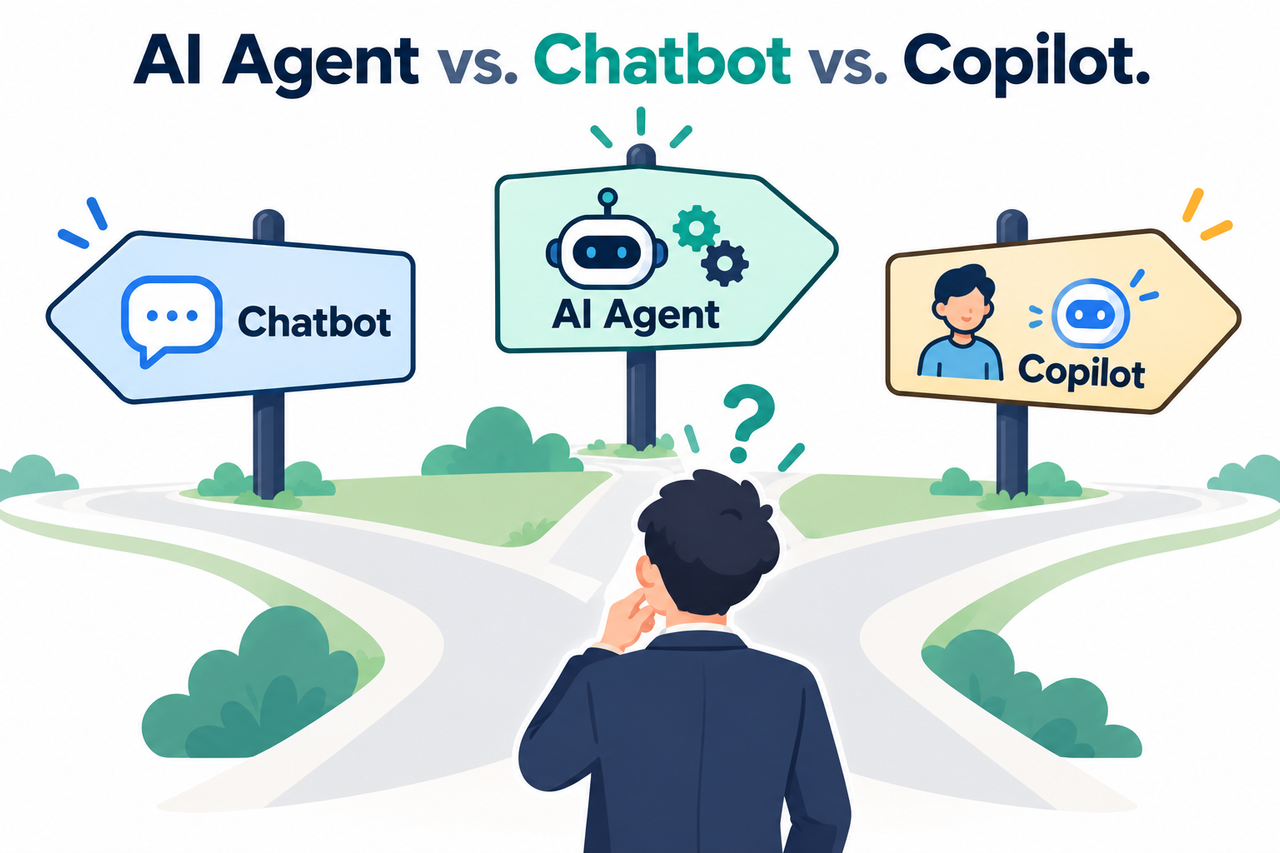
If you’re about to sign off on an “AI agent” platform based on a vendor’s sales deck, pause first. The market uses these three terms so inconsistently that even experienced buyers regularly discover, months into a contract, that what they bought can’t actually do what they were shown in the demo.
What Is the Real Difference Between an AI Agent, a Chatbot, and a Copilot?
Quick Answer
A chatbot is a conversational interface that matches messages to responses within a single interaction and cannot take action in connected systems. An AI agent pursues a goal through multiple adaptive steps, using external tools and memory to actually complete tasks. A copilot assists a human who remains the primary decision-maker, rather than replacing that human’s judgment or actions.
In my experience walking teams through vendor evaluations, this is the single most common source of wasted budget I’ve seen in the last two years. Not bad software, just a mismatch between what was promised under one label and what actually got delivered under a different definition of that same label.
Why Do Vendors Use These Terms So Inconsistently?
I want to be fair to the vendors here before getting into how to protect yourself from this, because the confusion isn’t always deliberate deception.
The Market Has No Agreed-Upon Definition
Anthropic’s own engineering documentation states plainly that “agent” is defined multiple ways across the industry: “Some customers define agents as fully autonomous systems that operate independently over extended periods… Others use the term to describe more prescriptive implementations that follow predefined workflows.” Anthropic That’s coming directly from a leading AI lab, not a disgruntled buyer, which tells you the ambiguity is structural, not incidental.
Vendors Have a Commercial Incentive to Overstate Capability
I’ve sat through my share of vendor demos over the years, and the pattern documented by industry analysts matches what I’ve personally observed: “Almost none of them define the terms consistently. Buyers sit through demos that use ‘agent’ and ‘chatbot’ interchangeably, or that call an agent-assist tool a ‘copilot’ and a copilot feature an ‘agent,’ and leave without a clear picture of what they evaluated.” Kustomer That’s about as direct a description of the exact problem as you’ll find.
The Underlying Architecture Question Rarely Gets Asked
The real technical distinction, buried underneath all the marketing language, is whether a system follows a predefined code path someone wrote in advance, or whether the underlying language model itself dynamically decides what steps to take and which tools to use. Most buyers never ask this question, because most sales conversations never surface it.
What Actually Separates These Three Categories at a Technical Level?
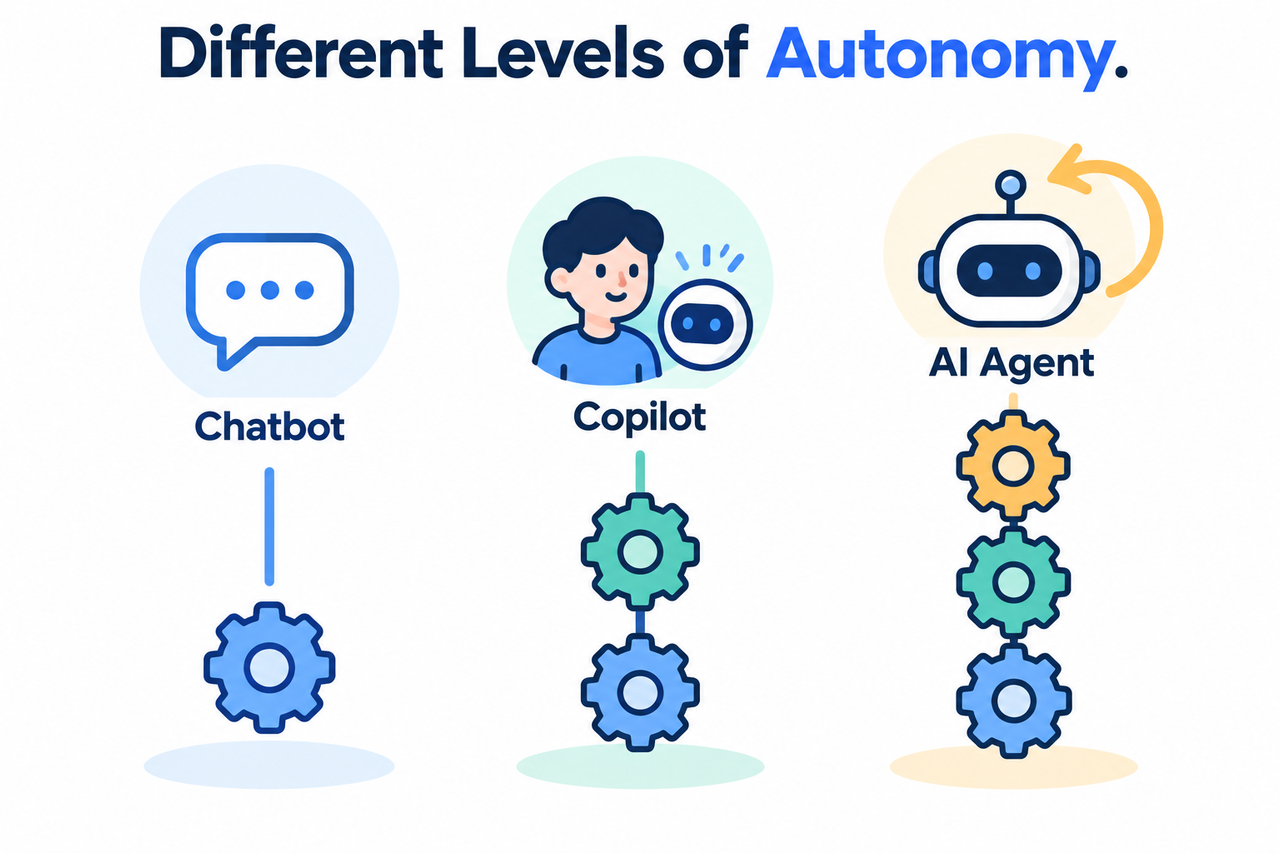
Let me lay out the actual capabilities, because vague descriptions are exactly what got everyone into this confusion in the first place. A conversational AI chatbot operates in single or short turns: it retrieves relevant information and returns it, but it cannot plan multi-step actions or reach into connected systems to actually do something on your behalf.
An autonomous agent, by contrast, has four properties a chatbot lacks: memory that persists across the interaction, access to external tools like databases or APIs, multi-step task planning, and persistence toward a goal rather than stopping after a single response. This is what agentic AI actually refers to at a technical level — not just fluent conversation, but genuine goal pursuit through adaptive steps.
A copilot occupies an entirely different category, because it isn’t primarily responding to an end customer or user at all. A copilot assists a human who remains in the loop, surfacing information, suggesting responses, and reducing cognitive load, while the human stays the one taking action and making the final call. Microsoft’s own official framing draws this line precisely: “agents are specialized AI tools built to handle specific processes… Think of agents as the apps of the AI era, with the copilot as the interface.” Microsoft
| Category | Who Acts | Core Capability | What It Cannot Do |
|---|---|---|---|
| Chatbot | The tool responds directly to the end user | Match a message to a relevant response in real time | Take multi-step action in a connected system |
| AI Agent | The tool acts autonomously toward a goal | Plan, use tools, remember context, and complete tasks | Guarantee predictable behavior without oversight |
| Copilot | A human remains the primary actor | Surface information and suggestions to support a human | Replace human judgment or take final action alone |
How Do You Test Which Category a Tool Actually Belongs To?
This is the part I actually care about getting right, because understanding the theory doesn’t protect your budget — a concrete testing process does.
- Stop trusting the label alone. Evaluate capability through direct demonstration rather than the term a vendor chooses to use, since the market has no stable, consistent definitions.
- Test a chatbot claim with a follow-up question. Ask the vendor to show it answering a knowledge base question, then push a follow-up requiring account access — if it escalates to a human, it’s a genuine chatbot.
- Test an AI agent claim with a three-step task. Ask for a live demonstration of retrieving account-specific data, making a decision based on that data, and taking action in a real connected system, not a static demo.
- Test a copilot claim by checking who acts. Ask to see the tool inside a real human’s live workflow — if there’s no human remaining as the primary decision-maker, it isn’t actually a copilot.
- Apply Anthropic’s core architecture question. Determine whether the system follows a fixed code path, which Anthropic calls a workflow, or whether the model dynamically directs its own process and tool calling, which is a true agent. Anthropic
- Match the category to your actual business problem. Choose a chatbot for informational contact volume, a copilot for human resolution speed and quality, and a genuine agent only when the task requires real action-taking in connected systems.
- Remember agents and copilots can work together. Microsoft’s own model treats agents as specialized task-performing tools with the copilot as the conversational interface layered on top, meaning mature deployments often use both.
I want to expand on step 3, because it’s the one I see skipped most often, usually because it’s the most uncomfortable question to ask in a sales meeting. A vendor showing you a fluent, impressive conversation is not the same as a vendor showing you a tool taking a real, consequential action inside a live connected system. Insist on the second one before you sign anything.
Test Scenario: Verifying an "AI Agent" Claim (Illustrative example)

Ask: "Show me the tool looking up this specific customer's order,
deciding whether it qualifies for a refund based on your policy,
and issuing that refund in your live connected system — not a
sandbox, not a scripted demo."

If the vendor can only show a conversation about refund policy,
without an actual action taken in a real system: you're looking
at a chatbot with agent-sounding marketing, not a genuine agent.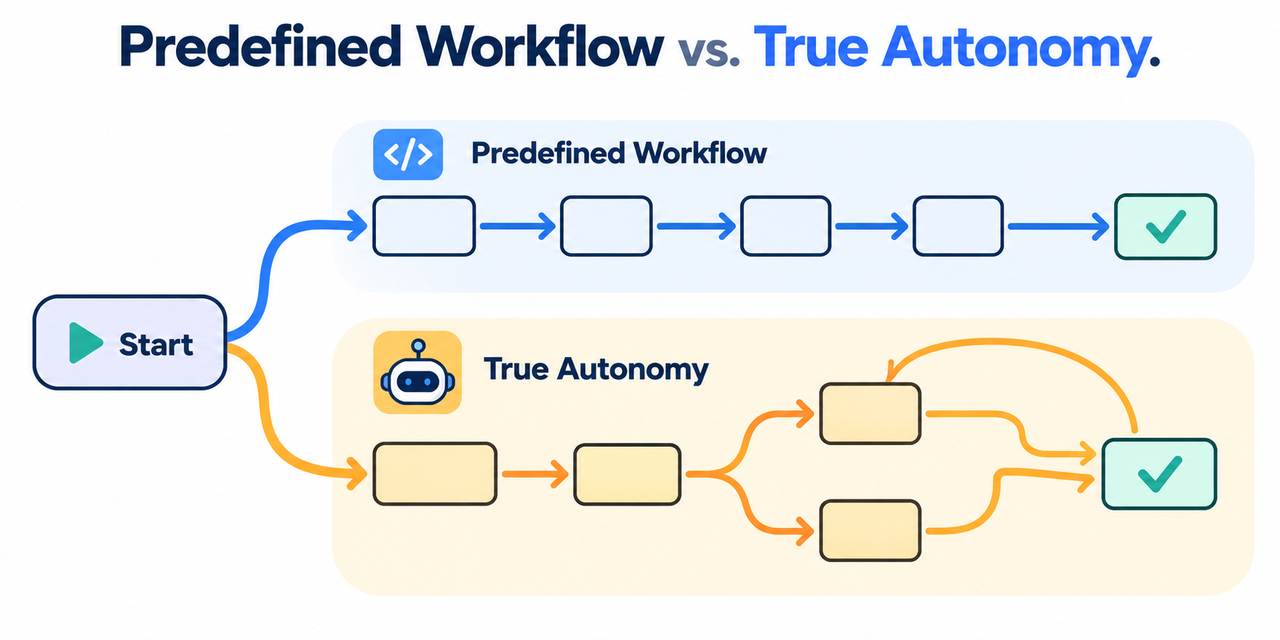
What Do Microsoft and Anthropic Officially Say?
I always prefer going straight to primary sources on a definitional question like this rather than relying on secondary summaries, so here’s what the two most relevant official sources actually say. Microsoft’s documentation states: “agents are specialized AI tools built to handle specific processes… think of agents as the apps of the AI era, with the copilot as the interface.” Microsoft
Anthropic draws the more technically rigorous distinction, separating LLM orchestration through predefined workflows from genuine agents where the model maintains control over its own process: “‘Agent’ can be defined in several ways. Some customers define agents as fully autonomous systems… Others use the term to describe more prescriptive implementations that follow predefined workflows.” Anthropic Read together, these two sources tell you that even the companies building this technology haven’t converged on one universal definition — which is exactly why testing beats trusting a label.
Why Does This Distinction Actually Matter for Your Budget?
I don’t want to leave this at the level of interesting trivia, because the actual stakes here are financial and reputational. If your team greenlights an expensive platform under the impression it offers full workflow automation with human-in-the-loop oversight only where truly needed, but it actually requires a human to approve every single step, you’ve bought something closer to a chatbot with extra steps than the autonomous agent you were pitched.
I’ve watched this exact scenario play out with return-on-investment projections built around headcount reduction that never materializes, because the tool couldn’t actually complete tasks independently the way the sales deck implied. Getting the category right before signing isn’t pedantic terminology policing — it’s the difference between a project that delivers the value it promised and one that quietly underperforms for a year before anyone official admits it.
Bad vs. Good Way to Evaluate These Tools
Let me put the two approaches side by side, because the framing you choose before a purchase decision determines whether you end up debugging a mismatch or celebrating a good fit.
Bad: “The vendor called it an ‘AI agent’ in the sales deck, so I assumed it could handle our returns process end-to-end with no human involved, and now three months into the contract we’ve discovered it can only answer FAQ questions and hand everything else off to a person.”
Good: “Before signing, I asked the vendor to demonstrate the tool completing a task that required looking up a specific customer’s order, making a decision based on that data, and actually issuing a refund in our connected system live — not in a scripted demo — which confirmed it was a genuine AI agent and not just a well-marketed chatbot.”
The bad approach trusts a label under pressure to move fast. The good approach spends thirty extra minutes in a demo to protect months of budget and credibility.
Which Category Actually Fits Your Specific Problem?
Once you’ve correctly identified what a tool actually is, the next question is whether that category even matches what your business needs, since buying the “most advanced” sounding option isn’t automatically the right call. If your core problem is answering a high volume of repetitive, informational questions, a genuine chatbot solves that efficiently without the added complexity and risk of a system taking autonomous action.
If your core problem is that your human team is slow or inconsistent, but you still want a person making the final call on sensitive decisions, a copilot is very likely the better fit, not an agent. Reserve genuine AI agent investment for situations where the task truly requires multiple adaptive steps, real tool access, and enough integration infrastructure already in place to support autonomous action safely.
How Should You Structure a Vendor Evaluation Going Forward?
Based on everything above, I’d restructure any AI tool evaluation process around capability testing rather than label matching from this point forward. Build the three test scenarios described earlier — the chatbot escalation test, the three-step agent task, and the human-in-the-loop copilot check — into your standard vendor evaluation checklist before any demo begins.
Require every vendor to run through the specific test that matches their claimed category, live, using your actual use case rather than their prepared example. This single change in process, more than any deeper technical education, is what actually prevents the expensive mismatch this entire article is built around.
Does This Confusion Extend Beyond These Three Terms?
It’s worth flagging that “agent,” “chatbot,” and “copilot” aren’t the only overloaded terms in this space, and I don’t want you to walk away thinking a vocabulary lesson on exactly three words solves the entire problem permanently. Terms like “autonomous,” “agentic,” and even “AI-powered” get stretched to cover everything from a simple rules-based script to genuinely sophisticated multi-step reasoning systems.
The underlying discipline that actually protects you is the same regardless of which specific term a vendor uses next year: define the exact capability you need in plain, testable language before you ever sit down in a demo, and then verify that capability directly rather than accepting whatever label the vendor’s marketing team has settled on. Terminology in this industry moves faster than shared definitions can keep up with, so the testing habit matters more than memorizing any single glossary.
What Should You Document After Every Vendor Demo?
One habit I’d strongly recommend building into your evaluation process is writing down, in your own words, exactly what capability you watched the tool demonstrate live, separate from whatever the vendor called it. If a vendor’s slide says “AI agent” but what you actually watched was a scripted response to a single, predictable question, write down “scripted single-turn response,” not “AI agent,” in your evaluation notes.
This might feel like an unnecessary extra step in the middle of a busy procurement process, but I’ve found it’s the single most effective safeguard against the exact failure mode this article is about: months later, when someone asks why the tool isn’t delivering the autonomous capability that was promised, you’ll have your own contemporaneous record of what was actually shown, rather than relying on memory or a vendor’s marketing deck to settle the disagreement.
For a broader look at troubleshooting common AI tool confusion and evaluation mistakes, see our complete guide to troubleshooting AI tools.
Frequently Asked Questions
What’s the simplest way to tell an AI agent apart from a chatbot?
Ask whether the tool can take a real action in a connected system, like issuing a refund or updating a database — chatbots retrieve and respond, but only genuine agents complete multi-step tasks with real consequences.
Is a copilot just a less capable version of an AI agent?
No — a copilot serves a fundamentally different role, assisting a human who remains the primary decision-maker, while an agent is built to act with its own autonomy toward a goal. Microsoft
Why do so many products marketed as “AI agents” turn out to be simple workflows?
Because the term “agent” has no industry-standard definition, and many vendors use it to describe predefined, scripted processes rather than systems where the AI genuinely directs its own steps. Anthropic
Can a business use a chatbot, an agent, and a copilot at the same time?
Yes — Microsoft’s own architecture treats agents as specialized task tools and copilots as the interface layered on top, so mature deployments often combine multiple categories rather than choosing just one. Microsoft
What’s the single best question to ask a vendor before buying an “AI agent” platform?
Ask for a live demonstration of a three-step task involving real data retrieval, a decision based on that data, and an actual action taken in a connected system, not a pre-scripted demo environment. Kustomer
Does choosing the wrong category actually cost a business money?
Yes — buyers who assume “agent” branding means full autonomy often discover months into a contract that the tool only handles FAQs and escalates everything else, wasting budget and credibility on a mismatched solution.
Leave a Reply