
Transparency Note: This article may contain affiliate links. If you make a purchase through these links, we may earn a commission at no extra cost to you.
How to Prompt AI to Write Like a Human (The “Perplexity & Burstiness” Framework)
You know the feeling. You’re reading a blog post or an email draft, and suddenly, you hit a sentence that stops you cold. It’s grammatically perfect. The vocabulary is impressive. But it feels… wrong.
It feels hollow. Soulless. Like a polite alien trying to mimic a LinkedIn influencer.
This is the text-based “Uncanny Valley.” For content creators, copywriters, and students, it is the ultimate frustration. You turned to AI to save time, but now you’re spending 45 minutes deleting words like “delve,” “tapestry,” and “realm,” trying to inject some actual life into the copy. Sometimes, it feels like it would have been faster to just write the thing yourself.
The problem isn’t that the AI is bad at writing; it’s that the AI is too safe. But we can fix that. We aren’t just going to tell you to “be conversational.” We are going to use the technical concepts of Perplexity and Burstiness to mathematically trick the LLM into breaking its own robotic patterns.

Why Your AI Writing Sounds Robotic (The Math)
To fix the robot, you have to understand how the robot thinks. Large Language Models (LLMs) like ChatGPT or Claude are, at their core, prediction machines. They are designed to predict the next most statistically probable word in a sequence.
If I say, “The cat sat on the…”, the AI predicts “mat” because that is the safest, most common completion. It doesn’t want to say “The cat sat on the philosophical implications of despair,” even though that would be a much more interesting sentence.
Technically, “Human” writing differs from AI writing based on two specific metrics:
- Perplexity: This measures the unpredictability of a text. AI aims for low perplexity (safety and clarity). Humans naturally write with high perplexity (complexity and creative word choice).
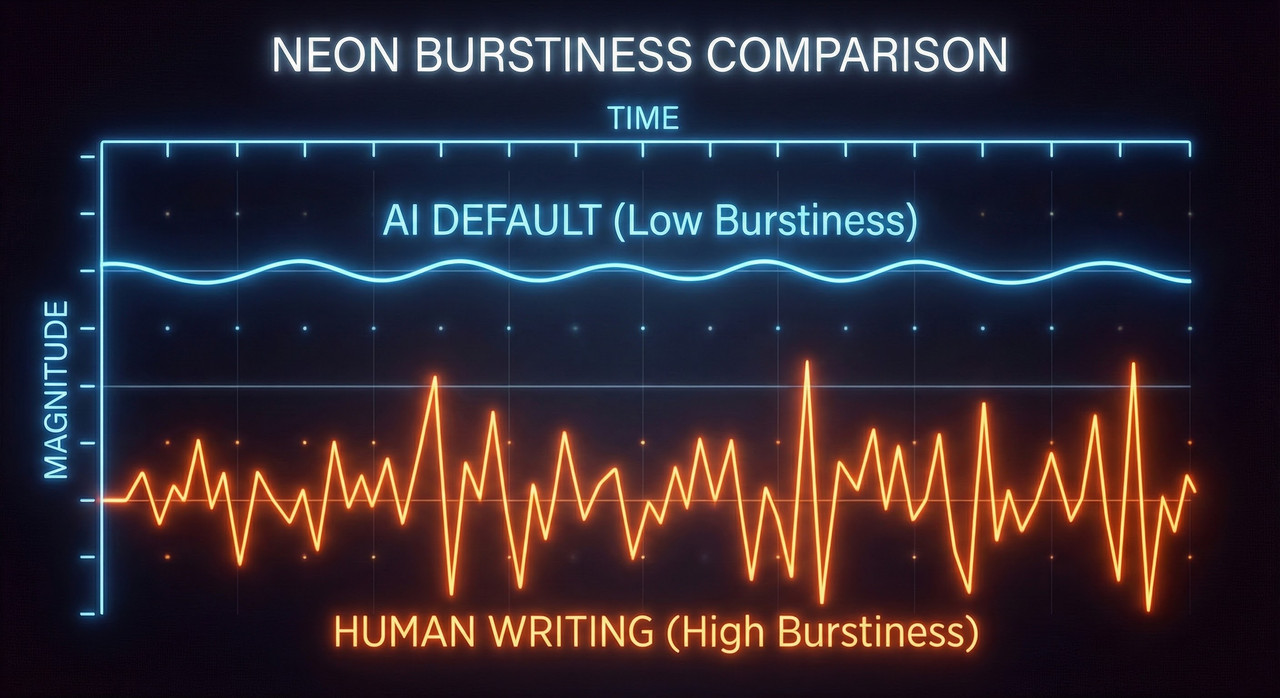
- Burstiness: This measures the variation in sentence structure. AI defaults to sentences of uniform length and rhythm—monotone. Humans are “bursty.” We write short, punchy sentences. Then, we follow them up with long, winding explanations that meander through a thought before coming to a rest.
If you want your AI to sound human, you have to force it to abandon its safety protocols.
Step 1: The “Few-Shot” Style Transfer Method
The biggest mistake people make is asking for a “tone” without providing data. If you tell an AI to be “witty” or “professional,” it accesses its generic, statistical average of what those words mean. The result is usually a caricature.
Instead of describing the tone, show it. This is called “Few-Shot Prompting.”
Before you ask the AI to write your article, feed it 3-4 paragraphs of your own previous writing (or the writing of someone you want to emulate).
“I am going to paste a sample of text below. Please analyze the sentence length, vocabulary level, and tone of this sample. Do not generate content yet. Just confirm you understand the style.”
Once it confirms, you say: “Great. Now write the following newsletter utilizing this exact style.”
Step 2: The “Anti-Robot” Negative Constraints
Sometimes, addition by subtraction is your best strategy. The fastest way to sound human is to explicitly ban the words that robots are obsessed with.
LLMs have a weird affinity for certain “smart-sounding” words that humans rarely use in casual conversation. If you see the word “tapestry” in a blog post about marketing software, you know a machine wrote it.
You need to set up a Negative Constraint filter.

The “Banned List” to Copy/Paste:
Add this to your custom instructions or the bottom of your prompt:
Do not use transition words like ‘Moreover,’ ‘Furthermore,’ or ‘In conclusion’ unless absolutely necessary to the logic.”
Step 3: Forcing “Burstiness” with Variable Syntax
Now that we’ve fixed the word choice (Perplexity), we need to fix the rhythm (Burstiness).
If you don’t instruct otherwise, the AI will give you a wall of medium-length sentences. It’s hypnotic, and not in a good way. You need to demand structural variety to mimic the chaotic flow of human thought.
“Write with a mix of short, punchy sentences and longer, complex clauses. Avoid starting consecutive sentences with the same word. Do not use the passive voice. Break up long paragraphs.”
The Ultimate “Humanizer” Prompt Template
You don’t need to remember the math every time you open ChatGPT. Here is a master prompt that combines Style Transfer, Negative Constraints, and Burstiness into one request.
The Scenario:
Let’s say you want to write a blog post about coffee.
- Bad Prompt: “Write a blog post about coffee. Make it sound human and natural.”
- Result: “Coffee is a beloved beverage enjoyed by millions. In this article, we will delve into the rich tapestry of flavors…” (Boring. Robotic.)
The “Humanizer” Master Prompt:
Task: Write a 200-word rant about why instant coffee is a crime against humanity.
Style Guide:
1. Perplexity: Use active voice only. Be opinionated. Include one analogy comparing instant coffee to dirty dishwater.
2. Burstiness: Vary your sentence length. Use fragments for effect.
3. Negative Constraints: Strictly PROHIBIT the words: beverage, delve, beloved, rich tapestry, elevate.
Write it now.”
Summary & Next Steps
Remember the formula: High Perplexity + High Burstiness = Human Tone.
You don’t have to settle for “good enough” content that requires an hour of editing. By forcing the AI to break its statistical patterns and banning its favorite crutch words, you can get output that feels authentic, engaging, and distinctly not robotic.
Try this today: Take the “Humanizer” Master Prompt above, swap out the topic for your own, and run it. Compare the time you spend editing this version versus your usual default prompts. You’ll feel the difference immediately.
Leave a Reply