
How to Fix Your AI Homework Helper (Without Cheating or Wasting Time)
Let me be direct with you: if you’ve landed here, you’re probably frustrated. Maybe your AI homework helper gave you a wrong answer. Maybe your teacher flagged your essay. Maybe you copied a solution, submitted it, and then completely blanked during the test. I’ve seen all three scenarios play out — and every single time, the root problem wasn’t the AI. It was how the student was using it.
There’s a deeper fear underneath that frustration too. A lot of students quietly worry: “Am I cheating? Am I getting dumber? What happens when I can’t use AI in the exam room?” Those are valid, important questions — and this guide answers all of them.
What an AI Homework Helper Should Actually Do
Here’s the 40-word answer Google and your brain both need:
An AI homework helper should act like a personal tutor — explaining concepts step‑by‑step, checking your work, and giving hints. It should not write full essays or solve every problem for you. Misuse creates learning gaps and raises your AI detection for homework risk.
That’s the foundation. Everything below is the practical fix.
Why Students Keep Getting Stuck With AI Homework Helpers
The single most common mistake I see: students open ChatGPT homework help, paste in the assignment, and hit send. The AI produces a polished paragraph or a neat algebra solution. The student copies it. Done — or so it seems.
What actually happens is a slow erosion of skills. The AI homework solver becomes a crutch. The student never wrestles with the problem. They never build the neural pathways that come from productive struggle. Come test day, there’s nothing there to draw on.
According to Hechinger Report , students who relied on ChatGPT as a study assistant actually performed worse on assessments than peers who studied without it. That’s not an anti-AI argument — it’s an argument for using AI correctly.
The Hidden Fear: Cheating, Detection, and Lost Skills
I talk to parents and tutors regularly, and the anxiety is real. The fear isn’t just about a plagiarism flag — it’s about a student who aces every AI-assisted assignment but freezes on an in-class essay. That scenario is already happening in classrooms everywhere.
The Conversation makes a critical point: AI detection for homework tools are unreliable. They produce false positives — meaning honest students get accused, while sophisticated misusers slide through. The real problem isn’t detection; it’s whether genuine learning is happening.
Meanwhile, College Board found that a majority of high school students now use generative AI for schoolwork. The tool isn’t going away. The question is whether students are building skills or quietly losing them.
Key fears worth naming directly:
- Plagiarism and AI cheating accusations — even for honest work
- Dependency on AI homework helpers and failing closed-book exams
- Parents and teachers losing trust in a student’s actual abilities
- Long-term gaps in foundational knowledge that surface in college
How to Use an AI Homework Helper Without Cheating
Here’s the reframe that changes everything: stop thinking of your AI homework solver as an answer machine. Start treating it like a very patient, always-available tutor who has read every textbook ever written.
A good tutor doesn’t do your homework for you. They ask questions. They give you the next small step. They check your reasoning. That’s exactly how you should be prompting AI.
The core shift:
- ❌ “Solve this quadratic equation for me.”
- ✅ “I tried solving this quadratic equation. Here’s my working. Tell me where I went wrong and explain the next step only.”
This keeps you in control of the thinking. The AI homework helper fills gaps and corrects errors — but you are doing the learning. Learn more about how to write better AI prompts for students to sharpen this skill further.
Better Prompts for Step‑by‑Step Math Solvers and Writing Help
Prompt engineering is a skill, and it’s genuinely the difference between useful AI and useless AI. In my testing, the most effective AI-tutor style prompts always include three things: subject, grade level, and format instruction.
For math (step‑by‑step math solver style):
“I’m a 10th-grade student studying algebra. I’m stuck on factoring trinomials. Don’t give me the answer. Walk me through just the first step of solving: x² + 5x + 6 = 0 and explain why.”
For writing (AI-generated essay prevention):
“Here is my rough draft paragraph about the causes of World War I. I want to keep my own ideas. Critique only the structure and suggest one specific improvement. Do not rewrite the whole thing.”
For a homework picture solver question:
“I’ve attached a photo of a geometry problem I can’t visualize. Describe what’s happening in the diagram and give me a hint — don’t solve it yet.”
The pattern: give context → share your attempt → ask for one step, not the final answer.
Spotting When the AI Homework Helper Is Failing You
Not every failure is the student’s fault. Sometimes the tool itself is underperforming. Here are the red flags I watch for:
- The AI gives the same style of generic explanation no matter how specific your question is
- The step-by-step math solver skips steps or jumps to the answer without showing reasoning
- Written responses feel like a template — formal, fluffy, devoid of your actual argument
- The AI confidently states something factually wrong (this happens more than people admit)
- Every homework picture solver result gives you an answer but no reasoning walkthrough
When you see these signs, don’t just re-submit the same prompt. Diagnose the issue first:
- Wrong answers? Cross-reference with your textbook before accepting any AI solution
- Generic explanations? Add more specificity — grade level, exact concept, what you’ve already tried
- Flagged by AI detector? Pull out your notes and drafts to demonstrate your own process
If your work gets accused of being AI-generated, the best defense isn’t argument — it’s evidence. Keep every draft, every scratch note, every version of your work. Process is proof.
Simple Workflow: AI Homework Helper + Real Practice
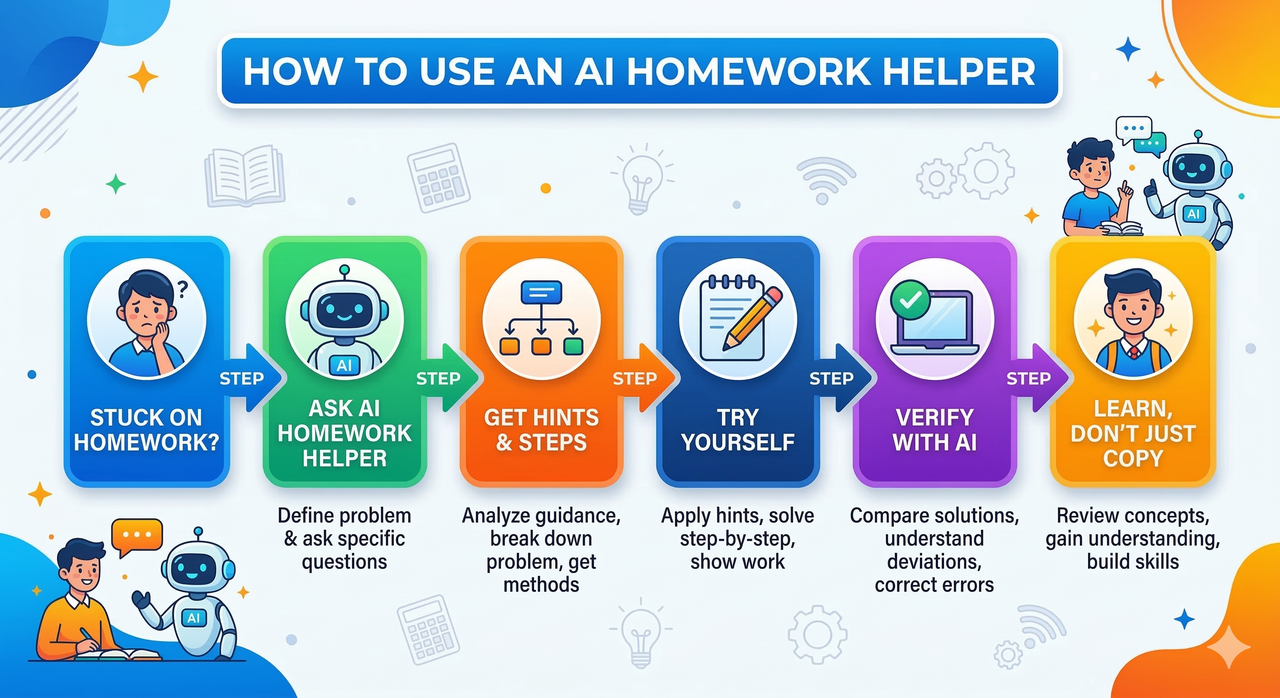
Here’s the exact routine I recommend to students and tutors alike:
- Attempt first — Spend 10–15 minutes on the problem or draft before opening any AI tool
- Identify your specific block — “I got to step 3 and don’t know why the equation flips here”
- Prompt with context — Share your attempt and ask for the next step only
- Apply and continue — Take the AI’s guidance, apply it yourself, then move forward
- Test yourself — After finishing, close the AI and try a similar problem from scratch
- Repeat — Use generative AI for schoolwork as a check, not as a first resort
This cycle turns an AI homework helper into a genuine learning accelerator, not a shortcut that leaves you empty-handed on exam day.
Examples of Good vs Bad AI Homework Helper Use
Let me show you the contrast in plain language. Both students have the same essay assignment: “Discuss the causes of World War I.”
❌ Bad Pattern:
“Write me a 500-word essay about the causes of World War I. Make it sound like a high school student.”
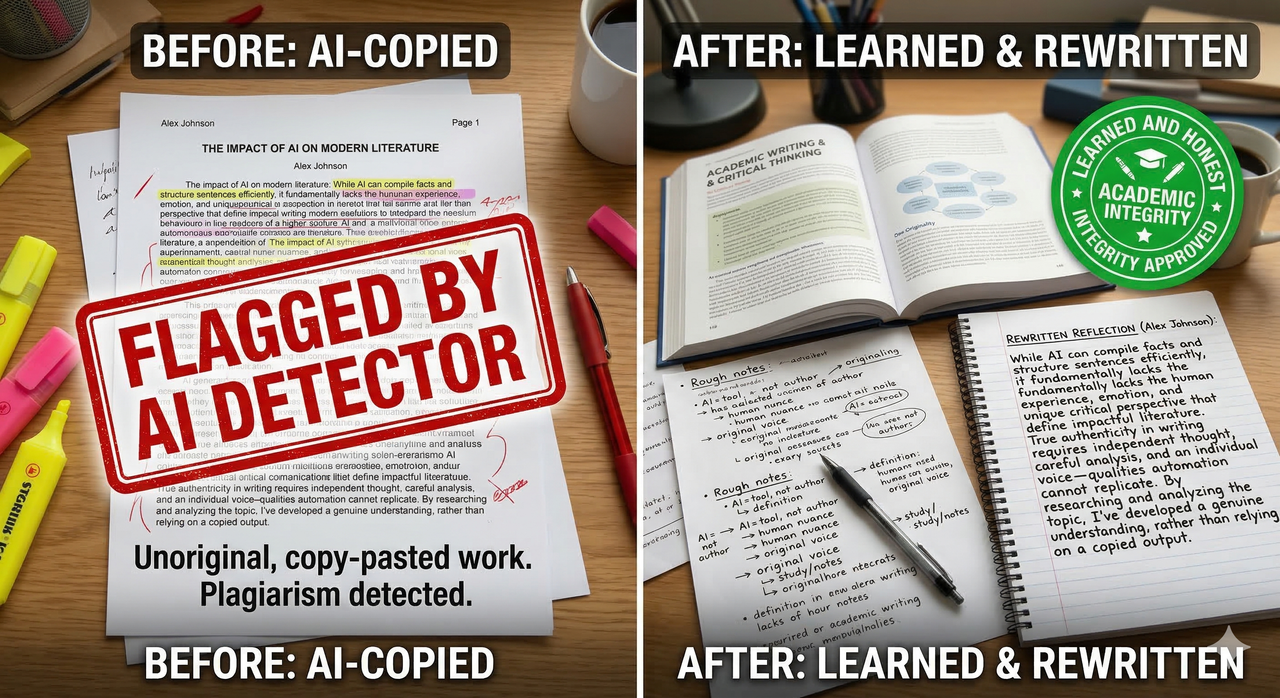
The AI produces a clean, competent essay. The student submits it. Three problems: the student learned nothing, the essay has no personal voice, and a plagiarism and AI cheating flag is a real possibility.
✅ Good Pattern:
“I tried to outline the causes of World War I. Here are my four main points: nationalism, the alliance system, the assassination of Franz Ferdinand, and imperial competition. Is my structure logical? Am I missing anything important? Then help me rewrite only my weakest paragraph — I’ll show you which one.”
The AI becomes a thinking partner. The student owns the argument. The final product reflects genuine understanding, and there’s a full draft trail to back it up.
How Parents and Tutors Can Guide Teens Safely
If you’re a parent or K–12 tutor reading this, your instinct to be cautious is correct — but outright banning AI is not the answer. College Board data confirms the majority of high schoolers are already using these tools. The goal is to shape how they use them.
Practical guidance for parents:
- Ask your teen to show you their draft alongside the final submission — if there’s no draft, ask why
- Encourage them to explain their homework to you out loud; if they can’t, they didn’t learn it
- Frame the AI homework helper as a “tutor you can text at midnight,” not a ghostwriter
- Check that AI use focuses on step-by-step math solvers and concept explanations, not full essay generation
Practical guidance for tutors:
- Build sessions around the student’s AI-assisted attempts — review what the AI told them and correct any misconceptions
- Assign “explain it back” exercises: the student prompts AI, reads the answer, closes it, and explains the concept in their own words
- Teach AI-tutor style prompts explicitly — this is now a core academic skill, like knowing how to search a library
- Remind students that AI-generated essay detection tools create false positives — keeping process documentation protects honest students
The goal isn’t to fight AI. It’s to make sure the student is the one actually learning — and that the AI homework helper is doing its real job: making that learning faster, clearer, and more effective.
Published on AIQnAHub.com | Category: Troubleshoot | Keyword: AI Homework Helper
Leave a Reply