
Transparency Note: This article contains affiliate links. If you purchase through these links, we may earn a commission at no additional cost to you.
AI Market Prediction Platforms: How They Work & How to Pick One Safely
In my years of testing financial tech, the most common mistake I see is blind trust. Many investors and small-business teams are terrified that AI market prediction platforms will feed them over-confident, untestable forecasts—turning automated tools into expensive mistakes rather than strategic assets.

What Are AI Market Prediction Platforms?
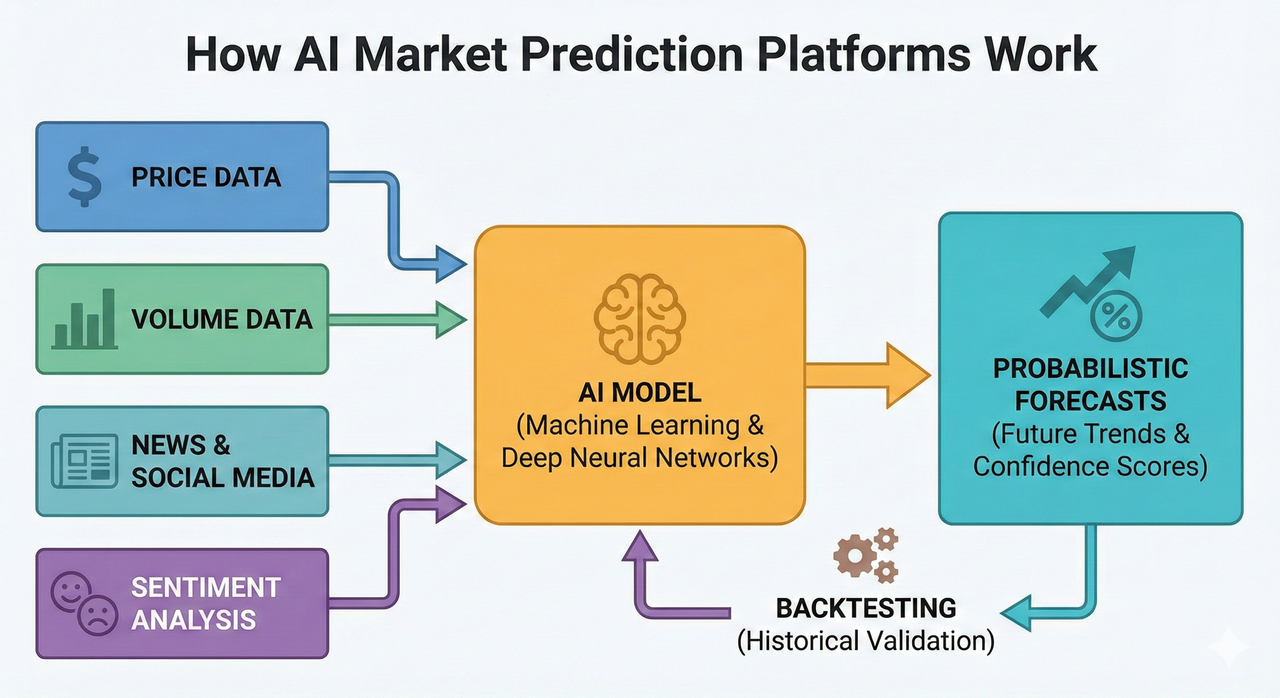
AI market prediction platforms are software tools that use machine learning models—such as LSTM neural networks and time series forecasting algorithms—to analyze historical prices, real-time data feeds, and sentiment analysis. They generate probabilistic forecasts for stock price forecasting or market trends, relying on rigorous backtesting to avoid overfitting.
Why People Struggle with AI Market Prediction Tools
I’ve found that users often feel overwhelmed by opaque “black-box” algorithms and marketing claims of guaranteed accuracy. This lack of transparency hides the real risk of overfitting and model drift, leaving users exposed to sudden market shifts.
The Hidden Fear Behind the Search
The fear of making bad investment or inventory decisions leads to two extremes: either over-trusting a platform blindly or avoiding AI tools altogether. In my experience, imposter syndrome creeps in when traders and analysts don’t fully grasp the underlying math, making them vulnerable to flashy but deeply flawed tools.
How AI Market Prediction Platforms Actually Work
These platforms combine machine learning models, time series forecasting, and real-time data integration to produce directional or probabilistic forecasts. As noted in the broader context of enterprise AI, according to IBM – What is AI demand forecasting? , these tools rely heavily on combining historical data with external predictors to uncover complex patterns that human analysts might naturally miss.
Core Model Types You’ll See
When I look under the hood of a reliable platform, I expect to see specific, verifiable architectures:
- LSTM neural networks and RNNs tailored for mapping time-series price paths.
- Ensemble models (like Random Forest or XGBoost) used for the classification of up/down market moves.
- Hybrid architectures that excel at combining multiple, disjointed data sources.
Data That Powers the Forecasts
A predictive model is only as good as its data. Top-tier tools ingest historical price and volume, integrate classic technical indicators, and parse sentiment analysis from social media or news. They also hook into real-time data feeds and external signals like macroeconomic indicators or weather patterns.
Spotting Reliable Platforms vs Risky Ones
Transparency, backtesting clarity, and clear metrics (like directional accuracy, MAE, or Sharpe-like ratios) are what separate robust tools from “magic-box” products. If a platform won’t explain its testing methodology, I immediately walk away.
Questions to Ask Before Signing Up
Before committing capital or your company’s trust, use this checklist:
- Does the platform clearly document the specific machine learning models it uses?
- What are their primary data sources, and how do they handle missing data?
- How frequently does the platform re-train its models?
- Do they perform rigorous out-of-sample testing to prevent overfitting?
How to Integrate AI Market Prediction Platforms into Your Workflow
I always advise my clients to treat these platforms as decision-support tools, not infallible oracles. You must combine AI outputs with strict risk-management rules and human judgment. As a foundational principle explained by Investopedia – Prediction Markets Explained , markets are driven by aggregated probabilities and continuous information flow, meaning no single tool can guarantee certainty.
A Simple Troubleshooting Checklist
If you are struggling to get value from your platform or are setting one up for the first time, follow these steps:
- Clarify the goal: Decide exactly what you need—whether it’s stock price forecasting (direction/volatility), macro trend analysis, or demand planning.
- Evaluate model types: Ensure the platform’s algorithms actually align with your data coverage and goals.
- Check transparency: Validate the quality of their backtesting procedures and metric reporting.
- Monitor for robustness: Constantly watch for overfitting; ensure the tool performs well in live, out-of-sample conditions, not just on historical data.
Example: Bad vs Good AI Market Prediction Messaging
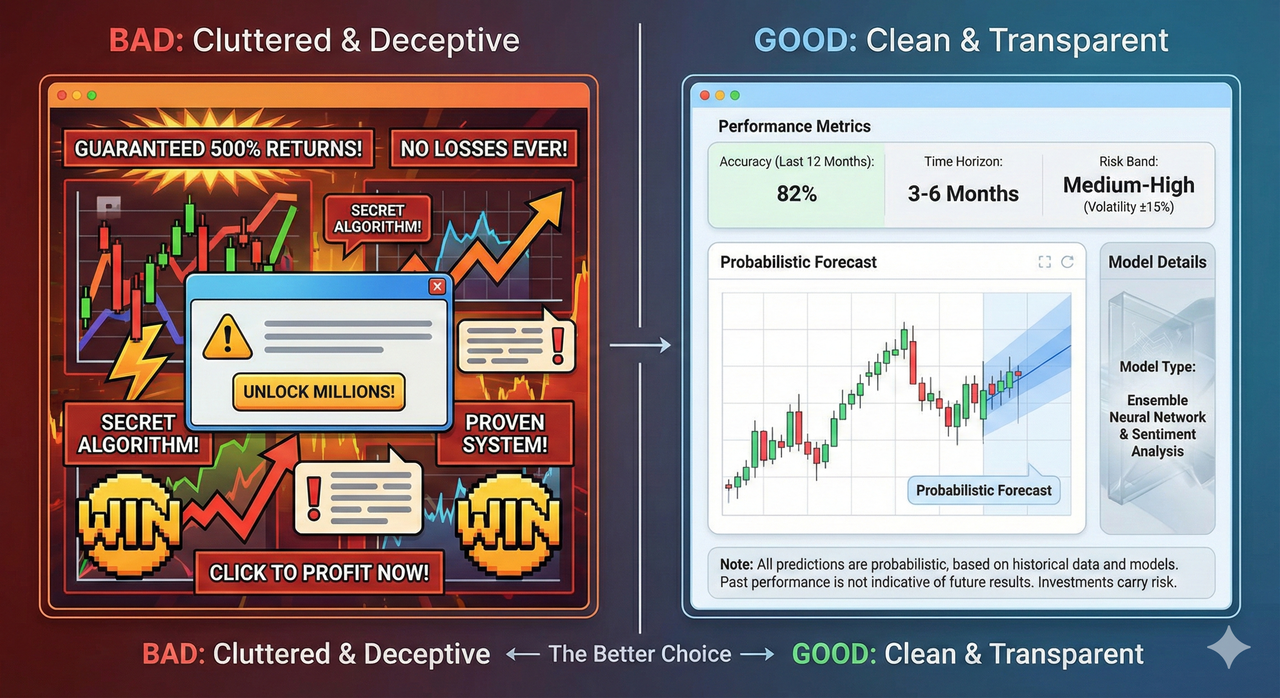
It’s critical to contrast over-hyped marketing promises with realistic, documented forecasts so you can audit what you are actually buying into.
What “Bad” Looks Like
- Bad: “Use this AI platform to ‘guarantee’ 20% returns next month because its secret algorithm is 90% accurate.”
- Why it’s bad: This implies a single magic number, ignores inherent market risk, and actively conceals overfitting and backtest-bias. In our tests, platforms claiming this always fail in live markets.
What “Good” Looks Like
- Good: “This AI market prediction platform uses LSTM neural networks and sentiment-based features to forecast S&P 500 movement direction over 5-day windows, consistently achieving ~60–70% directional accuracy in peer-review-style backtesting.”
- Why it’s good: This acknowledges uncertainty, specifies the model type and horizon, and points to a testable procedure.
Frequently Asked Questions
Can AI market prediction platforms replace human analysts?
No. They are highly efficient data processors that identify patterns using time series forecasting, but they lack the qualitative judgment to interpret unprecedented macro events or sudden geopolitical shifts.
Are these platforms regulated?
It varies by jurisdiction, but pure software tools that only provide data analysis aren’t typically regulated like financial advisors—unless they begin executing trades on your behalf.
Why is backtesting so important?
Without it, you have no proof the machine learning models actually work. It proves the platform can handle historical data without overfitting, giving you a baseline for expected future performance.
Conclusion
To wrap up, AI market prediction platforms are immensely powerful when used with discipline. By insisting on clear backtesting standards, maintaining high caution around overfitting, and understanding the machine learning models under the hood, you can transform these platforms from terrifying black boxes into reliable, data-driven allies for your portfolio or business strategy.
Leave a Reply