Transparency Note: This article contains affiliate links. If you make a purchase through these links, I may earn a small commission at no additional cost to you.
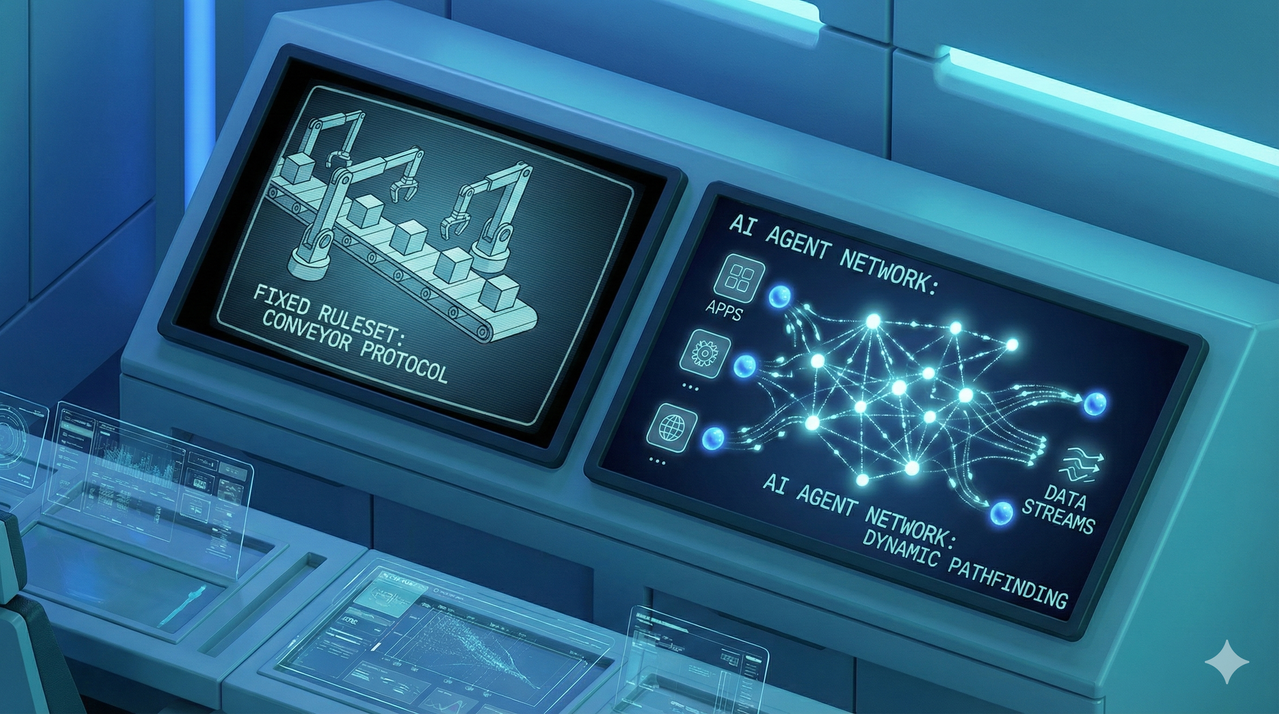
How Does Agentic AI Differ From Traditional Automation
You’ve likely already sunk significant time and budget into RPA and scripted workflows. So, the last thing you want to hear is that you need to rip everything out for the next buzzword, only to discover it was just hype.
I’ve been there—staring at a “broken” bot that failed because a UI button moved three pixels to the left. The frustration is real. But here is the reality check: The question isn’t whether to abandon your current stack. The real question is where agentic AI adds value on top of your existing automation, and where it doesn’t.
In this guide, I’ll break down exactly how these two paradigms differ, not just in theory, but in the messy reality of engineering operations.
Quick Answer – Agentic AI vs Traditional Automation
Here is the bottom line: Agentic AI uses autonomous, goal-oriented behavior to reason, plan, and act across tools using generative AI agents and feedback loops. It adapts to changing conditions without needing a script rewrite.
In contrast, traditional automation relies on rule-based systems and fixed workflow automation that execute predefined steps. It is deterministic: if A happens, do B. If the inputs, apps, or rules change even slightly, traditional automation typically breaks or requires manual updates.
Why This Question Matters for Your Automation Roadmap
If you are an engineering manager or operations leader, you have likely hit the “ceiling” with traditional automation.
We see the symptoms constantly:
- The “Bleeding Neck” Maintenance: You spend more time fixing broken bots than building new ones because of UI changes or API updates.
- Ticket Ping-Pong: Automation handles the easy 80%, but the messy 20% of exceptions (unstructured data, ambiguous requests) flood your human support queues.
- Stalled ROI: You can’t automate complex cross-system decisions because you can’t write an
if/thenrule for every possible scenario.
The hidden fear is betting on the wrong paradigm—either overhauling everything for agentic AI and creating a governance nightmare, or ignoring it until competitors deploy autonomous workflows that outpace you. This isn’t about “Agentic vs. Automation”; it is about knowing where each fits.
Core Concepts – What Agentic AI and Traditional Automation Actually Are
Traditional Automation in Plain Language
Traditional automation is the backbone of most modern enterprises. It includes rule-based systems, workflow engines, and Robotic Process Automation (RPA). Think of it as a digital assembly line. It executes deterministic tasks perfectly, provided the environment never changes.
- Typical Stack: RPA bots (UiPath, Automation Anywhere), scheduled Python scripts, Zapier/Make workflows.
What Agentic AI Brings to the Table
Agentic AI represents a shift from “following a recipe” to “being a chef.” It consists of generative AI agents capable of context-aware decision-making. Instead of being told how to do a task, the agent is given a goal (e.g., “Resolve this refund request”). It then plans the steps, chooses the right tools/APIs, and coordinates actions.
As defined by industry leaders, agentic AI isn’t just a chatbot; it is a system that can take action on your behalf.
“Agentic AI is a type of artificial intelligence that can act autonomously to achieve specific goals… it can reason, plan, and execute tasks without constant human intervention.” — Google Cloud – What is agentic AI?
How Generative AI Agents Power This Shift
The magic ingredient is the Large Language Model (LLM). It allows the system to reason over language and understand context. This enables multi-agent orchestration, where different agents handle planning, tool execution, monitoring, and escalation, mimicking a human team rather than a single script.
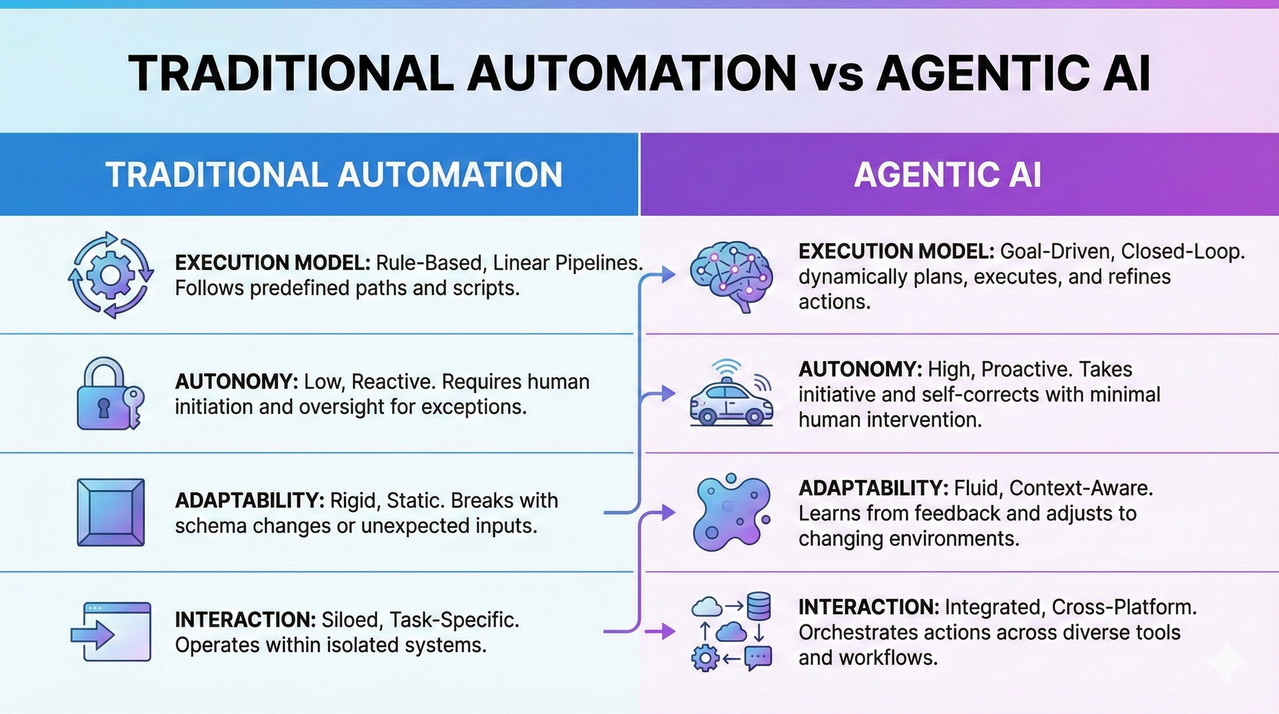
The 7 Dimensions Where Agentic AI Differs from Traditional Automation
1. Execution Model – Static Workflows vs Dynamic Plans
- Traditional Automation: Relies on linear, event-driven workflows. The path is hard-coded: Step 1 → Step 2 → Step 3.
- Agentic AI: Agents generate and update plans in real-time. If Step 1 reveals new information, the agent dynamically rewrites the plan for Step 2.
2. Autonomy & Agency – Following Rules vs Pursuing Goals
- Traditional: Zero independent agency. Every exception must be explicitly coded.
- Agentic: Agents utilize autonomous goal-oriented behavior. They interpret a high-level objective, break it down, and attempt to solve it, even if the path isn’t pre-mapped.
3. Decision-Making – Rule-Based Systems vs Context-Aware Reasoning
- Traditional: Strict logic (
if invoice > $500, then approve). It is fragile when inputs are ambiguous. - Agentic: Context-aware decision-making. It uses generative AI to interpret nuances (“This invoice is $499 but looks suspicious based on the vendor history”) and decides the next action.
4. Adaptability & Learning – Manual Updates vs Feedback Loops
- Traditional: When an app changes, a developer must rewrite the code.
- Agentic: Uses feedback loops (success/failure signals, user corrections). If an API call fails, the agent can read the error message, correct its own parameters, and retry—often without human intervention.
5. Scope of Tasks – Repetitive Tasks vs End-to-End Workflows
- Traditional: Excels at narrow, repetitive tasks like data entry and file transfers.
- Agentic: Better for dynamic, multi-step workflows like customer journeys, complex exception handling, and cross-system coordination.
6. Architecture – Bots and Scripts vs Multi-Agent Orchestration
- Traditional: You orchestrate scripts, APIs, and bots via a central controller.
- Agentic: You leverage multi-agent orchestration. Multiple agents (a “Researcher,” a “Writer,” a “Reviewer”) collaborate, share context, and hand off tasks to achieve the goal.
7. User Interaction – Back-Office vs Natural Language Interfaces
- Traditional: Usually invisible to the end-user or configured via complex dashboards.
- Agentic: Can be driven by natural language. A business user can say, “Analyze the Q3 churn data and email me a summary,” and the agent constructs the workflow on the fly.
Practical Examples – Side-by-Side Scenarios
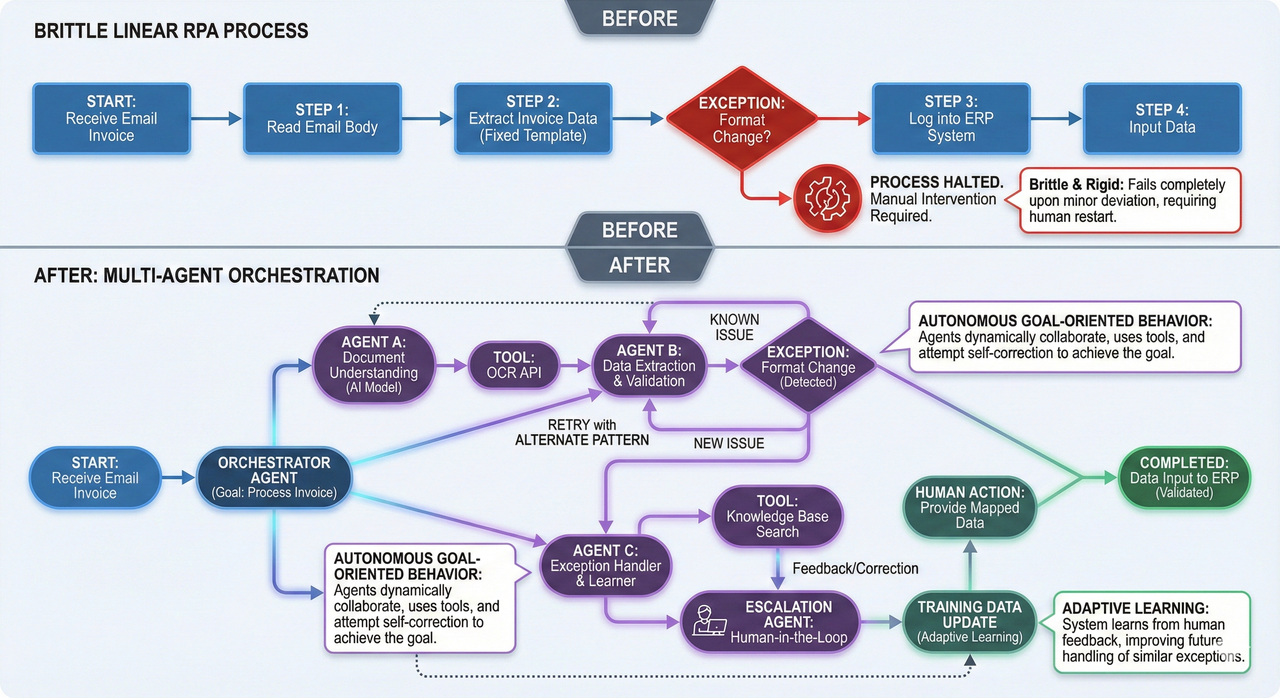
Example 1: Invoice Processing with Exceptions
- Traditional Automation: OCR reads the PDF. If the format matches Template A, it extracts data. If the vendor updates their invoice layout, the bot crashes, and a human must manually key it in.
- Agentic AI: The agent “looks” at the document. It understands that “Total Due” and “Amount Payable” mean the same thing, regardless of layout. If information is missing, it can draft an email to the vendor asking for clarification.
Example 2: Customer Support Ticket Resolution
- Traditional: Static routing. “If ticket contains keyword ‘Refund’, route to Finance Queue.”
- Agentic: The agent reads the ticket history, realizes the customer is angry about a recurring bug, checks the engineering Jira board for status, and drafts a personalized apology offering a credit, which a human agent just needs to approve.
Example 3: Marketing Campaign Optimization
- Traditional: A batch job runs every night to pause ads with a CTR below 1%.
- Agentic: An agent continuously monitors performance. It notices a trend (e.g., a specific creative failing on mobile), forms a hypothesis, generates a new ad variation using generative AI agents, and tests it immediately.
When to Use Traditional Automation, Agentic AI, or Both
Don’t throw away your scripts yet.
Keep Traditional Automation for Stable, Structured Tasks
If the process has low variability, clear rules, and strict compliance requirements (e.g., payroll processing, regulatory reporting), keep it on rails. Traditional automation is faster, cheaper, and 100% predictable.
Bring in Agentic AI for Dynamic, High-Variance Work
When you are dealing with unstructured data, high exception rates, or tasks requiring human-like judgment, this is where agentic AI shines.
“Agents can use this reasoning capability to break down complex tasks into smaller, manageable steps… and determine the right sequence of actions.” — AWS – What is Agentic AI?
Hybrid Pattern – Agentic AI on Top of Rule-Based Systems
The winning strategy I see most often is the hybrid approach. Use the Agent as the “brain” and the Traditional Automation as the “hands.”
- Pattern: Agent receives request → Plans workflow → Calls existing RPA bot to do the data entry → Agent verifies output → Agent emails customer.
Risk, Governance, and Troubleshooting Concerns
New Risks Introduced by Agentic AI
With great power comes great capability for things to go wrong. Agents can hallucinate (make up facts), get stuck in infinite loops, or make decisions that technically solve the goal but violate company policy.
Guardrails and Controls You Must Design
You need strong governance. Never give an agent “write” access to a production database or the ability to send external emails without a “human-in-the-loop” confirmation step initially. Whitelist the tools they can use.
Troubleshooting – If Your Early Pilots Misbehave
If your agent is failing, it usually isn’t the model’s fault—it’s the context.
- The Fix: Tighten the goal definition. Instead of “Fix the data,” try “Identify rows with missing email addresses and flag them for review.” Refine the feedback loop so the agent knows when it has succeeded.
Implementation Roadmap – How to Experiment Without Breaking Everything
- Identify Candidate Use Cases: Look for the workflows that are currently “brittle”—the ones that break every week. Prioritize processes where adaptive learning can reduce maintenance time.
- Design a Pilot with Guardrails: Start small. Give the agent read-only access first.
- Integrate with Workflow Automation: Connect your agents to your existing API gateways or RPA orchestrators.
- Scale and Upskill: Move from single agents to multi-agent orchestration. Train your automation engineers on prompt engineering and agentic design patterns.
Leave a Reply