
Why AI Models Give Different Answers (2026)
I’ve spent over three decades in IT, and if there’s one category of problem that reliably separates a real technical explanation from a hand-wavy one, it’s non-determinism. Why AI Models Give Different Answers to the Same Prompt is a genuinely deep technical question, not a simple settings issue, and I’ve watched experienced developers spend hours debugging their own code before realizing the variation was never coming from their side at all.
Why AI Models Give Different Answers to the Same Prompt comes down to two layered causes: intentional randomness from sampling settings like temperature, and a deeper, unintentional source rooted in how GPU servers process multiple users’ requests simultaneously. For example, a controlled test running 1,000 identical prompts at temperature zero still produced 80 different completions.
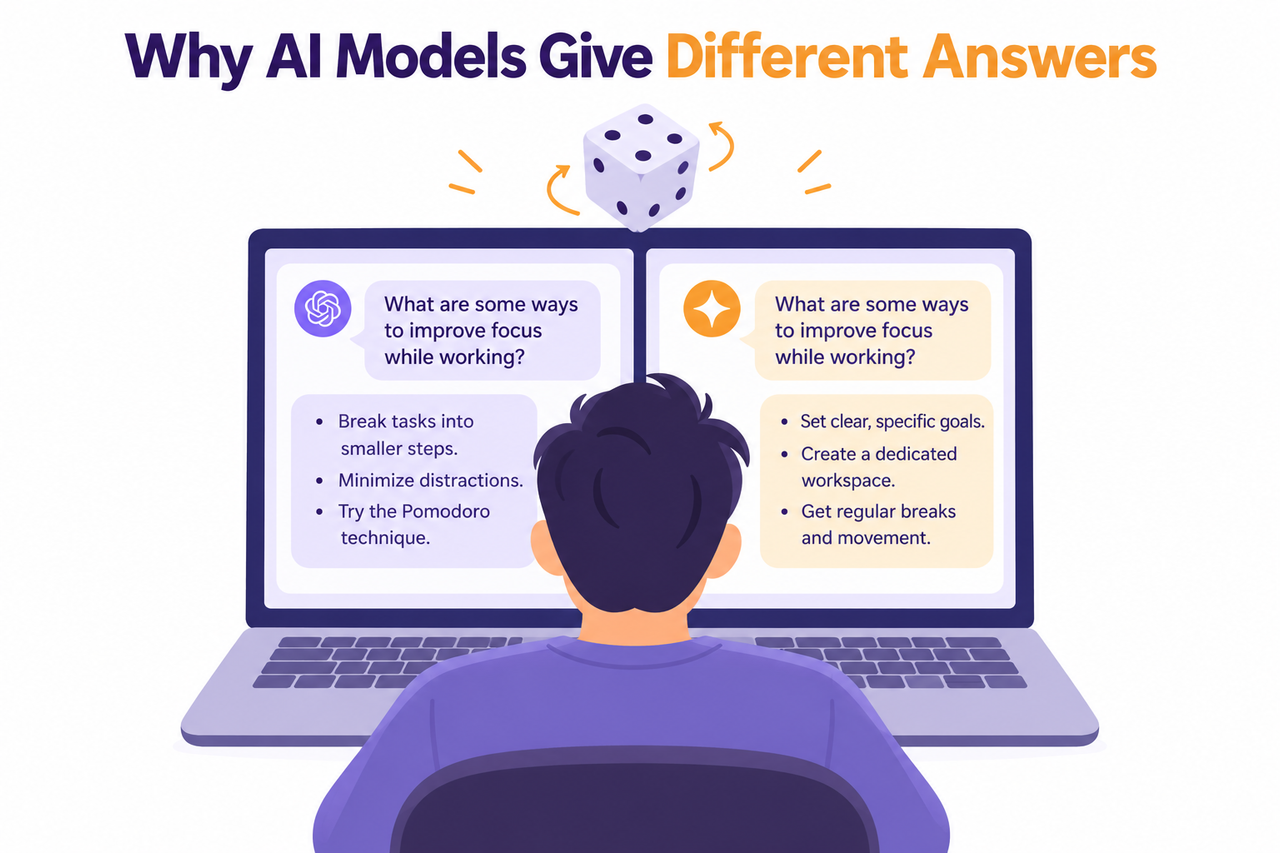
I want to be direct about something before we go further: if you’ve set temperature to zero and a fixed seed and still gotten different answers, that’s not evidence you configured something wrong. It’s evidence of a real, documented limitation that the providers themselves haven’t fully solved.
Why Do AI Models Give Different Answers to the Same Prompt?
Quick Answer
AI models give different answers to the same prompt for two reasons: intentional randomness from temperature sampling, which is designed to make responses feel varied, and an unintentional technical cause — floating-point non-associativity combined with non-batch-invariant GPU processing — that persists even at temperature zero. A real experiment found 1,000 identical prompts at temperature zero still produced 80 unique completions. Thinking Machines Lab
In my experience explaining this to technical teams, people generally accept the first cause immediately, since temperature-driven randomness is well known. The second cause is the one that genuinely surprises people, because it means the variation isn’t something you can fully eliminate through your own configuration choices.
Is This Variation a Bug or Expected Behavior?
Before troubleshooting anything, it’s worth separating these two distinct causes clearly, since they require completely different mental models.
Sampling Settings Introduce Randomness on Purpose
Temperature sampling and top-p settings deliberately make the model choose from a range of likely words rather than always picking the single most probable one. This is intentional design, not a flaw — without it, every response to a creative prompt would feel robotic and repetitive rather than natural.
Even Temperature Zero Doesn’t Guarantee Identical Output
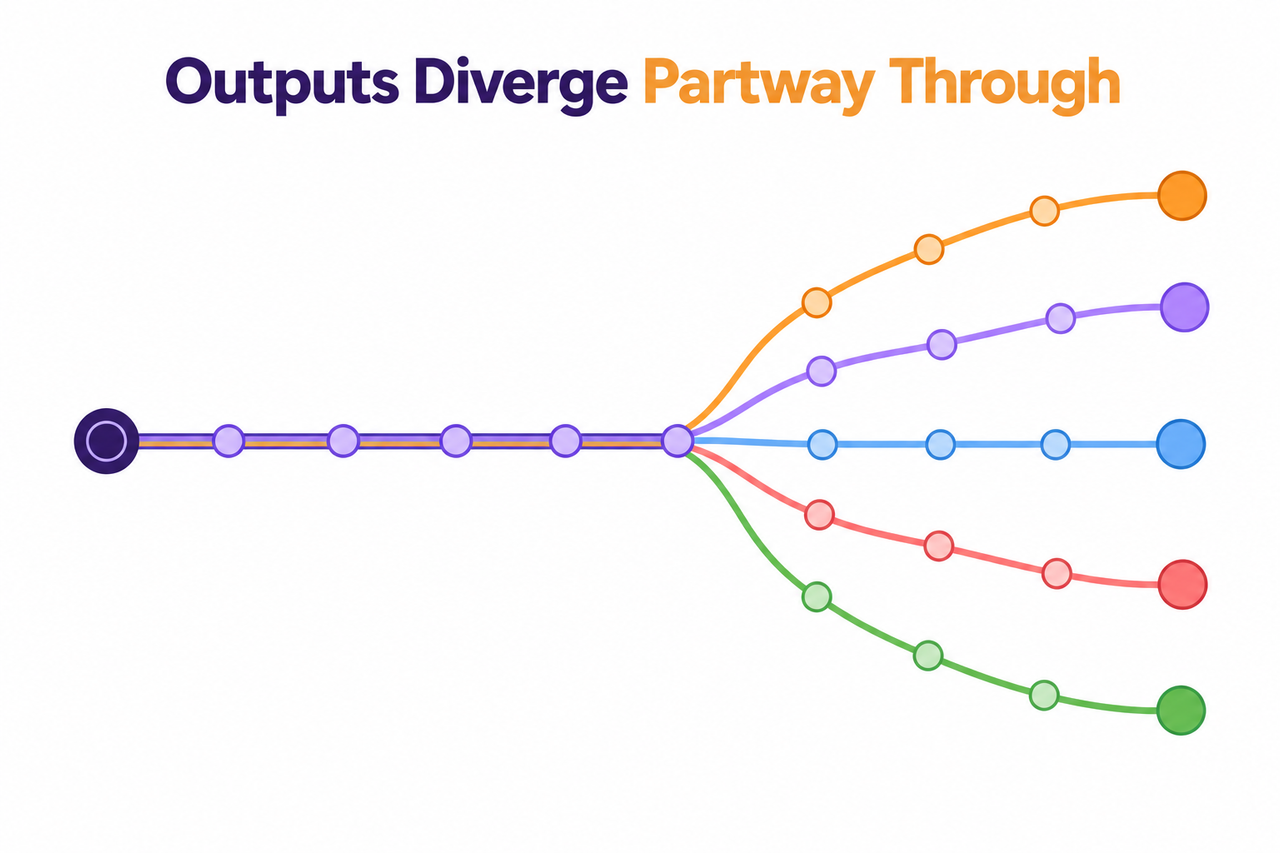
A controlled experiment found that identical prompts at temperature zero still diverged, starting at exactly the 103rd token across 1,000 completions. This is the detail that genuinely changed how I think about reproducibility, because temperature zero is supposed to mean “always pick the most likely next token,” which should be fully deterministic in theory. Thinking Machines Lab
The Real Cause Is Outside Your Control
Variation at temperature zero stems from how GPU concurrency affects inference servers batching and processing multiple users’ concurrent requests, not from anything in your prompt or settings. Floating-point arithmetic isn’t strictly associative, and how a GPU batches your request alongside everyone else’s requests at that exact moment changes the order operations happen in, which can shift the result by a tiny margin that eventually compounds into a different word choice.
I’ve found that once people understand this mechanism, the frustration shifts from “what am I doing wrong” to “okay, this is a known infrastructure limitation,” which is a genuinely more productive place to be troubleshooting from.
How Do You Reduce (Not Eliminate) Answer Variation?
Here’s the exact sequence I walk through with developers trying to get the most consistency realistically achievable from current commercial AI APIs.
- Recognize when variation is intentional. If temperature is set above zero, differing answers are expected behavior, not a malfunction.
- Set temperature to zero and use a fixed seed. Use the same integer seed parameter value across every request you want to compare, while keeping every other parameter, including max_tokens, identical. Microsoft Learn
- Check the system fingerprint on every response. If the system fingerprint field changes between calls, the backend model configuration itself has changed, which will affect output regardless of seed or temperature. Microsoft Learn
- Accept that perfect matching still isn’t guaranteed. Even a matched seed, temperature, and system_fingerprint does not guarantee identical results, since the underlying cause sits in server-side request batching.
- Know that true reproducibility requires specialized infrastructure. Genuinely reproducible output currently requires batch-invariant inference infrastructure that standard commercial APIs don’t provide by default. Thinking Machines Lab
- Expect more divergence in longer responses. The first 102 tokens of 1,000 test completions matched exactly, with divergence only beginning at token 103, meaning short answers are far more likely to match than long ones.
- Don’t treat one response as definitive. Since server load at the moment of your request influences output, running the same prompt multiple times reveals more than trusting a single response.
- Build tolerance into automated evaluation pipelines. Avoid exact string matching between AI outputs across runs, and build tolerance for minor phrasing variation into your evaluation logic instead.
I want to flag step 4 specifically, because in my experience it’s the step that resets unrealistic expectations fastest. Once you’ve done everything correctly on your end and still see variation, that’s your confirmation the remaining cause genuinely isn’t something you can configure away.

What Does the Real Documentation Actually Say About This Limitation?
I always prefer quoting official documentation directly rather than paraphrasing, especially on a topic this technical, because the exact wording matters. Here’s the verbatim caveat from Microsoft’s own official Azure OpenAI documentation: Microsoft Learn
Determinism isn't guaranteed with reproducible output. Even in
cases where the seed parameter and system_fingerprint are the
same across API calls it's currently not uncommon to still
observe a degree of variability in responses. Identical API
calls with larger max_tokens values, will generally result in
less deterministic responses even when the seed parameter is set.
That’s about as direct an admission as you’ll get from an official source. A separate confirmation from OpenAI’s own Developer Community adds a blunt practical summary: “No parameter can produce truly repeatable results… The upshot of this is that the models will always have some degree of variation in output across calls.” OpenAI Developer Community
Why Does Divergence Happen Later Rather Than Immediately?
This detail deserves more explanation than a single bullet point can offer, because it’s counterintuitive at first. If the underlying cause is present from the very first token, you might expect divergence to show up immediately rather than after roughly 100 tokens.
The explanation lies in how small the floating-point differences actually are at any single step. A tiny numerical discrepancy in how probabilities are calculated might not be large enough to change which token gets selected as “most likely” in the first several dozen predictions, especially when the correct next word is overwhelmingly obvious given the context. As the response continues and choices become less obviously determined — genuinely closer calls between two or three plausible next words — those small numerical differences become large enough to actually flip which option wins, and that’s the point where two otherwise identical generations start to diverge.
How Does Server Load Actually Affect What You Get Back?
I’ve found this is the part that feels the most unsettling to people the first time they hear it, because it means your output can depend on something that has nothing to do with you at all. The specific batch of requests your prompt gets grouped with on the server, determined by whatever else is happening on that hardware at that exact millisecond, can influence the numerical computation path your request takes.
This isn’t a deliberate design choice by the AI provider to make things unpredictable. It’s a genuine engineering tradeoff: building inference infrastructure that’s fully “batch-invariant,” meaning your result would be identical regardless of what else is being processed alongside it, is significantly harder and more expensive to build than infrastructure that accepts small variations in exchange for better overall throughput and lower cost. Providers have generally chosen throughput over perfect reproducibility, which is a reasonable business tradeoff but a frustrating one if reproducibility happens to be exactly what you need.
What’s the Practical Difference Between the Two Causes for Your Work?
Understanding why this happens matters less than knowing what to actually do about it depending on which cause is driving your specific situation. If your variation comes from a non-zero temperature setting, you have direct control — lowering temperature reduces variation immediately and predictably.
If your variation persists even at temperature zero with a matched seed, you’re dealing with the infrastructure-level cause, and no amount of further parameter tuning on your end will close that gap. In that scenario, the more productive move is adjusting your expectations and your downstream systems, building tolerance for minor variation into whatever process consumes the AI’s output, rather than continuing to hunt for a setting that doesn’t exist.
Bad vs. Good Way to Think About Answer Variation
Let’s put these side by side, because the difference in framing changes how much time you spend chasing a fix that isn’t available.
Bad: “I set the seed and temperature to 0 and still got different answers twice in a row, so the API must be broken or I configured something wrong.”
Good: “I confirmed the seed, temperature, and system_fingerprint all matched across both requests and still saw minor variation, so I now understand this is a documented limitation of how inference servers batch concurrent requests — not something fixable through parameters alone — and I’ve built my evaluation process to tolerate small phrasing differences rather than expecting exact matches.”
The bad version treats infrastructure-level non-determinism as a personal configuration failure. The good version correctly identifies where the limitation actually sits and adjusts the surrounding process accordingly.
What Should You Do If You’re Building a Testing or Evaluation System?
If you’re building automated tests or evaluation pipelines around AI model outputs, this limitation has direct implications for how you should design that system from the start. Exact string comparison between expected and actual output will produce false failures regularly, even when the model’s actual behavior is functioning correctly.
I’d recommend building your evaluation logic around semantic similarity or key-fact presence rather than character-for-character matching. Check whether the required information appears in the response, rather than checking whether the response is byte-identical to a previous run. This approach is both more resilient to the non-determinism discussed here and, frankly, a more meaningful test of whether the model is actually doing its job correctly.
How Should This Change the Way You Evaluate a Single AI Response?
Beyond automated testing, this has a practical implication for anyone manually evaluating AI output quality too. If you’re comparing two prompts to see which one produces better results, running each prompt only once and comparing the single outputs can mislead you, since the difference you’re seeing might reflect run-to-run variation rather than a genuine difference caused by your prompt change.
I’d recommend running each version of a prompt multiple times and looking at the range of outputs you get back, rather than trusting a single comparison. If one prompt version consistently outperforms the other across several runs, that’s a meaningful signal. If the two versions produce overlapping ranges of quality, the difference you initially noticed may have been noise rather than a real effect of your prompt change.
What Does This Mean for Comparing Different AI Models Against Each Other?
If you’re evaluating multiple AI providers against the same prompt to decide which one to use, this non-determinism adds a layer of complexity worth accounting for explicitly. A single comparison run between two models can be misleading in either direction, since you might be comparing one model’s unusually good response against another’s unusually mediocre one, purely due to normal run-to-run variation rather than a genuine capability difference.
I’d recommend running each model multiple times on the same prompt set before drawing any conclusions about which one performs better for your specific use case. This matters more for close calls between similarly capable models than for obvious mismatches, but even a clear-seeming winner deserves at least a few repeated runs before you commit to that conclusion in a production decision, a published comparison, or a recommendation to a client.
| Scenario | Recommended Approach | Why |
|---|---|---|
| One-off casual question | Trust the single response | Minor phrasing variation rarely matters for everyday use |
| Comparing two prompt versions | Run each version 3-5 times | Isolates genuine prompt effect from normal run-to-run noise |
| Comparing two different models | Run each model on the same prompt set multiple times | Avoids mistaking normal variation for a real capability gap |
| Automated production testing | Use semantic or key-fact checks, not exact string matches | Exact matching produces false failures unrelated to actual quality |
How Much Does This Actually Matter for Everyday Use?
It’s worth stepping back and putting this in proportion, since I don’t want to leave the impression that every casual use of an AI model is secretly unreliable. For a one-off question where you just want a quick, useful answer, this level of variation almost never matters in any way you’d notice or care about.
Where this genuinely matters is in exactly the scenarios covered above: automated testing, scientific research requiring reproducibility, formal evaluation comparisons between models or prompts, and any production system where downstream logic depends on parsing a precisely structured output. If you’re just asking a question and reading the answer, the underlying non-determinism is a technical curiosity rather than a practical problem worth losing sleep over.
I’d rather you walk away from this understanding the real mechanism than memorizing a false promise that a specific setting combination guarantees identical output every time, because that promise simply isn’t true with current commercial AI infrastructure.
For a broader look at understanding AI model behavior and answering common technical questions about how these systems work, see our complete guide to AI questions and answers.
Frequently Asked Questions
Can setting temperature to zero guarantee identical AI outputs?
No — even at temperature zero with greedy sampling, a controlled experiment found that 1,000 identical prompts still produced 80 unique completions due to server-side factors outside the user’s control. Thinking Machines Lab
Does the seed parameter make AI outputs fully reproducible?
No — the seed parameter can reduce variation but official documentation explicitly states determinism isn’t guaranteed, even when the seed and system_fingerprint match exactly across calls. Microsoft Learn
Why does variation get worse in longer AI responses?
A controlled test showed the first 102 tokens of 1,000 completions matched exactly, with divergence beginning at token 103, meaning longer generated text has more opportunity to diverge than short answers. Thinking Machines Lab
What actually causes AI output to vary even with identical settings?
Floating-point non-associativity combined with non-batch-invariant GPU processing, meaning your output can be affected by how many other users’ requests are being processed simultaneously on the same server.
Is there any way to get truly reproducible AI output?
Genuine reproducibility currently requires specialized batch-invariant inference infrastructure that standard commercial APIs don’t provide by default, making it an unsolved infrastructure problem rather than a settings fix. Thinking Machines Lab
Should automated testing systems expect exact matches from AI model outputs?
No — testing and evaluation pipelines should build in tolerance for minor phrasing variation rather than relying on exact string matching, since standard API parameters cannot guarantee identical results across runs. Microsoft Learn
Does this non-determinism mean AI models are unreliable for real work?
Not necessarily — the core facts and reasoning in a response tend to remain consistent across runs even when exact phrasing varies, so the practical impact depends heavily on whether your use case needs identical wording or just consistent substance.
Leave a Reply