
How to Verify AI-Written Content Before Publishing: An Editorial Checklist (2026)
I’ve spent over three decades in IT, and one thing I’ve learned from every technology transition I’ve lived through is this: the tools that feel most trustworthy are often the ones that most need double-checking. How to Verify AI-Written Content Before Publishing: An Editorial Checklist matters because AI drafts read with a confidence that has nothing to do with whether the underlying facts are actually true, and I’ve watched skilled writers publish fabricated statistics simply because the sentence sounded right.
How to Verify AI-Written Content Before Publishing: An Editorial Checklist is a structured process for confirming every checkable claim in AI-generated text is accurate before it goes live, rather than trusting fluent prose as evidence of accuracy. For example, searching a cited study’s exact title in Google Scholar before publishing confirms whether that source actually exists rather than just looking authoritative.
I want to be direct about something before we go further: the mistake I see most isn’t laziness. It’s mistaking a smooth read for a verified one. Those are genuinely two different things, and conflating them is exactly how false claims slip through experienced editorial teams.
Why Can’t You Just Proofread AI-Written Content?
Quick Answer
Verifying AI-written content before publishing requires a dedicated verification pass separate from proofreading, built around claim extraction, confirming underlying sources rather than citation appearance, corroborating high-impact claims independently, and making an explicit publish decision for each one. EvergreenFeed Proofreading alone catches typos, not fabricated statistics or invented citations dressed in fluent, confident prose.
In my experience reviewing AI-assisted content for clients, proofreading and verification get treated as the same task constantly, and they’re fundamentally different jobs. Proofreading asks “does this read well.” Verification asks “is this actually true,” and a sentence can pass the first test completely while failing the second one badly.
Why Are AI Hallucinations So Hard to Catch by Reading?
Before building a verification habit, it helps to understand exactly why this specific failure mode evades normal editorial instincts.
Fabricated Citations Are Usually Perfectly Formatted
A fabricated citation typically includes a real journal name and looks formally correct, making it indistinguishable from a genuine source on sight. Editage I’ve pulled up citations myself that looked completely legitimate — proper formatting, a real-sounding author name, a journal that genuinely exists in that field — and found nothing when I actually searched for the specific paper.
Smooth Prose Gets Less Scrutiny Than Awkward Prose
Readers naturally slow down at clumsy sentences and speed through fluent ones, meaning the most polished AI paragraphs receive the least critical attention. This is precisely backwards from where scrutiny should go, since AI models tend to produce their most confident, fluent prose regardless of whether the underlying claim is accurate.
Google Doesn’t Penalize AI Use Itself, But It Penalizes the Result
Official guidance confirms AI-assisted content must still meet Search Essentials and avoid scaled content abuse or adding little to no value. Google Search Central This distinction matters practically: the risk isn’t that you used AI, it’s that unverified AI output can produce exactly the kind of low-value, inaccurate content Google’s guidelines were written to address.
I’ve found that once people internalize why smooth writing specifically hides errors rather than revealing them, they stop trusting their gut sense of “this reads fine” as a substitute for actual verification.
How Do You Verify AI-Written Content Before Publishing?
Here’s the exact sequence I use myself and recommend to every content team I work with, based directly on documented verification frameworks rather than ad hoc habits.
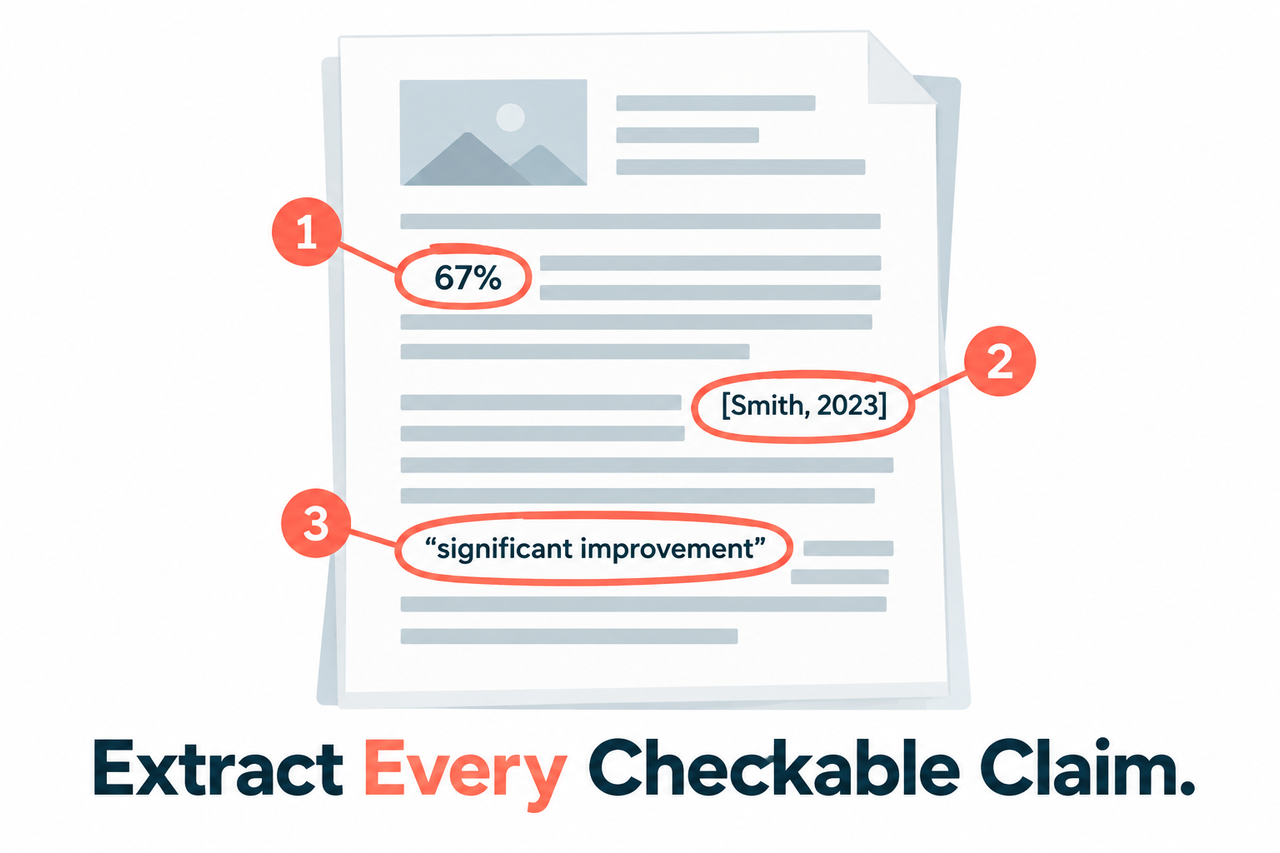
- Extract every checkable claim into a separate list. Mark every date, statistic, name, quote, ranking, causal statement, and vague authority phrase like “studies show” rather than reading for overall tone. EvergreenFeed
- Confirm every citation actually exists. Search the exact title and author in Google Scholar, CrossRef, or the publisher’s own site as a form of primary source verification, since a formal-looking citation isn’t evidence until the source is confirmed. Editage
- Match quotes and statistics word-for-word to their source. Trace every statistic back to the original dataset or study rather than trusting a secondary article that may have misreported it. Editage
- Corroborate high-impact claims with two independent sources. Two articles repeating the same press release don’t count as independent confirmation for contested or fast-changing claims. EvergreenFeed
- Check that the context actually matches. Confirm a statistic applies to the same country, time period, sample size, and product version described in your article. EvergreenFeed
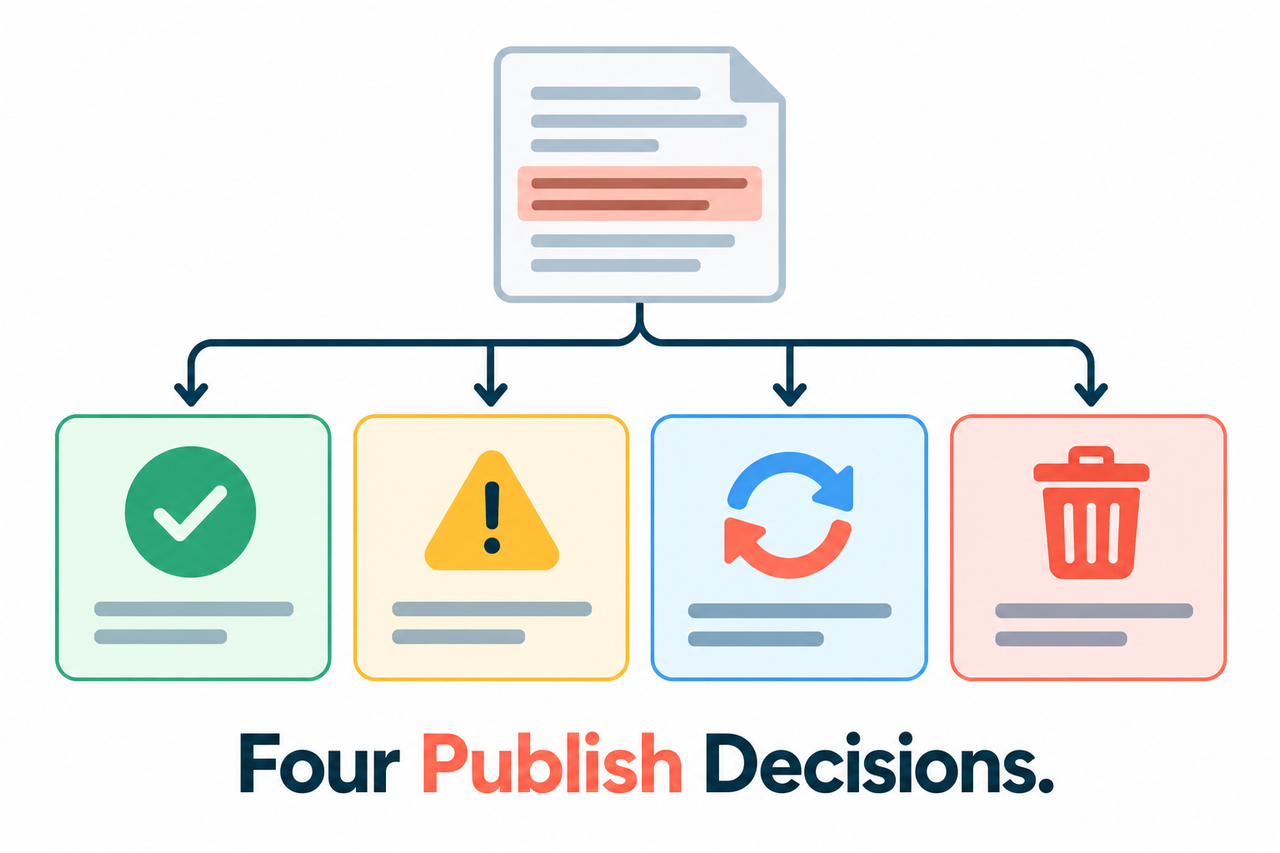
- Make an explicit publish decision for every claim. Keep, qualify, replace, or delete each material claim rather than leaving any of them in an unresolved state.
- Apply extra scrutiny to YMYL-adjacent claims. Involve a qualified subject-matter reviewer for health, legal, financial, or safety-related claims, since these draw the most E-E-A-T compliance scrutiny. Google Search Central
- Keep a lightweight verification log. Record each checked claim, its source, the check date, and the reviewer to protect against future challenges and avoid duplicate verification work.
I want to flag step 6 specifically, because in my experience it’s the step teams skip most often even after doing the actual research work. You can spend twenty minutes verifying a claim and still leave it in limbo if you never make the final call on whether it stays, gets qualified, gets replaced, or gets cut entirely.
What Does a Real Fabricated Citation Actually Look Like?
I always prefer citing documented, specific examples over general warnings, and this particular description matches something I’ve personally encountered more than once. Here’s the verbatim documentation on what a fabricated citation actually looks like in practice:
A fabricated citation is usually perfectly formatted and even
includes the name of a real journal in the field, at times.
That single sentence explains why so many fabricated citations slip through review. Editage Nobody is checking formatting when they should be checking existence, because formatting was never the thing that made a citation fake in the first place.
Why Does Corroboration Matter More Than a Single Good Source?
I’ve noticed a common shortcut people take once they’ve confirmed one source supports a claim: they stop there. In my tests reviewing AI-assisted drafts, this single-source habit is where a surprising number of subtly wrong claims survive, because one source being real doesn’t guarantee the claim is being represented accurately.
A source can be entirely genuine and still be misapplied — a statistic from a five-year-old study presented as current, a finding from one country’s market applied globally, a niche result generalized as a universal trend. Corroborating with a second independent source isn’t redundant work. It’s specifically designed to catch the cases where the first source checks out but the claim built around it still doesn’t hold up under a second look.
How Do You Handle a Claim That’s Technically True But Misleadingly Framed?
This is one of the trickier verification scenarios, because it doesn’t fail on factual grounds the way a fabricated statistic does. The underlying number might be completely real, but the way it’s framed in the AI-generated draft can still misrepresent what it actually shows.
I’ve found the most reliable check here is going back to the original source and reading the surrounding context, not just the specific number the AI pulled out. If a study reports a finding with important caveats, sample limitations, or a narrower scope than the AI’s sentence implies, that context needs to make it into your published version too. A numerical hallucination doesn’t always mean a fake number — a technically accurate number presented without its real-world context can mislead readers just as much, even though nothing in the sentence is technically false.
Which Claim Types Carry the Highest Hallucination Risk?
Not every kind of claim carries equal risk, and understanding which categories deserve the most attention helps you allocate limited verification time where it matters most.
| Claim Type | Hallucination Risk | Why |
|---|---|---|
| Specific statistics and percentages | High | Easy for AI to generate a plausible-sounding number with no real source |
| Named studies and citations | High | Formatting looks identical whether the source exists or not |
| Direct quotes attributed to people | High | AI can invent plausible-sounding quotes attached to real names |
| General definitions and concepts | Low | Less likely to be fabricated, though still worth a quick sanity check |
| Your own original analysis or opinion | Low | Not a factual claim requiring source verification in the same way |
I’d recommend spending the majority of your verification time on the top three categories in this table, since that’s where fabrication is both most likely and most damaging if it slips through. General definitions and your own analysis still deserve a read-through, but they don’t carry the same reputational risk that a fabricated statistic or invented quote does.
What Do the Four Publish Decisions Actually Look Like in Practice?
I’ve found that having four named options rather than a simple yes-or-no decision genuinely changes how editors handle borderline claims, since a binary choice tends to push people toward “keep” by default when they’re uncertain.
Keeping a claim means it’s fully supported by a source you’ve independently confirmed, with the context matching what your article states. Qualifying a claim means the underlying fact is real, but you’ve added a bounded caveat the original AI draft omitted, like a specific year, region, or sample size that changes how broadly the claim applies. Replacing a claim means you found the actual fact through your own verification and swapped it in for the AI’s version, which happens more often than most people expect once you start actually checking things. Deleting a claim means you searched and found no adequate support for it, and rather than softening the language and hoping nobody asks, you removed it entirely.
Why Does Editorial Disclosure Matter for AI-Assisted Content?
Beyond verifying the claims themselves, it’s worth thinking about how transparent you are with readers about your process. I’ve found that being upfront about using AI as a drafting tool, combined with clear evidence that a human verification process sits behind the final published piece, tends to build more trust than either pretending AI wasn’t involved or publishing without any indication of the verification standard you held the piece to.
This doesn’t need to be an elaborate editorial disclosure statement on every page. Even a simple, consistent internal policy — AI-assisted drafts always go through the eight-step verification process before publishing, with a named reviewer for every piece — gives you something concrete to point to if a reader or competitor ever challenges a specific claim. Having that answer ready, rather than scrambling to verify a claim after publication once someone’s already flagged it publicly, is the difference between a minor correction and a credibility crisis.
Bad vs. Good Way to Verify AI Content
Let’s put these side by side, because the difference in process is what actually protects your credibility.
Bad: “The AI-generated draft reads smoothly and cites its sources, so I’ll do a quick proofread for typos and publish it.”
Good: “I extracted every checkable claim from the draft into a separate list, searched each citation in Google Scholar to confirm it actually exists, traced the ‘27% increase’ statistic back to the original study to confirm the number and context matched, and removed one claim entirely because I couldn’t find any source supporting it — only then did I publish.”
The bad version trusts fluency as a proxy for accuracy. The good version treats fluency and accuracy as two completely separate things that both need to be true before anything goes live.
How Do You Build This Verification Habit Into a Real Editorial Workflow?
Knowing the steps is one thing. Actually running them consistently under deadline pressure is a different challenge entirely, and I’ve watched even well-intentioned teams skip verification specifically when they’re rushed, which is exactly when the risk is highest.
I’d recommend treating claim extraction as a mandatory checkbox in your publish-ready checklist, the same way a spell-check pass is mandatory, rather than an optional extra step reserved for content that “feels” risky. Building it into the process itself, rather than relying on an editor’s judgment call about whether a piece needs extra scrutiny, is what actually makes this habit survive contact with a real deadline.
What Should a Small Team Do Differently Than a Solo Writer?
If you’re working alone, you’re both the writer and the verifier, which creates a specific risk: you already trust the draft because you were part of producing it, even if AI generated the actual sentences. I’d recommend building in a deliberate pause between drafting and verifying, even just overnight, so you’re reviewing the claims with fresh eyes rather than the momentum of having just finished writing.
For a small team, splitting the drafting and verification roles between two different people tends to catch more issues than one person doing both, since the verifier isn’t carrying any attachment to the draft’s phrasing or structure. If your team is too small to split these roles formally, at minimum rotate who does the final verification pass so the same person isn’t always checking their own work.
What’s the Realistic Time Cost of Doing This Properly?
I get asked constantly whether this level of verification is actually feasible given real publishing schedules, and the honest answer depends heavily on how claim-dense the piece is. A short, opinion-heavy blog post with two or three checkable facts might take fifteen minutes to verify properly. A data-heavy comparison article citing a dozen statistics and several studies can reasonably take an hour or more if you’re doing it right.
I’d rather a content team publish fewer pieces with genuine verification behind them than a higher volume of unverified content, since the reputational cost of one publicly caught fabrication tends to outweigh the productivity gain from skipping this step across dozens of pieces. Treat the time this takes as a real, budgeted part of your content production cost, not an optional extra squeezed in only when time allows.
For a broader look at evaluating AI-generated content and answering common AI-related questions beyond this specific verification process, see our complete guide to AI questions and answers.
Frequently Asked Questions
Does Google penalize content just because it was written with AI?
No — Google’s official guidance confirms appropriate AI use isn’t against its guidelines, but the content still must meet Search Essentials and avoid scaled content abuse or providing little to no added value. Google Search Central
Why do fabricated AI citations look so convincing?
A fabricated citation is usually perfectly formatted and often includes the name of a real journal in the field, making it visually indistinguishable from a genuine source without direct verification. Editage
What’s the difference between proofreading and verifying AI content?
Proofreading catches typos and awkward phrasing, while verification is a separate process of confirming every checkable claim’s underlying source, which proofreading alone will never catch.
How many sources should you check before trusting a statistic in AI-written content?
At least two independent reliable sources for any high-impact or contested claim, since two articles repeating the same press release don’t count as independent confirmation. EvergreenFeed
What should you do with a claim you can’t verify at all?
Delete it — every material claim should end with an explicit decision to keep, qualify, replace, or delete it, rather than being left unresolved before publishing. EvergreenFeed
Do all claims in AI-written content need the same level of scrutiny?
No — health, legal, financial, safety, and other YMYL-adjacent claims require a qualified subject-matter reviewer and stricter scrutiny than lower-stakes factual claims.
Can a claim be factually true but still count as a problem worth fixing?
Yes — a technically accurate statistic presented without its original context or caveats can mislead readers just as much as a fabricated one, so context matching matters as much as confirming the underlying number is real.
Leave a Reply