
How can I review and maintain an AI-generated codebase that grows faster than I can inspect it is a verification-capacity problem: constrain incoming changes, automate repeatable checks, and prioritize human review by risk. For example, isolate an authorization fix in one pull request, test permitted and forbidden access, and require accountable approval before merging.
The urgent risk is not that you cannot read every generated line today. It is that critical changes can reach production without anyone understanding their consequences. More generated code is not progress when nobody can confidently approve, deploy, or repair it.
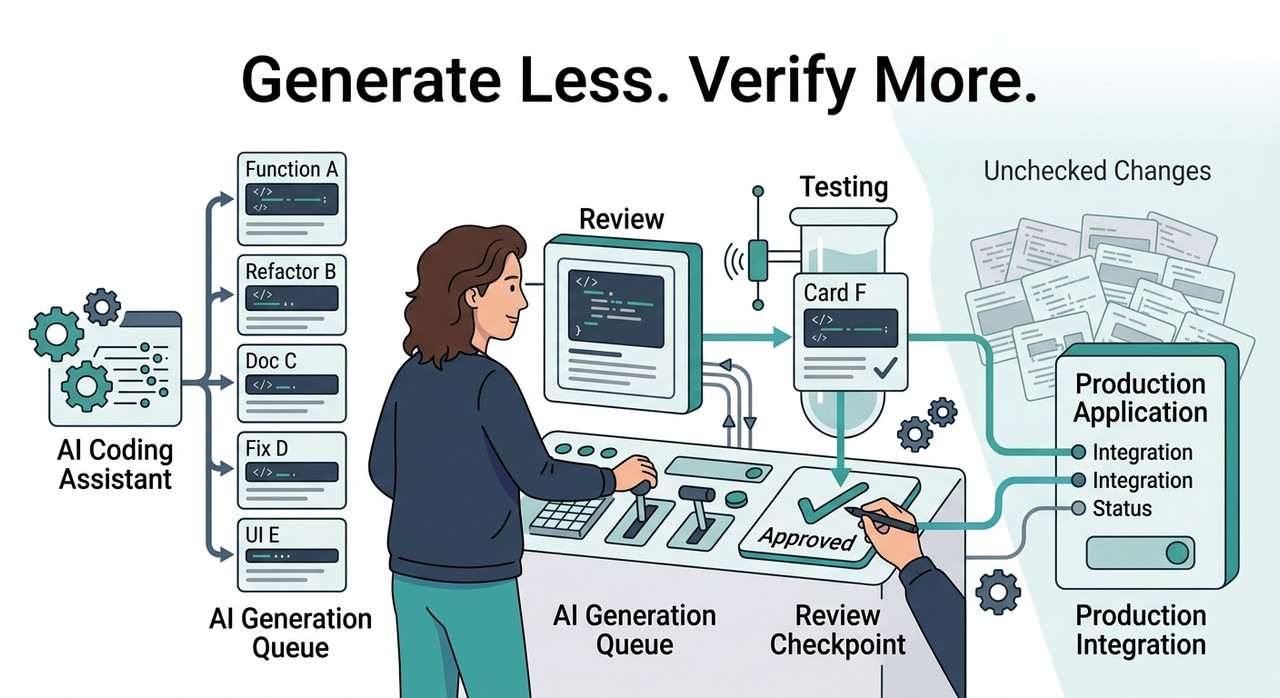
I recommend separating recovery into two workstreams: contain incoming changes and stabilize the existing codebase. That gives you a practical alternative to either stopping development entirely or letting an expanding review queue dictate your releases.
Evidence note: No repository, completed test, or incident log was supplied. The invoice-authorization scenario below comes from the supplied research brief but is illustrative, not a reported production vulnerability. My recommendations draw on the cited documentation; they do not claim firsthand experiments or measured improvements.
How can I review and maintain an AI-generated codebase that grows faster than I can inspect it?
Quick Answer
Review and maintain a fast-growing AI-generated codebase by limiting concurrent changes, requiring small pull requests, automating repeatable checks, and prioritizing human review of high-risk behavior. Establish a reproducible baseline, add independent tests around critical workflows, assign ownership, and enforce merge controls. Reduce generation intake whenever unreviewed work continues growing despite these safeguards.
Match generation intake to verification capacity—not the other way around. An assistant can generate another implementation immediately. Your team still needs time to establish whether its assumptions, permissions, data handling, and operational behavior are acceptable.
I would begin with risk-based code review rather than trying to read the entire repository in file order. Identify what could hurt customers or block recovery, then direct attention there while preserving appropriate verification for every production-bound change.
When the question is “How can I review and maintain an AI-generated codebase that grows faster than I can inspect it?”, the first decision is about work intake. Do not open additional parallel coding tasks simply because the generator is available.
GitHub’s review guidance covers functional checks, testing, static analysis, architecture, dependencies, and human oversight. That breadth matters: no single scanner or second AI opinion establishes that a change is ready. GitHub Docs — Reviewing AI-generated code
Why is AI-generated code becoming harder to review?
Generation removes some typing effort, but it does not remove engineering responsibility. A larger diff introduces more behavior to understand, more assumptions to verify, and potentially more dependencies to maintain. Mixed-purpose changes make those obligations harder to separate.
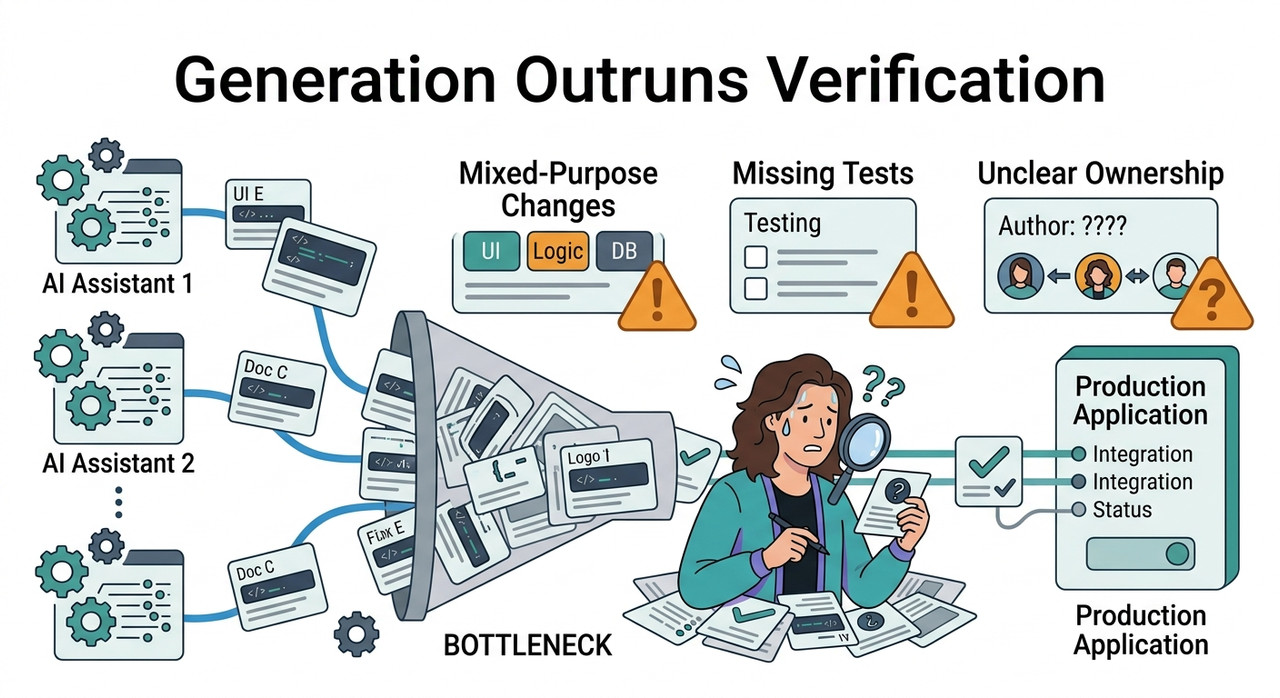
The following table lists diagnostic possibilities, not confirmed findings about your application. Use it to decide what evidence to collect before buying another tool or ordering a rewrite.
| Observable symptom | Likely contributing cause | First action |
|---|---|---|
| Pull requests wait longer each week | Intake exceeds review capacity | Limit concurrent tasks |
| Reviewers cannot summarize a diff | Mixed-purpose or oversized changes | Split by coherent behavior |
| Tests pass but regressions escape | Tests miss requirements or failure paths | Add independently specified cases |
| Similar utilities multiply | Weak architectural guidance | Identify the existing approved pattern |
| Sensitive changes lack reviewers | Missing ownership | Assign responsible maintainers |
| Unexpected changes merge | Incomplete or bypassed controls | Test repository enforcement |
| Small fixes require extensive investigation | Missing setup and design evidence | Document critical paths and decisions |
A useful diagnostic reframing is: “How can I review and maintain an AI-generated codebase that grows faster than I can inspect it without adding another source of unchecked changes?” An AI review agent may help, but its comments also require triage and verification.
The deeper problem is often missing independence. If the same assumed requirement drives both implementation and generated tests, both can agree while being wrong. Review must compare behavior with an approved requirement outside that implementation.
No application-specific error log is available. A growing backlog is a workflow symptom, not a particular exception or compiler message. The example below is a proposed investigation record, not captured system output.
Observation: A pull request changes invoice-download authorization. Evidence requested: Approved access rules and executed test results. Review questions: - Can an unauthenticated request retrieve an invoice? - Can one customer retrieve another customer's invoice? - Can an authorized customer still retrieve their own invoice? Decision: Pending verification; no test outcome is asserted.(Illustrative example)
What steps bring an AI-generated codebase back under control?
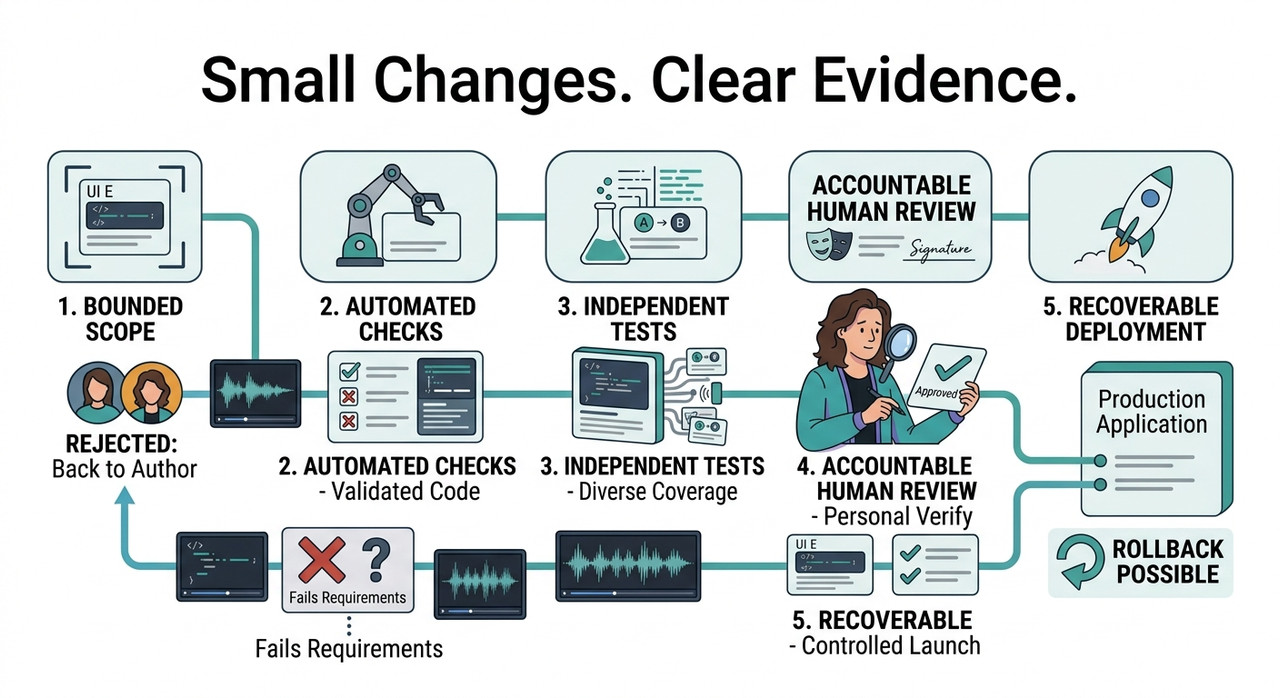
I would start with containment rather than cleanup. Make the next change reviewable, preserve a known starting point, and improve the highest-risk areas incrementally. A repository-wide rewrite can reproduce the original problem at a larger scale.
1. Establish a reproducible baseline
Identify the deployed commit, not merely the newest branch tip. Record the runtime, dependency lockfiles, configuration requirements, and documented setup commands. Run installation, build, and tests from a clean checkout in an appropriate nonproduction environment.
Keep existing failures separate from regressions. Otherwise, a maintainer may dismiss a new failure as “already broken” or spend the review fixing unrelated problems. Neither helps establish the consequences of the proposed change.
For “How can I review and maintain an AI-generated codebase that grows faster than I can inspect it?”, a reproducible baseline supplies the comparison point. Without it, you cannot reliably distinguish improvement, breakage, and environmental differences.
- Record the release identifier and environment assumptions.
- Capture commands, actual outcomes, and known failures.
- Identify a recovery procedure and its limitations.
- Pause nonessential generation in unstable components.
Deliverable: A baseline record another maintainer can reproduce. Do not call a backup recoverable simply because a file exists; validate restoration where practical, without exposing production data or disrupting service.
2. Map critical paths and assign owners
Inventory the application’s entry points, services, stores, external integrations, and deployment workflows. Start with a compact map that supports decisions rather than an exhaustive diagram nobody maintains. Identify which paths can change permissions, move money, destroy records, or expose sensitive information.
Use code ownership (CODEOWNERS) where appropriate, but distinguish assignment from enforcement. An ownership file helps route attention; repository settings determine whether the relevant approval is actually required.
If you ask “How can I review and maintain an AI-generated codebase that grows faster than I can inspect it?” without identifying accountable maintainers, every difficult change can become somebody else’s problem. Name an owner even when one person covers several components.
- Prioritize authentication and authorization boundaries.
- Identify payments, sensitive-data handling, and destructive operations.
- Include migrations and deployment configuration.
- Record an escalation path when the owner is unavailable.
Deliverable: A risk-and-ownership map. Lower-risk classification is not an exemption from review; it helps determine the depth and expertise needed.
3. Restrict each pull request to one coherent change
Require small pull requests with one explainable purpose and their related tests. Separate unrelated formatting, dependency upgrades, refactoring, and feature work. A change can be short yet risky, so line count is a warning signal rather than a safety certificate.
Google recommends small, self-contained changes and separating refactoring from behavioral changes where practical. Its guidance does not establish a universal safe number of changed lines. Google Engineering Practices — Small changes
“How can I review and maintain an AI-generated codebase that grows faster than I can inspect it?” becomes manageable when tasks have explicit boundaries before generation. Otherwise, the assistant may solve the immediate problem while introducing unnecessary architectural changes.
- State the expected behavior and acceptance criteria.
- Name permitted components and prohibited changes.
- Specify whether dependencies or interfaces may change.
- Set a work-in-progress limit based on reviewer capacity.
Deliverable: A bounded task brief. If the implementation discovers that broader work is necessary, stop and revise the scope instead of silently expanding the pull request.
4. Require a verified review packet
A review packet should make the change easier to investigate, not persuade reviewers to skip investigation. Require the author to describe changed behavior, affected components, design rationale, dependency changes, executed tests, known limitations, and recovery considerations.
I would distinguish “tests suggested,” “tests added,” and “tests executed.” They are different claims. An assistant’s confident statement that a fix is covered does not establish which command ran or which commit produced the result.
For anyone asking “How can I review and maintain an AI-generated codebase that grows faster than I can inspect it?”, evidence quality matters more than summary length. The responsible maintainer should verify the packet against the actual diff.
- Include the requirement or issue being addressed.
- Identify behavior and interfaces that remain unchanged.
- Record test commands and observed results.
- Document unresolved risks and deployment constraints.
Deliverable: A reusable pull-request template. Keep secrets and sensitive customer information out of pasted logs, review descriptions, and external AI tools.
5. Automate repeatable checks before deep review
Use continuous integration (CI) to catch repeatable problems before a human spends time on deeper questions. Select formatting, linting, type checks, build verification, and tests appropriate to the actual language and deployment environment.
Add static application security testing (SAST) and software composition analysis (SCA) where relevant. SAST looks for potential problems in code; SCA examines components and dependencies. Neither replaces review of the application’s business rules or deployment configuration.
“How can I review and maintain an AI-generated codebase that grows faster than I can inspect it?” is not answered by installing every scanner available. Choose checks with useful signals, actionable failures, and an identified maintainer.
For new dependencies, inspect existence, origin, purpose, maintenance, licensing, and known vulnerabilities. A plausible package name in generated code is not verification that the package is appropriate or trustworthy.
GitHub’s review guidance treats automated analysis as part of a broader review process, not permission to abandon human oversight. GitHub Docs — Reviewing AI-generated code
Deliverable: A documented CI pipeline with mandatory checks, expected execution conditions, and clear ownership for failures.
6. Verify that merge controls actually block unsafe changes
Configure branch protection rules or the applicable repository controls to require pull requests, relevant checks, and appropriate approvals. Review code-owner requirements, stale-approval handling, and bypass permissions. Available controls depend on repository configuration and plan.
GitHub documents required reviews and status checks, but configuration must match your intended policy. An approval on an earlier diff should not become a blanket authorization for later consequential edits. GitHub Docs — Protected branches
The operational question behind “How can I review and maintain an AI-generated codebase that grows faster than I can inspect it?” is whether your process can actually stop an unverified change. A policy document alone cannot do that.
GitHub documents that required checks may accept successful, skipped, or neutral states. Confirm mandatory jobs actually execute and inspect workflow conditions. An acceptable status label is not evidence that every intended test ran. GitHub Docs — Protected branches
- Use an isolated test repository or appropriately protected test branch.
- Introduce a deliberately failing check and verify merging is blocked.
- Test an unapproved change through the normal contributor workflow.
- Record bypass permissions and any intentional exceptions.
Deliverable: Evidence of enforcement. Never merge intentionally broken changes into production to test your safeguards. Recheck current platform documentation before changing repository policy.
7. Add independent tests around critical behavior
Introduce characterization tests around poorly understood code before refactoring. These capture observable behavior, which helps identify unintended changes. However, existing behavior may be incorrect, so compare it with approved requirements before treating it as the desired contract.
Prioritize cases involving denied access, malformed inputs, duplicate requests, dependency failures, and state transitions where relevant. A happy-path test alone says little about how an application fails or whether a user can cross a trust boundary.
When answering “How can I review and maintain an AI-generated codebase that grows faster than I can inspect it?”, I would prioritize meaningful assertions over a coverage target. Executing a line is not the same as verifying its consequences.
- Write expected outcomes from requirements before consulting implementation details.
- Test both allowed and forbidden behavior.
- Include relevant integration boundaries and failure paths.
- Confirm that a deliberately incorrect implementation would fail the test where safe to do so.
Deliverable: Requirement-linked tests for critical workflows. AI can propose additional cases, but a qualified maintainer must decide whether the assertions reflect the real contract.
8. Review consequences and assumptions manually
Spend human attention on permissions, trust boundaries, data validation, concurrency, error handling, compatibility, and migrations. Ask what happens when inputs are hostile, services are unavailable, requests repeat, or two operations overlap.
Compare the implementation with the requirement rather than only with the generated explanation. A clear summary can omit the very behavior that needs scrutiny. Follow important calls into shared helpers and dependencies when the change relies on their guarantees.
“How can I review and maintain an AI-generated codebase that grows faster than I can inspect it?” does not mean outsourcing accountability to another agent. Use AI to suggest questions and possible defects, then verify consequential findings and proposed fixes.
For high-risk changes, seek another qualified reviewer when feasible. Solo maintainers should separate implementation from review and obtain external expertise where the consequences exceed their confidence or domain knowledge.
Deliverable: An explicit review decision with unresolved risks recorded. Do not approve a consequential change merely because it is difficult to explain or the release is already late.
9. Reduce technical debt in small, tested changes
Prioritize technical debt that combines high business impact, frequent changes, recurring defects, and weak tests. A confusing module edited every week usually deserves more attention than an untidy but stable component with little operational consequence.
Record consequential decisions in architecture decision records (ADRs). Explain the context, chosen approach, alternatives, and trade-offs. This gives future contributors and AI-assisted tasks a design baseline instead of inviting another local reinvention.
“How can I review and maintain an AI-generated codebase that grows faster than I can inspect it?” is also a maintenance-documentation question. If every fix requires rediscovering setup steps and implicit rules, your available review capacity keeps shrinking.
- Remove dead code only after checking relevant references and runtime usage.
- Consolidate duplication through small, tested changes.
- Update setup instructions and operational runbooks.
- Keep cleanup separate from unrelated behavioral fixes.
Deliverable: A prioritized maintenance backlog. Avoid replacing an unexplained codebase with an equally unexplained AI-generated rewrite.
10. Adjust generation intake using backlog measurements
Measure incoming review work, completed reviews, waiting time, and active review effort. Track escaped defects, reverts, and flaky tests alongside throughput. Faster merging is not success if repair work and customer impact rise.
If the queue keeps growing, reduce concurrent generation or narrow task scope before adding more automation. Also examine whether reviewer availability, missing requirements, or unresolved ownership is creating the bottleneck.
The answer to “How can I review and maintain an AI-generated codebase that grows faster than I can inspect it?” must change when measurements show the current process cannot cope. Do not treat the initial work-in-progress limit as permanent.
Deliverable: A recurring capacity review using your repository’s baseline. Choose local improvement targets and record what changed; do not claim universal productivity gains from an untested workflow.
How do you measure whether the review backlog is improving?
Start with a simple measure that everyone can interpret consistently:
Weekly review-backlog change = open PRs awaiting review at week end − open PRs awaiting review at week start.
A positive result means the queue grew. Zero means its size stayed constant, not that old work moved. A negative result means the queue shrank, but closures, abandoned work, and task restructuring may explain part of that movement.
“How can I review and maintain an AI-generated codebase that grows faster than I can inspect it?” requires both a capacity signal and a quality signal. Pair backlog change with the oldest unreviewed PR age and escaped defects.
| Measure | What it helps reveal | Important limitation |
|---|---|---|
| Backlog change | Whether incoming work exceeds completed review | PRs have unequal effort |
| Oldest unreviewed PR age | Stalled work hidden by new activity | Some pauses are intentional |
| Active review time | Human effort spent investigating | Excludes queue delays |
| Escaped defects and reverts | Problems reaching later stages | Severity and attribution differ |
| Representative maintenance-task time | Whether changes are becoming easier | Tasks must be reasonably comparable |
I would compare similar change types and record abandoned or superseded work separately. Splitting one oversized pull request into several coherent changes can temporarily increase the count while improving reviewability.
How can I review and maintain an AI-generated codebase that grows faster than I can inspect it with better task briefs?
A useful task brief limits what the assistant may change and defines evidence before implementation. It gives the reviewer a clear question to answer instead of an open-ended request to assess everything the agent decided to improve.
Bad:
“Refactor the backend, upgrade libraries, fix authentication, add billing, and merge when CI passes.”
This combines unrelated risks and lets implementation choices determine the scope. It also treats passing automation as sufficient approval, even though the tests may omit permissions, migration behavior, and architectural constraints.
Good:
“Fix only the missing authorization check on invoice downloads. Preserve the API contract, add no dependencies, and avoid unrelated refactoring. Test unauthenticated access, another customer’s invoice, and permitted access against approved requirements. Document the diff and test results. Open a pull request for the responsible reviewer; do not merge automatically.”
This is the supplied illustrative scenario, not a tested fix or an observed vulnerability. Its useful properties are one outcome, constrained scope, independently specified behavior, explicit evidence, and accountable approval.
“How can I review and maintain an AI-generated codebase that grows faster than I can inspect it?” becomes a repeatable workflow when every task has those properties. The goal is not a more elaborate prompt; it is a change a maintainer can explain and verify.
For a full overview of related troubleshooting topics, use the site’s troubleshooting hub. Keep the immediate recovery plan focused on your repository’s evidence rather than collecting more generic advice.
Frequently Asked Questions
Do I need to manually read every line of AI-generated code?
Every production-bound change needs appropriate verification, but review depth should reflect risk. Automate mechanical checks and inspect changed behavior, critical assumptions, and affected dependencies. Do not treat unfamiliar or poorly understood changes as safe simply because AI generated them.
For large generated artifacts, inspect the source, generator configuration, and reproducibility as appropriate, while still examining security and behavioral consequences. A generated label does not remove the need to understand what reaches production.
Can another AI agent replace a human reviewer?
An AI reviewer can suggest defects, summarize changes, and propose tests. It cannot provide accountable approval or guarantee independent validation. Different agents can still share incorrect assumptions, so verify important findings and retain qualified human judgment for consequential changes.
How small should an AI-generated pull request be?
Small enough to explain, test, and review as one coherent change. There is no universal safe line count. Separate unrelated work and keep associated tests with the behavior they validate. Google’s small-change guidance supports coherence rather than a magic size threshold. Google Engineering Practices — Small changes
Is passing CI enough to approve a change?
No. CI checks only what its configuration and tests cover. Confirm mandatory jobs ran, inspect failures and exclusions, and review requirements, permissions, architectural fit, and operational consequences. Green status indicators cannot establish that the application implements the right behavior.
What if the existing codebase has almost no tests?
Establish a reproducible baseline and begin with critical workflows. Capture behavior through characterization tests, validate it against requirements, and add failure cases before refactoring. Keep changes narrow so you can understand their effects without relying on a broad rewrite.
What should a solo developer do without a second reviewer?
Separate implementation from review, use written acceptance criteria, and independently verify behavior. Keep changes narrow and use automated checks and AI assistance as supporting evidence. Obtain qualified external review for high-consequence changes when feasible; another AI pass is not equivalent to independent human approval.
What should I do first today?
Identify the deployed commit, pause nonessential generation in the riskiest area, and select one bounded change to verify completely. Record its requirements, test results, review decision, and recovery considerations. Then use that evidence packet as the starting standard for subsequent work.
If you return to “How can I review and maintain an AI-generated codebase that grows faster than I can inspect it?”, remember the governing principle: reduce unchecked intake, strengthen independent evidence, and keep every consequential change understandable to an accountable maintainer.
Leave a Reply