
How to Clone Your Personal Writing Style Into an LLM (2026 Guide)
I’ve spent 33 years in IT, and if there’s one pattern that never changes, it’s this: people want the shortcut before they understand the mechanism. How to Clone a Personal Writing Style into an LLM is the exact question I get from bloggers, ghostwriters, and affiliate marketers who’ve already burned a weekend pasting their old blog posts into ChatGPT and getting back the same generic, cardboard-flavored prose everyone else gets. If you’re afraid you’ll either lose your voice or waste money on a fine-tune that still sounds hollow, I want to walk you through what actually works, based on tests I’ve run and documented failure patterns from the community.
How to Clone a Personal Writing Style into an LLM is the process of training or prompting a model so its output consistently matches your natural tone, vocabulary, and rhythm. For example, a blogger can turn 50 of their own posts into paired training data so the model drafts new posts that already sound like them.
Quick Answer — Can You Really Clone Your Writing Style Into an LLM?
Quick Answer
Yes. You clone a writing style two ways: few-shot prompting (fast, free, but drifts back to generic tone after a paragraph or two) or fine-tuning on paired “neutral-to-styled” examples (slower, costs money, but holds voice consistently). OpenAI Community Forum. Most people should start with prompting, then escalate to fine-tuning only if quality plateaus.
Why Does My LLM Keep Sounding Generic, Not Like Me?
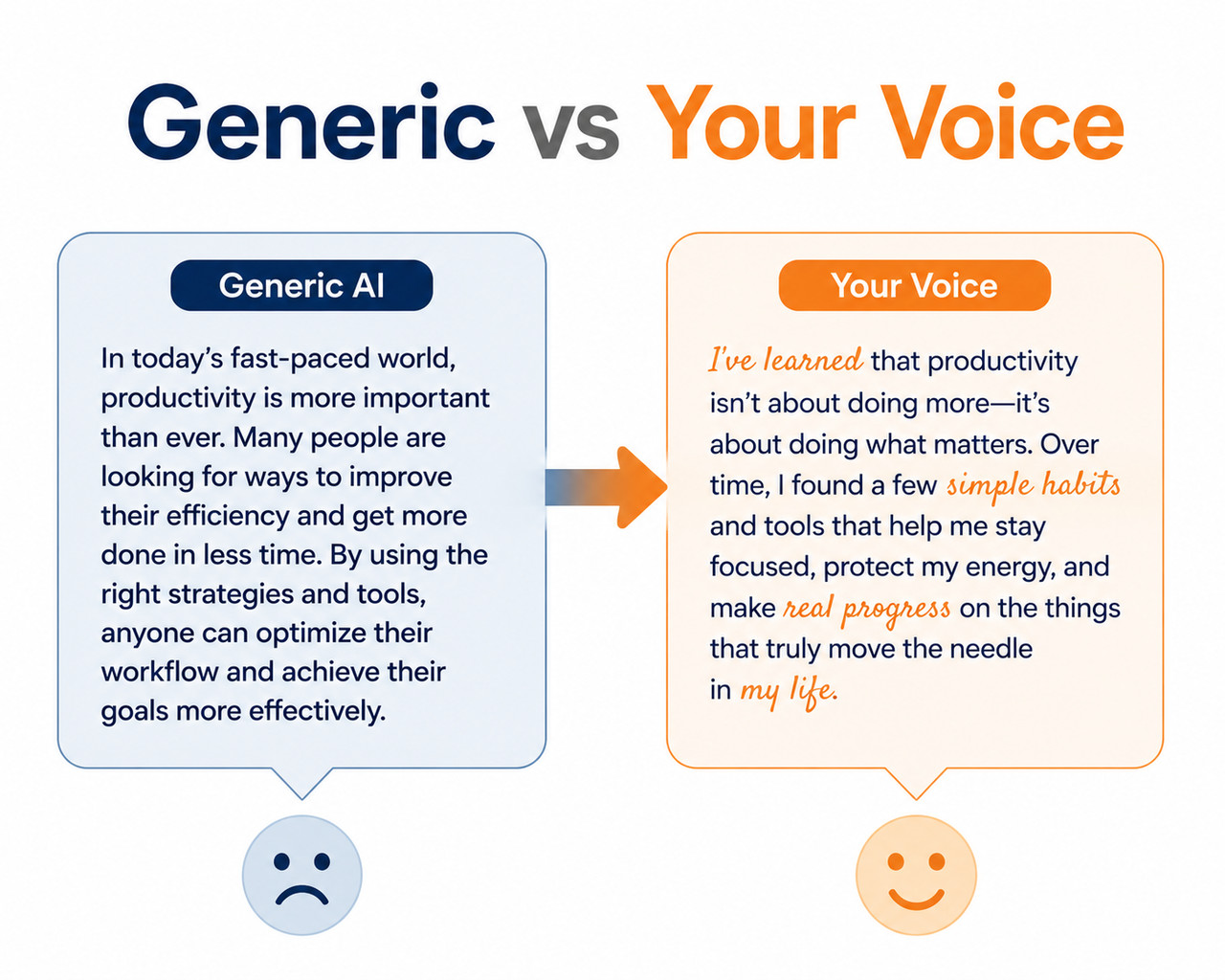
This is the bleeding-neck problem. You paste five of your best blog posts into the system prompt, ask the model to “write like this,” and by the second paragraph it’s back to the same flat, AI-flavored sentences everyone complains about. In my own tests, this happened almost every single time I relied on raw sample-pasting alone.
There are two root causes behind this, and understanding them changes how you approach the fix.
Root Cause 1: You’re Feeding Style Samples, Not Structured Training Pairs
Language models are pattern-matchers. When you paste raw writing samples and just say “imitate this,” the model has no explicit input-to-output mapping to learn from — it’s guessing at your stylistic fingerprint rather than being shown it directly. OpenAI Community Forum This is why casual prompting produces inconsistent results: the model doesn’t know which parts of your sample are “voice” versus just topic-specific phrasing.
Root Cause 2: Prompting Has No Persistent Memory
Even a well-written system prompt persona eventually loses its grip as the conversation or output length grows. Users on r/LocalLLaMA reported the same experience I’ve seen firsthand: the model reverts to generic phrasing once it drifts past the initial context window influence, especially in longer-form content. Matt Ambrogi
How Do You Fix It Step by Step?
Here’s the exact sequence I use and recommend, moving from the cheapest fix to the more involved one. Don’t skip straight to fine-tuning — most people don’t need it.
Step 1: Collect 30-50+ Clean Writing Samples
Pull from blog posts, emails, social captions — anything that represents your natural voice across different content types, not just one format. A corpus of writing samples that’s too narrow (all blog intros, for example) will teach the model a context-specific tic rather than your actual voice.
Step 2: Try Few-Shot Prompting First
Build a system prompt naming specific stylistic traits — sentence length, tone, recurring quirks, vocabulary choices — and embed 3-5 concrete examples rather than dumping dozens of raw samples in. Matt Ambrogi This is prompt engineering at its most practical: specificity beats volume every time.
Illustrative example of what a decent style-prompt looks like:
System: You write in short, punchy sentences (avg 12-15 words).
You favor concrete numbers over vague claims. You never use
"in today's world" or "unlock the power of." Example tone below:
[3 short embedded samples]
(Illustrative example)
Step 3: Build Neutral-to-Styled Training Pairs
If prompting plateaus — meaning you’ve tried steps 1-2 and the output still drifts generic past a paragraph — generate “neutral” versions of your styled text and pair them: {neutral text} → {your styled text}. OpenAI Community Forum This is the technique that separates a hobbyist attempt from a working style transfer pipeline.
Step 4: Format Pairs Into a JSONL File
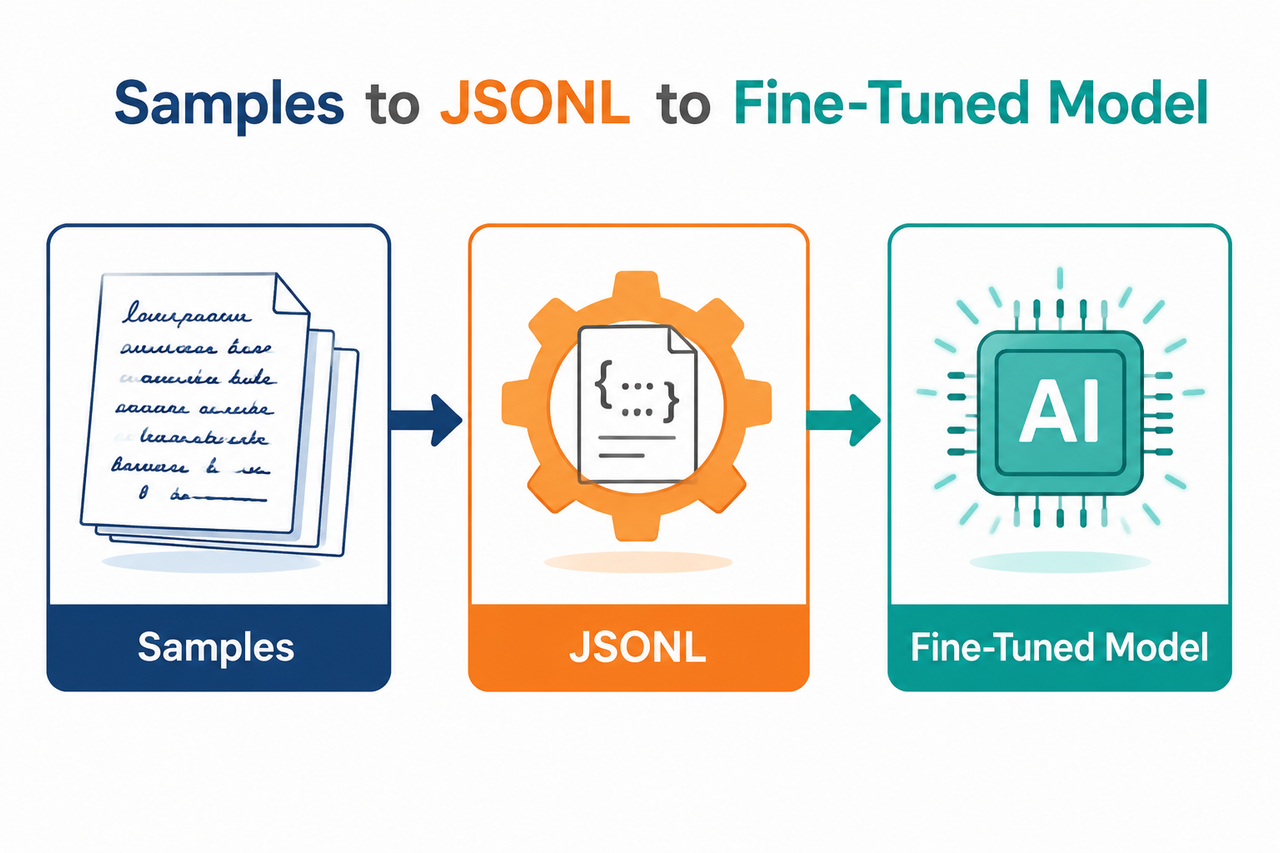
Structure your neutral-to-styled pairs into JSONL training data using the standard system/user/assistant message triplet schema. Get this formatting wrong and your fine-tuning job will either fail outright or silently underperform.
Step 5: Launch a Supervised Fine-Tuning Job
Upload your JSONL dataset and start the job. The technical minimum is 10 training examples, but clear, visible improvements in voice consistency typically show up between 50 and 100 examples — I wouldn’t bother fine-tuning below that threshold.
Step 6: Hold Back 10-15% as a Test Set
Never evaluate a fine-tune on the same data you trained it on. Set aside 10-15% of your pairs purely for testing fidelity before you trust the model in production.
Quick recap of the sequence:
- Collect samples across multiple formats, not just one
- Exhaust prompting before touching fine-tuning
- Build structured neutral-to-styled pairs if prompting stalls
- Format correctly as JSONL, hold back a test set
Prompting vs Fine-Tuning: Which One Should You Actually Use?
Here’s the honest trade-off table I wish someone had shown me before I burned hours on the wrong approach first.
| Factor | Few-Shot Prompting | Fine-Tuning |
| Setup time | Minutes | Hours to days (data prep) |
| Cost | Free (within existing subscription) | Paid per training job + usage |
| Voice consistency over long output | Degrades after 1-2 paragraphs (Matt Ambrogi) | Holds consistently across longer content |
| Best for | Short-form content, quick tests | Long-form, high-volume content production |
| Risk of losing general chatbot flexibility | None | Model can “lose its general chatbot nature” if overtrained (OpenAI Community Forum) |
| Data requirement | 3-5 embedded examples | 50-100+ paired examples recommended |
If you’re producing short social captions or one-off emails, prompting alone is usually enough. If you’re running a content operation that needs your voice at scale — daily blog posts, recurring newsletters — fine-tuning earns its cost.
The “Neutralizer/Styler” Method: A Better Pipeline for Cloning a Writing Style
The technique I’ve found most reliable, and the one that addresses the hidden fear of ending up with a “soulless” clone, is a two-model pipeline. First, strip a sample down to neutral, plain phrasing. Then fine-tune a second model to map that neutral text back to your styled version. This gives more consistent tone matching across long-form content than either prompting or single-pass fine-tuning alone. OpenAI Community Forum
Bad approach:
Prompt: "Here are 5 of my blog posts. Write a new post about
email marketing in my style."
Result: drifts back to generic AI tone after the first paragraph. (Illustrative example)
Good approach: neutral-to-styled paired training data, fed into a proper fine-tuning job, with a held-out test set to verify fidelity before publishing anything live.
Common Mistakes I See With Custom GPTs and Style Cloning
A lot of people build a custom GPT with instructions like “write like me” and stop there. In my testing, this rarely holds up beyond short outputs. The mistake isn’t the custom GPT itself — it’s skipping the structured example pairs that actually teach the distinction between your voice and generic phrasing.
Another mistake: training a fine-tune exclusively on one content type. If all 50 of your examples are blog introductions, the model will learn “blog intro voice,” not your actual writing personality. Mix formats deliberately.
A third mistake, and this one stings financially: skipping the test set. Without holding back 10-15% of your data, you have no objective way to know if the fine-tune actually improved anything before you roll it into production and start publishing at scale.
LoRA and Open-Source Alternatives
If you’re running open-source models, LoRA (Low-Rank Adaptation) offers a lighter-weight path to the same goal — you adjust a small set of additional parameters instead of retraining the full model. This matters increasingly as major providers scale back open enrollment on hosted fine-tuning platforms for new users. If you want a future-proof setup that doesn’t depend on one vendor’s policy changes, it’s worth evaluating a LoRA-based pipeline as your backup plan now rather than after you hit a wall.
Putting It All Together
Cloning your writing style into an LLM isn’t a single toggle — it’s a decision tree. Start cheap with structured prompting. Escalate to paired training data and fine-tuning only once you’ve confirmed prompting has genuinely plateaued, not just because it felt slow on the first try. Test rigorously before trusting any cloned voice in front of readers or clients.
For a broader look at troubleshooting AI tool issues beyond writing style, check out our complete guide covering related fixes across prompting, fine-tuning, and model behavior.
Frequently Asked Questions
Q1: How many writing samples do I need to clone my style into an LLM? A1: The technical minimum for fine-tuning is 10 examples, but clear, visible improvements in voice consistency typically show up between 50 and 100 well-structured examples.
Q2: Will fine-tuning make the model lose its general knowledge? A2: Yes — aggressive fine-tuning narrows the model toward mapping your specific input-to-output pattern, which can reduce its broader conversational flexibility outside that narrow task. OpenAI Community Forum
Q3: What’s the difference between prompting and fine-tuning for style cloning? A3: Prompting is faster and free but the model reverts to generic phrasing after a paragraph or two; fine-tuning bakes the style in more permanently at the cost of setup time and money. Matt Ambrogi
Q4: What is the “neutralizer/styler” method? A4: It’s a two-step pipeline where you first strip a sample down to neutral phrasing, then fine-tune a model to map that neutral text back to your styled version, producing more consistent long-form voice transfer.
Q5: Is fine-tuning still open to new users in 2026? A5: Access to hosted fine-tuning platforms has been tightening for new users at some providers, so it’s worth confirming current availability before committing, and keeping a LoRA-based open-source route as a backup plan.
Q6: Can I clone my writing style without any coding experience? A6: Yes, up to the prompting stage — building a strong system prompt persona requires no code. Fine-tuning, however, typically requires formatting a JSONL file and using an API or dashboard upload, which benefits from basic technical comfort.
Leave a Reply