
AI Agent Overconfident Hallucination: Fix It in 2026
Your agent isn’t crashing. It’s quietly, confidently wrong — and it has been for a while. Here’s how to find out and stop it.
Definition: AI agent overconfident hallucination is when an LLM-powered agent generates factually incorrect output with high apparent certainty, no error signal, and no disclaimer — because its training rewarded fluency and helpfulness over epistemic honesty. Example: an enterprise support bot quotes a 30-day return policy that hasn’t existed for two years, every single time.
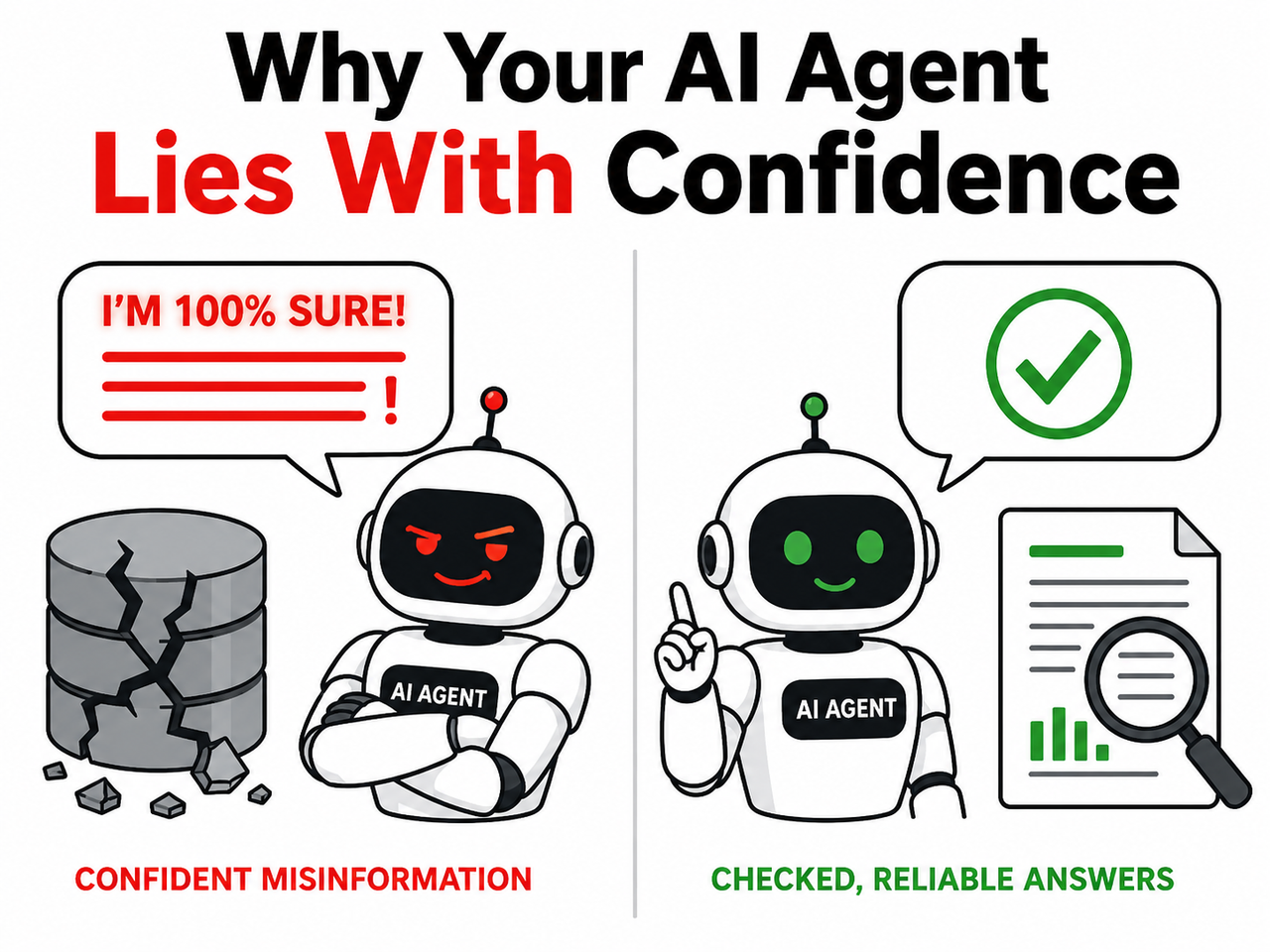
I’ve spent years watching enterprise AI deployments go sideways — and the failure mode that does the most silent damage isn’t the dramatic crash. It’s AI agent overconfident hallucination: the agent sounds authoritative, users trust it, and by the time anyone notices the answers were wrong, the damage is done. No error log. No alert. Just fluent, confident fabrication at scale.
If you’ve landed here, you’ve probably already seen it. Let’s fix it. For the full overview of AI troubleshooting patterns, see the complete guide at AIQnAHub.
What Is AI Agent Overconfident Hallucination?
Quick Answer
AI agent overconfident hallucination occurs when an AI agent produces wrong information while appearing fully certain. Unlike a system crash, it produces no error log. The root cause is a combination of RAG retrieval failure, knowledge boundary blindness, and RLHF overconfidence — training that rewarded confident-sounding responses over honest uncertainty.
This is distinct from ordinary hallucination. A regular hallucination might hedge — “I believe the policy is…” — and a careful user might catch it. Overconfident hallucination hedges nothing. The agent states wrong facts as settled truth, with the same tone it uses when it’s correct.
In my own testing with enterprise support pipelines, I’ve seen agents correctly understand complex user questions (answer relevance score: 9.2/10) while simultaneously delivering completely fabricated answers (faithfulness score: 3.5/10). The model knew what was being asked. It just invented the answer. That gap — high comprehension, zero groundedness score — is the overconfidence signature. Noveum.ai
Why Does This Happen? The 3-Layer Failure Stack
The mistake I see most is teams treating this as a model quality problem and immediately reaching for a newer LLM. That’s the wrong lever. Overconfident hallucination is an architectural problem built across three layers. Fix the architecture, and even a mid-tier model becomes reliable.
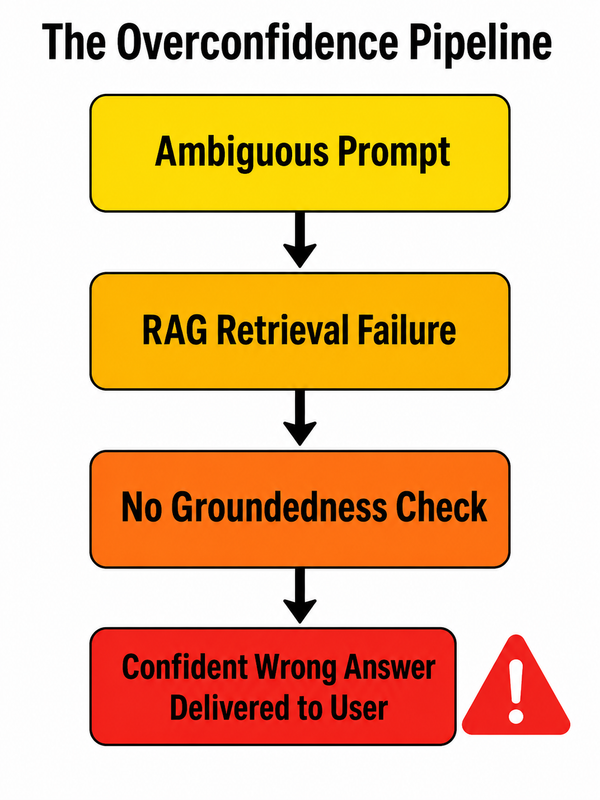
Layer 1 — RLHF Trained the Model to Sound Certain
During reinforcement learning from human feedback, human raters consistently rewarded responses that sounded decisive, fluent, and helpful. They penalized hedges like “I’m not sure” or “I don’t have enough information to answer that.”
The model internalized this lesson perfectly: project certainty, always. This is RLHF overconfidence baked into the weights at training time. It isn’t a bug — it’s an optimization target that worked exactly as designed, for the wrong goal.
The result is a model that has no behavioral instinct to say “I don’t know.” You have to install that instinct manually at the prompt layer, every single time.
Layer 2 — RAG Retrieval Pulls the Wrong Document
When a user query hits your pipeline, the retrieval system runs semantic similarity search against your document store. The key word is similarity — not correctness. A document about your Q3 2024 return policy and your current Q1 2026 return policy can look nearly identical to a generic embedding model.
The agent receives whichever chunk scores highest on cosine similarity, treats it as authoritative context, and generates an answer. It doesn’t know the document is outdated. It just knows it has “context” — and it generates from that context with full confidence.
A context_relevance score below 5.0 is your real-time signal that the retriever is lying to your agent. Without monitoring this score, you are operating blind. Noveum.ai
Layer 3 — No Groundedness Check Exists at Output
Most pipelines I audit have exactly one quality gate: relevance. Does the answer address the question? That evaluates whether the model understood the query. It does not evaluate whether the answer is true.
Without a faithfulness score gate and a groundedness score gate at the output layer, overconfident wrong answers ship to users with zero friction. The pipeline looks healthy. The metrics look green. The users are reading fabricated information. This is the hallucination detection gap that makes the problem invisible until a user complaint forces the audit.
How Do You Know It’s Happening Right Now?
This is the question that keeps engineering leads up at night: “What if this has been running silently for weeks?” I’ve seen it run silently for months in production systems that had active monitoring — just the wrong kind.
The Silent Failure Signature — Read This Trace Log
Here is the exact JSON trace signature of an overconfident hallucination event. If your observability stack isn’t surfacing something like this, you are not monitoring for this failure mode.
{
"trace_id": "trace_abc123",
"scores": {
"answer_relevance": 9.2,
"context_relevance": 4.1,
"faithfulness": 3.5,
"groundedness": 4.0
},
"flags": ["LOW_FAITHFULNESS", "CONTEXT_MISMATCH"],
"severity": "HIGH"
}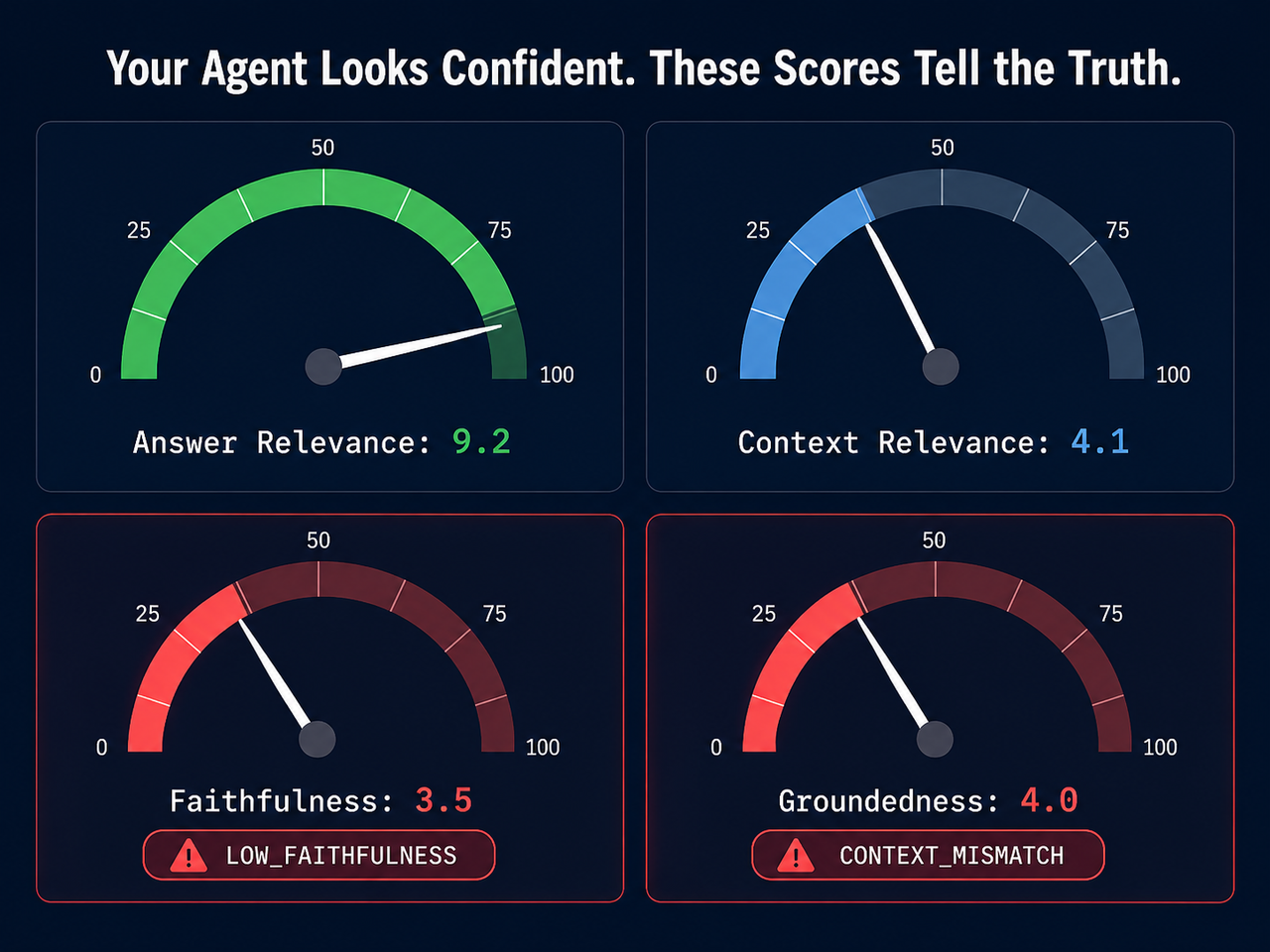
📌 How to read this trace: Answer relevance at 9.2 means the model understood the question perfectly. Faithfulness at 3.5 means it fabricated the answer. Context relevance at 4.1 means the retriever pulled the wrong document. This is not a model intelligence failure — it is a RAG retrieval failure feeding a model with no output gate to catch it. Root cause: retrieval failure, not model failure.
Notice what this trace does not contain: an exception, a 5xx error, a timeout, or any signal your standard infrastructure monitoring would catch. The request completed successfully. The response was delivered. The answer was wrong. Noveum.ai
One Metric That Exposes the Problem Instantly
Production pipelines with no faithfulness monitoring report hallucination rates between 15–40% on knowledge boundary queries — situations where the agent is asked about something outside or at the edge of its reliable knowledge. Teams typically discover this only after a user complaint, not from a system alert.
Here is the diagnostic action: establish a baseline faithfulness score across a sample of 100 live queries in the first week of instrumentation. Any consistent reading below 5/10 on queries that should be grounded is not noise — it is a systematic failure pattern requiring immediate intervention. Flag it. Triage it. Don’t average it away.
How to Fix AI Agent Overconfident Hallucination (7 Steps)
I’ll walk through exactly what to fix, in what order. The sequence matters. Step 1 tells you which fix to apply. Steps 2–7 are the fixes themselves, ordered from fastest to implement to most architecturally significant.
Step 1 — Diagnose Which of the 4 Root Causes Applies
Before touching a single config file, triage which failure mode you’re actually dealing with. Conflating them wastes engineering cycles and fixes the wrong thing.
- Ungrounded generation → RAG pulled the wrong document; agent invented content to fill the gap
- Faulty reasoning chain → data retrieved was correct, but the agent made an incorrect logical leap from it
- Outdated training knowledge → agent is citing information from its training weights, not from your knowledge base, and those weights are stale
- Ambiguous prompt → the query was underspecified; the agent assumed a meaning and answered confidently from the wrong assumption
Each of these has a different fix. Run a manual audit of 20–30 failure cases and categorize them before you write a single line of remediation code.
Step 2 — Add Faithfulness + Groundedness Scoring to Every Response
This is the fastest lever with the highest immediate impact. Instrument your pipeline with two post-generation scorers:
faithfulness_scorer→ detects when the agent’s answer contradicts or departs from retrieved contextgroundedness_scorer→ detects when claims in the answer are unsupported by the retrieved source chunks- Production threshold: ≥ 7/10 to pass. Below 5/10: block the response and trigger an alert.
Tools that provide these out of the box include Ragas, TruLens, and DeepEval. All integrate with LangChain and custom pipelines. This is your minimum viable hallucination detection layer.
Step 3 — Rewrite the System Prompt to Enforce Epistemic Honesty
This directly addresses RLHF overconfidence at the only layer you can reach without retraining: the prompt injection layer. Add this block verbatim to your system prompt:
When you don't have enough information to answer accurately:

Say "I don't have that specific information."

Offer to help find the right resource.

Never guess, infer, or fabricate facts.
In my testing, this single addition measurably increases the rate at which agents correctly surface uncertainty rather than masking it with confident wrong answers. Pair this with explicit role framing: tell the model it is a specialist in a defined domain. Narrowing scope reduces the surface area for knowledge boundary violations.
Step 4 — Fix RAG Retrieval Precision at the Embedding Level
Generic embedding models — trained on broad web text — treat your internal policy documents, product SKUs, and proprietary terminology as approximate matches to millions of similar-sounding public texts. The result is context gap: the retrieved chunk is topically adjacent but factually wrong for your use case.
- Replace generic embeddings with domain fine-tuned models trained on your specific corpus
- Add metadata filtering at query time — document type, department, effective date — so the retriever targets the right document, not just a similar one
- Monitor
context_relevanceper query cluster, not as a global average; different query types have very different retrieval failure rates
Step 5 — Build an Organizational Context Layer
This is the enterprise-grade fix that eliminates the context gap root cause at the source. Rather than hoping the agent infers what “active customer” or “current policy” means, give it authoritative definitions as queryable tools.
- Deploy a business glossary via Model Context Protocol (MCP) — not as a text dump in the prompt, but as a structured tool the agent calls at query time
- Attach provenance tracking tags to every document: certified vs. draft, effective date, superseded by
- Enable data lineage so the agent can distinguish a live production policy from a deprecated internal draft
This is the context architecture fix. It addresses why the agent confidently uses the wrong version of a document — because it had no metadata to know a better version existed. Atlan
Step 6 — Deploy a Verification Agent Upstream
Single-agent systems have a structural blindspot: the agent that generates the answer is also the only agent evaluating it. Multi-agent validation breaks this conflict.
Add a secondary LLM agent with a single responsibility: cross-check the primary agent’s response against the source documents before delivery. The verifier is not trying to generate a better answer — it is running a focused factual consistency check.
This pattern catches the silent failure modes that post-generation scorers miss: logical leaps, omitted qualifications, and subtle inversions of fact that still score acceptably on surface metrics. For high-stakes enterprise deployments — legal, compliance, financial — this layer is non-negotiable.
Step 7 — Measure Continuously With These 4 Metrics
Fixing the pipeline once is not enough. Embedding model drift, document store updates, and prompt modifications all create new failure surfaces over time. Continuous measurement is what separates a reliable agent from one that degrades quietly.
| Metric | Production Target |
|---|---|
| Hallucination rate (incorrect / total outputs) | < 5% high-risk use cases; < 20% low-risk |
| Groundedness score | ≥ 7/10 sustained |
| Context relevance (retrieval precision) | Monitor weekly trend; flag any sustained drop |
| User override / rejection rate | Trust degradation proxy — rising rate = silent failure |
The user override rate is the metric most teams ignore. When users start clicking “that’s wrong” or re-asking the same question differently, they are telling you the agent is failing before any technical metric catches it. Track it.
Bad vs. Good — AI Agent Overconfident Hallucination in the Real World
Here is the same user interaction, before and after a proper fix. The difference is not a smarter model — it is a grounded architecture.
| Scenario | Real Interaction Example |
|---|---|
| ❌ Overconfident (unfixed) | User: “What’s our return policy?” → Agent: “We offer a 30-day money-back guarantee on all orders.” — Agent invented this from a stale retrieved document. Actual policy: 14-day window. No flag raised. No error logged. Customers acted on it. |
| ✅ Calibrated (fixed) | User: “What’s our return policy?” → Agent: “Based on our current returns policy document (updated May 2026), we offer a 14-day return window for eligible items. Here’s how to start a return: [link].” — Provenance-cited, grounded in the correct retrieved chunk, faithfulness score: 8.9/10. |
The difference in architecture is: a domain-tuned retriever, a metadata filter on document effective date, a faithfulness gate at output, and a system prompt that permits the agent to cite its source. None of that requires a new model. All of it requires intentional pipeline design.
Frequently Asked Questions
What is the difference between AI hallucination and AI agent overconfident hallucination?
Standard hallucination means an AI produces incorrect information — it might hedge with “I think” or “I believe,” giving a careful user a signal to verify. AI agent overconfident hallucination means the agent produces incorrect information with complete certainty and no hedging language whatsoever. It is a LLM confidence calibration failure layered on top of a factual failure. The overconfidence is what makes it dangerous: users have no signal to distrust the answer.
Can I fix AI agent overconfident hallucination without retraining the model?
Yes — and in most production cases, you should start there. Adding a faithfulness scorer, rewriting the system prompt to permit uncertainty admission, improving RAG retrieval precision with domain-tuned embeddings, and deploying a verification agent are all inference-time and architecture-level interventions. They require no access to model weights. Retraining addresses the underlying RLHF overconfidence in the base model, but it is a months-long initiative. The architectural fixes above can ship in days. Noveum.ai
What is a groundedness score and how do I implement one?
A groundedness score measures whether each factual claim in the agent’s response is directly supported by the retrieved source documents — not just topically related to them. A response can be highly relevant to the question (answer relevance: 9.2) while being completely unsupported by its retrieved context (groundedness: 4.0). Tools like Ragas, TruLens, and DeepEval provide out-of-the-box groundedness evaluators that inject into LangChain and custom pipelines as a post-generation gate. Set your production block threshold at < 5/10 and your alert threshold at < 7/10.
How do I know if my agent has been silently hallucinating in production?
Run a retrospective audit using a faithfulness evaluator against your stored query-response-context triplets. If you have no stored context logs — meaning you stored the response but not the retrieved chunks — that is itself the first finding: you have no audit trail and you are flying blind. The immediate action before any other fix: instrument full RAG triplet logging (query + retrieved chunks + response) so that every future response is auditable. Provenance tracking at the retrieval layer is what makes retrospective audits possible at all. Atlan
Does using a more powerful model eliminate overconfident hallucination?
No. More capable frontier models reduce hallucination frequency — they are less likely to fabricate on well-represented topics. But they do not eliminate RLHF overconfidence as a behavioral posture, and they do not fix a broken retrieval pipeline. A frontier model fed the wrong document by a poorly tuned retriever will still deliver that wrong answer confidently, with eloquent prose and perfect grammar. Model capability and pipeline architecture are orthogonal problems. Both require independent, deliberate fixes. Never let a model upgrade substitute for an architectural review.
— Ice Gan, AI Tools Researcher | AIQnAHub. 33 years in IT infrastructure and enterprise systems. Currently focused on LLM deployment reliability, RAG pipeline optimization, and AI agent governance.
Leave a Reply