
Building a Simple AI Governance Checklist (2026)
I’ve spent over three decades in IT, and if there’s one thing that’s never changed across every compliance deadline I’ve ever helped a team meet under pressure, it’s this: the teams that panic are the ones who think they need to build something comprehensive. Building a Simple AI Governance Checklist for Small Teams doesn’t require that at all, and I want to walk you through exactly how small this can genuinely be while still being real.
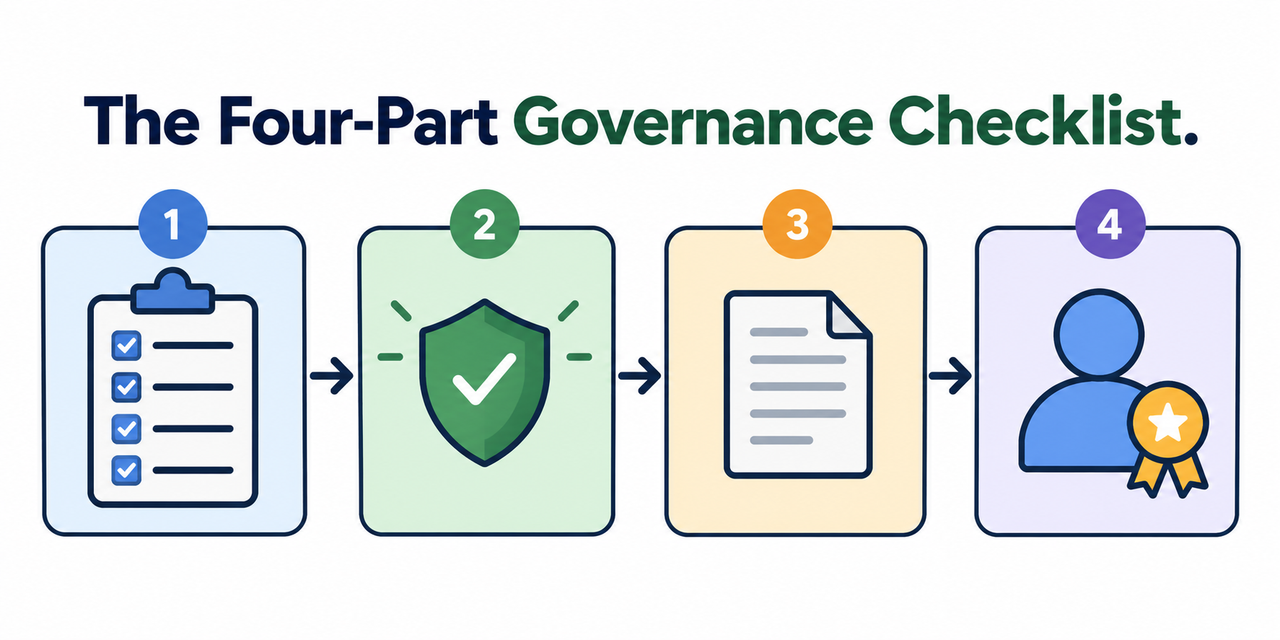
Building a Simple AI Governance Checklist for Small Teams means creating four lightweight, ongoing practices — a tool inventory, a risk rating, a short usage policy, and a named owner — scaled down from enterprise frameworks to fit a team without dedicated compliance staff. For example, NIST’s own official AI Risk Management Framework is explicitly voluntary and designed to scale to organizations of any size, not just large enterprises.
If a client contract clause, an investor due diligence questionnaire, or an uncomfortable admission from a team member just forced the question “what’s your AI policy?” and the honest answer is nothing, I want to tell you directly: you’re not alone, and you don’t need an enterprise compliance program to fix this by this afternoon.
What Does Building a Simple AI Governance Checklist for Small Teams Actually Require?
Quick Answer
Building a simple AI governance checklist for small teams requires four scaled-down activities: an inventory of every AI tool in actual use, a basic risk rating for each tool, a one-page acceptable use policy, and one named person responsible for oversight. This structure simplifies NIST’s official AI Risk Management Framework, and addresses a real gap — only 28% of organizations currently have a formal AI policy in place.
In my experience helping small teams get their first real policy in place, I’ve found the biggest obstacle isn’t technical complexity at all. It’s the mistaken belief that “governance” automatically means something heavy, bureaucratic, and expensive, when the actual requirement for a five-person team looks nothing like what a Fortune 500 compliance department would build.
Why Do Small Teams Need This Even Without Enterprise Resources?
Before walking through the actual checklist, I want to make the case for why this matters now, specifically for a team your size, not just in the abstract.
Most Organizations Have No Formal Policy at All
Only 28% of organizations report having a formal, comprehensive AI use policy, ISACA meaning most small teams asked about governance today genuinely have nothing to show. I find this statistic genuinely useful to share with nervous founders, because it reframes an embarrassing gap into an extremely common, fixable starting point rather than a unique failure.
Shadow AI Is the Single Highest Risk for Small Teams
Shadow AI — employees using personal AI accounts with company or customer data — is invisible to any governance process and worsens specifically when an approved tool feels slower or more restrictive than the free alternative employees would otherwise reach for. This is the risk I’d actually worry about most on a small team, more than any dramatic hypothetical, because it’s already happening quietly in nearly every organization that hasn’t addressed it directly.
The Underlying Framework Is Designed to Scale Down
NIST’s official AI RMF is explicitly voluntary and intended to support risk management efforts across organizations of any size, not exclusively large enterprises. NIST That matters because it means the checklist I’m about to walk through isn’t a watered-down improvisation — it’s a legitimate simplification of a real government-developed standard, scaled to fit your actual team.
Building a Simple AI Governance Checklist for Small Teams: Step by Step
Here’s the exact sequence I’d walk a small team through, start to finish.
- Build a complete AI tool inventory. List every AI tool in use by any team member, including AI features embedded inside other SaaS products that may have been enabled by default.
- Identify what data each tool actually processes. Flag any tool that touches customer personal information, employee data, financial records, or proprietary business information.
- Score each tool’s risk level. Rate each tool as minimal, limited, or high risk using a simplified framework adapted from NIST and EU AI Act risk tiers.
- Draft a one-page acceptable use policy. Cover five elements: approved tools, prohibited data categories, when human review is required, prohibited uses, and what to do if a mistake occurs.
- Name one person as the AI Governance Lead. Assign this role to an existing team member, such as a CTO or operations lead, typically requiring just 2-4 hours a week.
- Run basic vendor due diligence before adopting new tools. Ask whether the vendor trains on your data by default, offers a Data Processing Agreement, and has a clear breach response process.
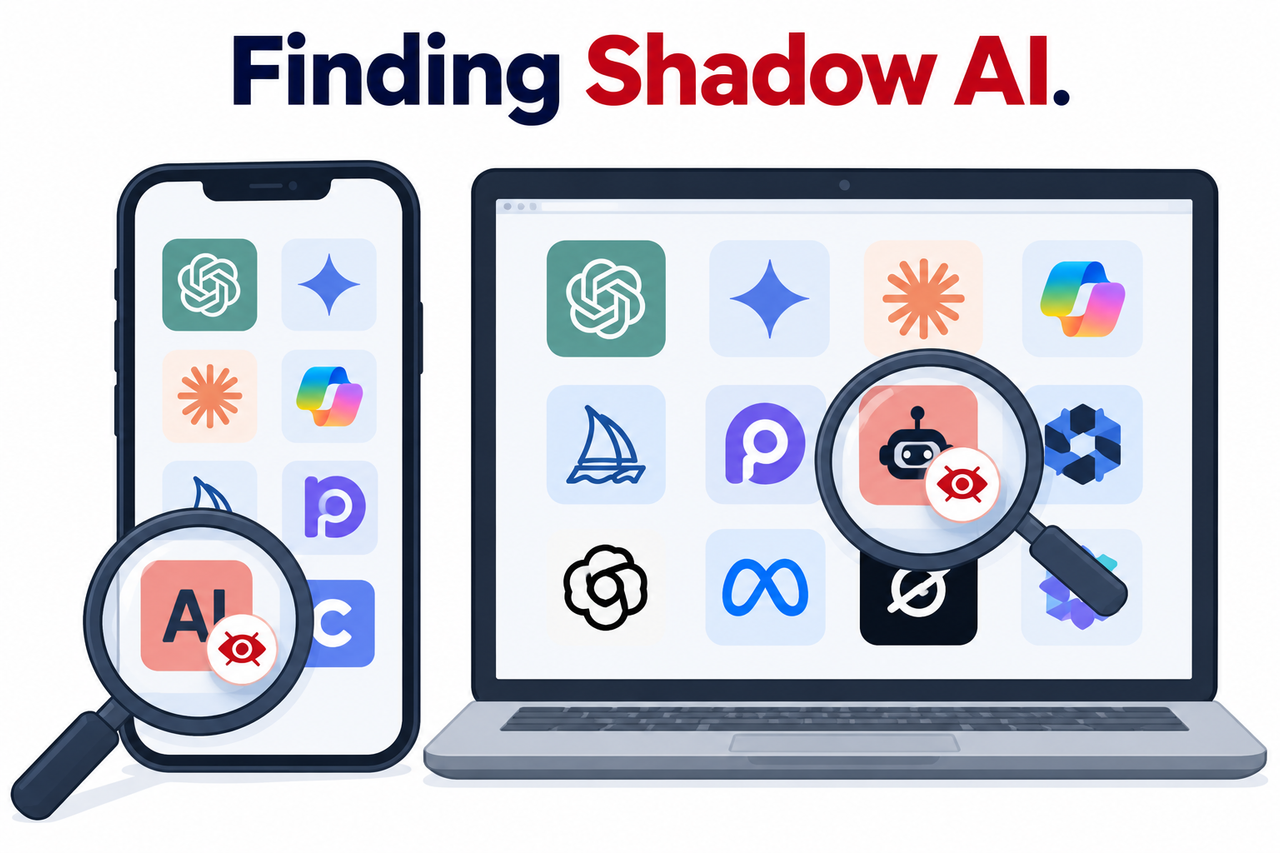
- Actively search for shadow AI. Check for AI browser extensions installed without IT visibility and review existing SaaS tools for AI features switched on by default.
- Set a recurring lightweight review cadence. Schedule a short monthly check for new unapproved tools and a periodic review of vendor terms and data-handling commitments.
I want to spend extra time on step 3, because the risk-tiering concept sounds more complicated than it actually is once you see it laid out concretely. A grammar-checking tool and an AI system screening job applicants are not remotely the same level of risk, and treating them identically either over-polices harmless tools or under-polices genuinely dangerous ones.
Simple Risk Tiering Example (Illustrative example)

Minimal risk: Grammar tool, generic writing assistant
  -> No special approval needed

Limited risk: Customer-facing chatbot, document summarizer
  -> Requires basic disclosure that AI is involved

High risk: AI influencing hiring, credit, or healthcare decisions
  -> Requires mandatory human review before any decision is final
Most tools your team actually uses day-to-day will land in the minimal or limited tier. The high-risk tier is rare for a small team, but when it applies, it’s exactly where you want the most deliberate oversight.
What Does a Real One-Page Policy Actually Look Like?
I think it helps to see the five required elements laid out concretely rather than left abstract, since “write a policy” can feel intimidating until you see how short it genuinely is. The policy needs to name which specific tools are approved for use, list the categories of data that can never be entered into any AI tool regardless of which one, specify when a human must review AI output before it goes anywhere external, state explicitly which uses are prohibited outright, and give a clear, simple instruction for what to do if someone suspects a mistake happened.
| Policy Element | What It Specifies |
|---|---|
| Approved tools | Which specific AI tools the team is authorized to use for work |
| Prohibited data | Categories of data — customer PII, financials, health records — that can never go into any AI tool |
| Human review trigger | When AI output must be checked by a person before being used externally |
| Prohibited uses | Specific use cases explicitly off-limits, such as automated hiring decisions without review |
| Incident response | What an employee should do immediately if they suspect a data exposure or AI-related error |
That’s the entire structure. I’ve seen completed versions of this fit comfortably on a single printed page, which is exactly the point — a policy nobody reads because it’s forty pages long protects nobody.
What Does NIST’s Official Framework Actually Say?
I always prefer pointing directly at the primary source rather than a secondhand summary, especially for something this foundational. NIST’s AI Risk Management Framework is described as “intended for voluntary use and to improve the ability to incorporate trustworthiness considerations into the design, development, use, and evaluation of AI products, services, and systems.” NIST
What I find genuinely useful about this framing, for a small team specifically, is the word “voluntary.” This isn’t a regulatory mandate written exclusively with enterprise compliance departments in mind — it’s a flexible standard explicitly designed to be adapted to an organization’s actual size and risk profile, which is precisely why the four-part scaled-down structure above is a legitimate simplification rather than a corner-cutting shortcut.
Why Does Shadow AI Keep Showing Up Even After a Policy Exists?
I want to address this directly, because writing a policy and actually preventing shadow AI are two different accomplishments, and conflating them is a mistake I’ve watched teams make repeatedly. A policy that exists only on paper doesn’t stop an employee from reaching for a faster, unapproved tool when the approved one feels like friction in the middle of a busy day.
The actual fix isn’t stricter rules — it’s making the approved path genuinely as convenient as the shadow alternative. If your approved AI tool requires three extra login steps compared to the free consumer version employees already have saved as a browser bookmark, don’t be surprised when people quietly default to the easier option under deadline pressure. Reducing friction on the sanctioned tool does more to prevent shadow AI than any amount of policy language ever will.
How Do You Actually Find Shadow AI That’s Already Happening?
I don’t think you can assume a new policy will surface existing unauthorized AI use on its own, so I’d recommend a short, deliberate audit as part of your rollout rather than treating detection as a one-time afterthought. Start by checking browser extension lists across company devices for AI writing assistants, summarizers, or chat tools nobody formally approved.
Next, review the settings panels of your existing SaaS tools — many platforms have quietly rolled out AI features that get switched on by default with a product update, meaning a tool you approved months ago may now be doing something entirely different without anyone having made a new decision about it. Finally, I’d simply ask people directly, in a low-stakes, non-punitive way, what AI tools they’ve been using to get their work done faster. In my experience, most people aren’t hiding this deliberately — they just never thought to mention it, because nobody had asked.
Bad vs. Good Way to Handle AI Governance on a Small Team
Let me put these side by side, because the contrast here is the entire difference between scrambling reactively and having something real ready when it’s needed.
Bad: “We’ve had ChatGPT, Claude, and two different AI-powered SaaS tools in use across the team for over a year with no written policy, no idea who’s pasting what into which tool, and when a client asked for our AI governance documentation last week, we had nothing to send them.”
Good: “We spent one afternoon listing every AI tool anyone on the team actually uses, flagged the two that touch customer data, wrote a single-page policy saying those two tools require using the business-tier account with training turned off, named our head of ops as the person responsible for reviewing this quarterly, and now have something real to show a client or investor who asks.”
The bad approach waits for an external trigger before doing anything at all. The good approach treats an afternoon of focused work now as cheap insurance against a much more expensive scramble later.
How Should You Maintain This Once It’s Built?
I don’t want to leave the impression that building the initial checklist is the finish line, because governance that isn’t maintained quietly decays back into the exact problem it was built to solve. Set a short, genuinely lightweight monthly check — ten or fifteen minutes is often enough — to scan for any new tools that have entered use since your last review.
Periodically revisit your vendor due diligence too, since a tool’s data-handling terms can change after you’ve already approved it, often without any prominent announcement. I’d treat this the same way I treat any other recurring IT hygiene task: unglamorous, easy to skip under pressure, and exactly the kind of small, consistent habit that prevents the next version of the exact scramble that brought you to this checklist in the first place.
What Should You Do Differently If a Client or Investor Specifically Asks?
I think it’s worth addressing the exact scenario that likely brought you here, because responding to a direct question is different from building a policy in the abstract. If a client contract now includes an AI usage clause, or an investor due diligence questionnaire specifically asks about your AI governance, resist the urge to improvise a vague, reassuring answer on the spot.
Instead, I’d recommend having your one-page policy, tool inventory, and named AI Governance Lead ready as concrete, shareable documents before the question ever comes up, rather than scrambling to produce something credible under time pressure once it has. A simple, honest, one-page policy that genuinely reflects your actual practices will hold up far better under scrutiny than an impressive-sounding verbal answer that falls apart the moment someone asks a specific follow-up question about how it’s actually enforced day to day.
Does This Checklist Need to Grow as Our Team Gets Bigger?
I’d treat this framework as a genuine starting point rather than a permanent ceiling, since the right level of governance scales with both team size and the stakes of what AI is actually being used for. A five-person team using AI purely for internal drafting and brainstorming has a meaningfully different risk profile than a fifty-person team whose AI tools touch regulated customer financial data or make decisions that directly affect people’s lives.
As your team grows, I’d expect the same four core components — inventory, risk rating, policy, and named ownership — to remain structurally the same, but each one deepens in proportion to actual need. The inventory might eventually need a dedicated internal tracking system instead of a shared spreadsheet, the named owner might eventually become a genuine part-time or full-time role rather than an add-on responsibility, and the policy itself may need separate sections for different departments handling meaningfully different kinds of data. Start with the simple version that fits your team today, and let it grow only as fast as your actual risk profile genuinely requires.
For a broader look at troubleshooting common AI adoption challenges for small teams, see our complete guide to troubleshooting AI tools.
Frequently Asked Questions
Do we need a dedicated compliance officer to have a real AI governance policy?
No — a simple AI governance checklist for a small team can be managed by an existing employee, such as a CTO or operations lead, spending roughly 2-4 hours a week on oversight.
What’s the single biggest AI risk for a small team specifically?
Shadow AI — employees using personal AI accounts with company or customer data completely outside any governance process, especially when approved tools feel slower or more restrictive.
How long does it actually take to build a basic AI governance checklist?
A tool inventory, risk rating, and one-page policy can realistically be drafted in a single afternoon for a small team, though ongoing review should continue monthly.
What should a one-page AI acceptable use policy actually cover?
Five elements: which tools are approved, what data can never be entered into an AI tool, when human review is required, which uses are prohibited, and what to do if a mistake occurs.
How many organizations actually have a formal AI policy right now?
Only 28% of organizations report having a formal, comprehensive AI use policy in place, ISACA meaning most small teams are not alone in having nothing documented yet.
What should we check before adopting a new AI tool?
Confirm whether the vendor trains on your data by default, whether they offer a Data Processing Agreement, and what their process is if their systems are breached.
Leave a Reply