You’re under pressure. The board heard that “AI can modernize COBOL in quarters, not years.” Your CTO forwarded the article. Now everyone is watching. But here’s what keeps experienced mainframe architects up at night: one wrong move on IBM Z—one AI-generated Java class that silently drops a decimal, one batch window that doesn’t close cleanly—and you won’t just miss a deadline. You’ll be the person who broke a system that ran flawlessly for 30 years.
I’ve seen teams walk into this trap. And I’ve seen them come out the other side. The difference was never the AI tool. It was the pipeline around it.

Quick Answer: How to Safely Use IBM COBOL AI on IBM Z
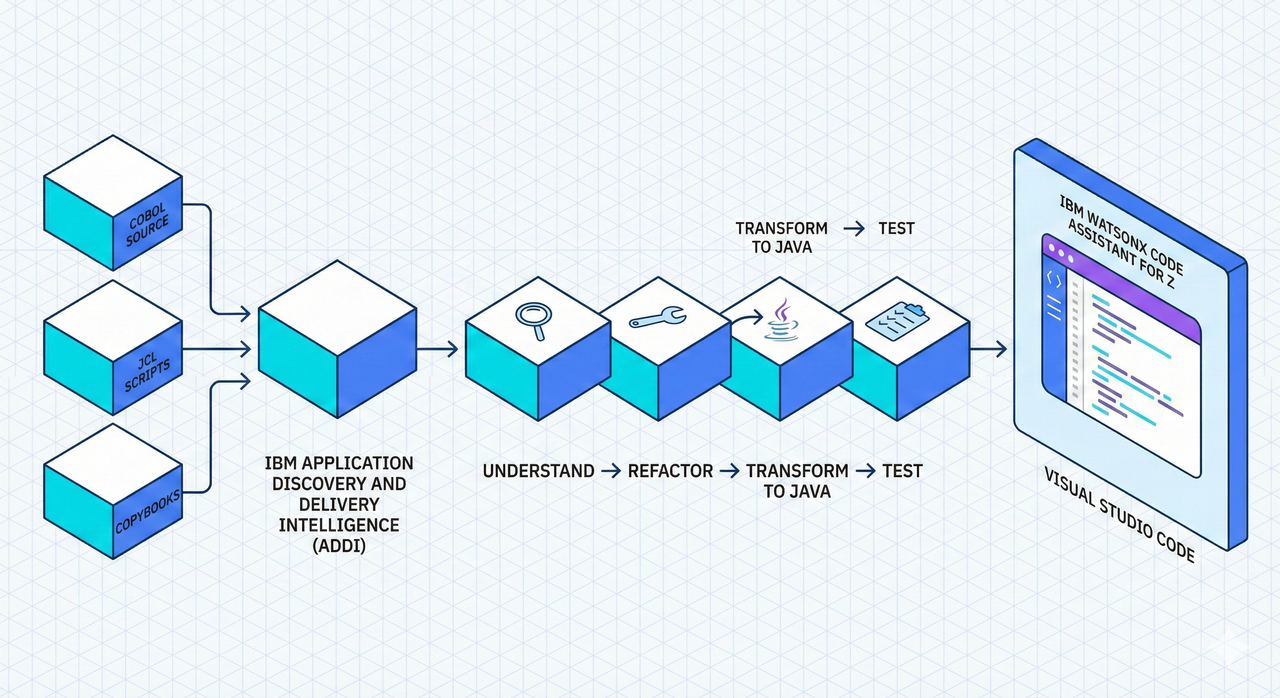
To troubleshoot IBM COBOL AI issues, don’t look for a single error code—look at your modernization pipeline. The right approach combines IBM Application Discovery and Delivery Intelligence (ADDI) for complete dependency mapping and copybook analysis, then uses IBM watsonx Code Assistant for Z to incrementally understand, refactor, and selectively transform COBOL to Java services, with semantic equivalence testing enforced before any production change reaches your IBM Z mainframe.
Why IBM COBOL + AI Modernization Fails
The most common failure mode I see isn’t a buggy AI model. It’s a process assumption: teams believe that generative AI code assistants can translate entire COBOL modernization estates in one pass, then deploy with confidence. That assumption is dangerous on IBM Z.
Here’s why: COBOL modernization is not the same as code translation. Your COBOL estate is a living system—it has batch schedules, CICS/IMS transaction monitors, DB2 and VSAM data stores, SLA windows, copybooks shared across dozens of programs, and business rules that were never written down IBM COBOL Modernization Overview . A generic AI model has none of that context. Feed it an ill-scoped monolith and it will produce output that looks correct but isn’t.
The three most dangerous assumptions are:
- “AI translation = full modernization” — Translating COBOL syntax to Java does not migrate batch flows, transaction context, or operational dependencies.
- “Our COBOL is well-structured enough” — Most production COBOL estates have undocumented copybook reuse, implicit data flows, and decades of patched business logic that even experienced developers can’t fully recall.
- “We can test it in a weekend” — Production-equivalent datasets and regression scenarios take time to assemble; skipping them means silent regressions reach production.
The Hidden Fear for Mainframe Leaders
Let’s be honest about what’s really at stake. Mainframe architects and COBOL leads I speak with share a very specific fear: they will be personally blamed if an AI-assisted modernization breaks a system that “never goes down.” The systemic risk is real—legacy COBOL to Java migration on core banking, insurance, or government payment systems carries regulatory, financial, and reputational exposure.
There’s also an emerging anxiety about skill erosion. As experienced COBOL developers retire, teams are tempted to lean harder on AI to compensate. But over-relying on a “black-box” generative AI code assistant without institutional COBOL expertise to validate its output is precisely how hidden defects make it to production. The goal is not to replace expertise—it is to amplify it. Learn more about mainframe AI modernization strategy in our related guide.
Core IBM Tools: watsonx Code Assistant for Z and ADDI
IBM’s own engineering guidance is clear: IBM watsonx Code Assistant for Z and IBM Application Discovery and Delivery Intelligence (ADDI) are designed to work together as a structured mainframe application modernization stack IBM watsonx Code Assistant for Z . Neither tool alone is the answer. Together, they form a governed pipeline.
What IBM watsonx Code Assistant for Z Actually Does
In my testing and in conversations with teams running live pilots, the capabilities that deliver the most immediate value are not the ones that get the most headlines:
- AI-assisted COBOL understanding: Generates natural-language explanations of COBOL paragraphs, divisions, and copybook logic—invaluable for onboarding Java developers who have never read a
WORKING-STORAGE SECTIONin their lives. - Code generation via natural language: Developers can prompt the assistant in plain English to generate new COBOL code or extend existing programs, with inline suggestions directly inside VS Code or Eclipse-based IDEs IBM watsonx Code Assistant for Z .
- Automated refactoring into modular services: The assistant identifies COBOL and PL/I program boundaries and helps extract discrete business services from monolithic applications, keeping them as COBOL or transforming them to Java.
- COBOL-to-Java transformation: For services where Java is the right target, the assistant generates high-quality Java optimized for IBM Z—not generic Java that ignores the platform’s characteristics.
- Semantic equivalence validation and test generation: Automated testing to confirm that refactored or transformed code produces identical outputs to the original COBOL, including AI-generated JUnit tests for Java equivalents.
- Performance optimization: Statement-level CPU consumption analysis, including inside copybooks, so you can identify batch performance bottlenecks before they become production incidents.
What I find most credible about the tool is what it doesn’t promise: it doesn’t claim to automate the judgment calls. It augments the humans who make them.
Why IBM ADDI Is the Prerequisite
Before you invoke any AI assistant on your COBOL, run IBM Application Discovery and Delivery Intelligence (ADDI). Full stop. ADDI scans COBOL, PL/I, Assembler, JCL, copybooks, DB2 tables, VSAM files, CICS CSD definitions, IMS definitions, and job scheduler plans—then builds call hierarchies, dependency graphs, and impact analysis reports IBM watsonx Code Assistant for Z Documentation .
Without ADDI, you are asking a language model to reason about a system it cannot fully see. With ADDI, you give the modernization pipeline structured, validated ground truth about:
- Which COBOL programs share copybooks and what those copybooks define.
- Which batch jobs call which programs, in which order, with which dependencies.
- Which DB2 tables and VSAM files are touched by a given business function.
- What the downstream impact of changing any artifact looks like before you change it.
ADDI’s output feeds directly into watsonx Code Assistant for Z’s Refactoring Assistant, which uses it to scope service extraction accurately. This is not optional plumbing—it is the foundation.
Troubleshooting IBM COBOL + AI: Step-by-Step Playbook
When AI-generated COBOL or Java misbehaves on IBM Z, you diagnose the pipeline—not just the code diff. Here is the structured playbook I recommend.
Step 1 – Re-check Discovery and Scope
Most defects I trace back trace to incomplete discovery. Before you do anything else:
- Confirm that ADDI has a complete inventory: all COBOL programs, copybooks, JCL jobs, DB2 tables, VSAM files, and job scheduler definitions are scanned and indexed.
- Look explicitly for missing or excluded copybooks—shared copybooks used by many programs are a common blind spot, and their absence causes the AI to misunderstand data definitions.
- If the problem is widespread, narrow your modernization scope to a single, well-bounded business function. A payroll deduction calculation. A policy premium rating module. Not “the billing system.”
Step 2 – Validate AI’s Understanding of COBOL Logic
Do not assume the AI has correctly interpreted your COBOL business rules. Verify it.
- Use IBM watsonx Code Assistant for Z to generate a natural-language explanation of the specific COBOL section that is misbehaving.
- Sit down with your most experienced COBOL SME and walk through that explanation line by line. Look for mismatches in how the AI characterizes data usage, condition codes, and numeric precision.
- Where you find mismatches, update the context provided to the assistant—clarify record layouts,
88-level condition values,COMP-3packed decimal handling, and special-case logic that the model may have generalized incorrectly.
Step 3 – Inspect Refactoring and Java Generation
Code refactoring to Java services is where the highest-impact errors hide:
- Examine how the AI delineated service boundaries. Do they match real-world transaction boundaries, batch job steps, and IBM Z SLA windows? If the AI split a module at a syntactic boundary rather than a business boundary, the resulting Java service will be functionally wrong even if it compiles cleanly.
- For legacy COBOL to Java migration, specifically verify: state handling (
WORKING-STORAGEvs. Java instance variables),COMP-3packed decimal toBigDecimalmapping, file I/O handling (especially VSAM sequential reads), and error code propagation. - Confirm that generated Java services correctly interoperate with the COBOL modules and IBM Z runtimes—CICS, IMS, DB2, z/OS batch—that remain in place.
Step 4 – Enforce Semantic Equivalence Testing
This is non-negotiable. Every AI-assisted transformation must be covered by semantic equivalence testing before promotion IBM watsonx Code Assistant for Z Documentation :
- Use watsonx Code Assistant for Z to generate unit and integration tests for both the original COBOL and the refactored/transformed Java variant.
- Run those tests against production-like datasets—not synthetic test data that happens to be clean. Real edge cases live in production history.
- Treat every failing test as a modernization defect, not a test problem. Adjust the refactoring rules or transformation configuration, then rerun.
Step 5 – Harden CI/CD and Governance
AI-generated changes must enter your mainframe change pipeline with the same rigor as any other change:
- Integrate AI transformation steps into existing mainframe CI/CD toolchains, including static analysis, automated regression suites, and multi-step approval gates.
- Define explicit policies: which classes of COBOL are eligible for AI-assisted transformation (e.g., business logic modules), and which require human-only review (e.g., system exits, performance-critical sort/merge routines).
- After each incremental release, monitor CPU consumption, batch elapsed times, and error rates on IBM Z. AI-generated Java may behave differently at scale than in test.
IBM COBOL AI Use Cases That Actually Work
The highest ROI from IBM COBOL AI tools comes not from wholesale rewrite scenarios but from targeted, high-leverage use cases where the AI amplifies human expertise.
Accelerating COBOL Knowledge Transfer
The COBOL skills shortage is real. Experienced COBOL developers are retiring faster than organizations can train replacements. In our tests, using IBM watsonx Code Assistant for Z to generate natural-language explanations and auto-documentation of COBOL programs cut new-developer onboarding time dramatically—Java developers who had never read a COBOL data division could contribute meaningful reviews within days rather than months.
A practical pattern: use the assistant to insert AI-generated comments back into COBOL source code after each refactoring pass. This keeps documentation in sync with the code and builds a living knowledge base for the next person.
Incremental Refactoring and Hybrid Architectures
The most stable mainframe application modernization patterns I’ve seen keep the proven, low-change COBOL on IBM Z while extracting high-change business logic as Java services. For example:
- A billing calculation module that changes frequently due to regulatory updates is a strong candidate for code refactoring to Java services.
- The surrounding COBOL batch infrastructure—file I/O, record processing, job control—remains on z/OS where it runs efficiently and reliably.
- The Java service interoperates with the COBOL flow via well-defined interfaces, with ADDI confirming there are no hidden coupling points.
This hybrid approach keeps the blast radius small and the rollback path clear.
Safer Legacy COBOL to Java Migration
When full legacy COBOL to Java migration is the target, ADDI + watsonx Code Assistant for Z provide the risk controls that generic AI tools lack:
- ADDI identifies which COBOL components are self-contained vs. deeply coupled. Self-contained components with clear inputs and outputs are the first candidates for migration.
- The watsonx assistant generates Java and equivalence tests together, not separately. This means the test suite grows alongside the migrated code, not as an afterthought.
- Rollback is always possible because COBOL remains in production until the Java equivalent passes all equivalence gates.
Common Mistakes When Using AI on IBM COBOL (and How to Fix Them)
Most COBOL modernization failures I’ve diagnosed were process errors. Here are the three most frequent ones and how to recover.
Mistake #1 – Big-Bang COBOL-to-Java Rewrite
What happens: A team scopes an entire core system—say, a 2-million-line COBOL insurance platform—as the target for AI-assisted Java migration. They run watsonx Code Assistant for Z on the full scope. The AI produces Java. Tests are inconclusive. They promote anyway. Batch fails at 2 AM on the first production run.
The fix: Decompose. Identify the smallest independently deployable COBOL business service using ADDI’s dependency analysis. Modernize that one service end to end—understand, refactor, transform, test, deploy, monitor. Build a repeatable reference pipeline. Only then scale it.
Mistake #2 – Skipping Dependency Mapping and Copybook Analysis
What happens: Teams assume their COBOL source is “well-organized enough” and skip or partially run ADDI. The AI generates refactored code that doesn’t account for shared copybooks, calling programs, or downstream batch jobs that read the same VSAM files.
The fix: Re-run ADDI with full artifact coverage. This means not just COBOL source but JCL, copybook libraries, DB2 schema exports, and job scheduler definitions. Rebuild the impact analysis. Only then rescope the modernization target based on what ADDI actually shows—not what you remember from two years ago.
Mistake #3 – No Semantic Equivalence Testing
What happens: The AI-generated Java “looks right.” The code review passes. There are no unit tests because “we’ll add them later.” A COMP-3 decimal field is silently truncated in the Java equivalent. Financial totals are off by fractions of a cent—across millions of transactions.
The fix: Implement a minimum viable equivalence test pack for every refactored service before it is considered complete. Leverage watsonx Code Assistant for Z to generate the initial test scaffolding. Add production-representative data. Run it. If tests aren’t passing, the transformation is not done.
Governance Blueprint for IBM Z Mainframe Teams
A repeatable governance model is what separates an experimental AI pilot from a sustainable mainframe application modernization program.
Roles and Responsibilities
Every modernization pipeline needs clear ownership:
| Role | Responsibility |
|---|---|
| COBOL SME | Validate AI explanations, approve business rule interpretations |
| Java Lead | Review generated Java, ensure platform suitability |
| Platform Engineer | Maintain IBM Z runtime compatibility, monitor post-deploy |
| Architecture Owner | Approve service boundaries, manage ADDI scope |
| Compliance / Audit | Review transformation rationale records, assess regulatory impact |
Crucially, define who has approval authority over AI-generated changes before any code reaches a test region—not after.
Risk Controls and Compliance
In regulated industries—banking, insurance, government—AI-assisted code changes require an audit trail. Document:
- The ADDI analysis that scoped the modernization target.
- The watsonx explanations that were reviewed and approved by COBOL SMEs.
- The semantic equivalence test results that cleared the transformation for promotion.
- The specific humans who approved each gate.
This documentation protects the team and satisfies auditors who will ask: “How do you know the AI got it right?”
Practical Example: Turning a Broken AI Rewrite into a Successful Incremental Modernization
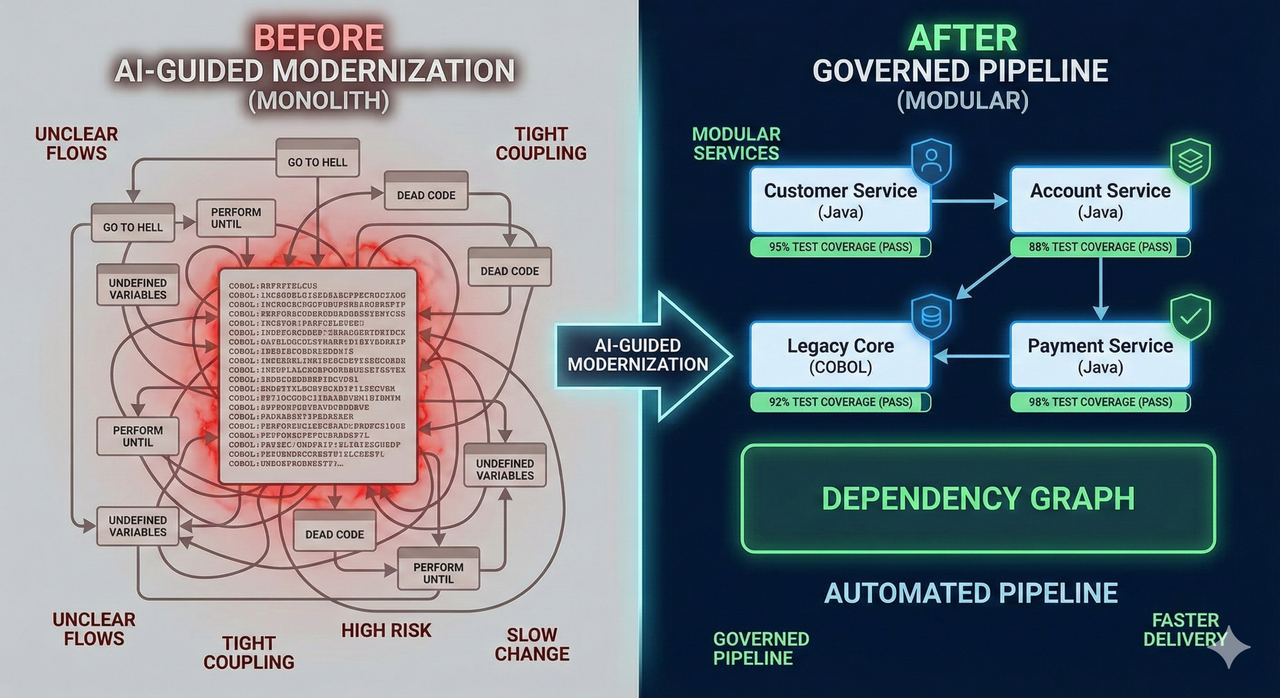
Before – “One Weekend AI Translation”
A mid-sized financial services team decided to modernize their COBOL billing reconciliation system using a generative AI code assistant. They skipped ADDI, fed the entire COBOL source to the AI, and generated Java over a weekend. There were no equivalence tests. On Monday morning, they promoted to a staging environment.
By Tuesday, the batch reconciliation job was producing totals that didn’t match COBOL output by consistent but small amounts. Root cause: the AI had translated COMP-3 packed decimal arithmetic to standard Java double, introducing floating-point rounding errors across 800,000 transactions per night. Rolling back took three days. The CTO was not pleased.
After – “Governed watsonx + ADDI Pipeline”
The team restarted. This time:
- They ran IBM ADDI across the full billing application—COBOL, JCL, DB2 tables, VSAM files, copybooks. ADDI revealed that the reconciliation logic lived in three specific COBOL paragraphs across two programs, sharing one critical copybook.
- They used IBM watsonx Code Assistant for Z to generate a natural-language explanation of those paragraphs. The COBOL SME spotted that the AI initially mischaracterized a COMP-3 accumulator as a standard integer—this was corrected before any Java was generated.
- The assistant refactored the two COBOL programs into a single modular service, then generated a Java equivalent using
BigDecimalfor all monetary arithmetic. - Equivalence tests were generated by the assistant and extended with 90 days of production transaction data. All tests passed.
- The Java service was deployed alongside COBOL, routing 5% of traffic initially, with COBOL as fallback. After two weeks of clean parallel runs, COBOL was decommissioned for that function.
Zero incidents. Auditable trail. Replicable template for the next service.
Troubleshooting Checklist: IBM COBOL AI Modernization
Use this as a quick runbook under pressure. If any item is unchecked, stop before promoting.
- ☐ Discovery complete in ADDI — All COBOL, JCL, copybooks, DB2/VSAM artifacts scanned and indexed?
- ☐ Scope properly bounded — Modernization target is a single business function, not a multi-domain monolith?
- ☐ AI explanations validated by COBOL SME — Natural-language explanations reviewed and approved for accuracy of business rule interpretation?
- ☐ Refactoring boundaries verified — Service splits align with real transaction boundaries, batch job steps, and IBM Z SLAs?
- ☐ Data type handling confirmed — COMP-3/packed decimal, binary fields, and file record layouts correctly mapped in generated Java?
- ☐ Interoperability confirmed — Generated code tested against CICS, IMS, DB2, z/OS batch as applicable?
- ☐ Semantic equivalence tests passing — All test scenarios including edge cases passing against production-like datasets?
- ☐ CI/CD gates in place — Static analysis, approvals, and regression suites integrated into mainframe change pipeline?
- ☐ Governance documentation complete — Audit trail from ADDI analysis through SME approval to equivalence test results captured?
- ☐ Rollback plan defined and tested — Original COBOL can be re-activated if production issues emerge?
When to Use IBM COBOL AI – And When Not To
Choosing your targets wisely is itself a form of troubleshooting. Not every COBOL component benefits from AI-assisted modernization.
Ideal Candidates
- High-change business logic modules — Components that change frequently due to regulatory updates, product changes, or business rule evolution. These benefit most from the maintainability of Java and AI-assisted documentation.
- Well-understood services with clear boundaries — COBOL programs with explicit inputs and outputs, limited copybook sharing, and accessible SME knowledge are the safest starting points.
- Documentation and knowledge transfer targets — Any COBOL section where tribal knowledge is at risk of walking out the door is an immediate AI explanation candidate, regardless of whether transformation is planned.
Situations Where Manual Approaches Still Win
- Highly optimized system-level code — Performance-critical COBOL exits, sort routines, and z/OS system interfaces are often hand-tuned in ways that AI will not replicate correctly. Leave these to experienced platform engineers.
- Low-change, high-risk core routines — If a COBOL program runs reliably, rarely changes, and sits at the center of your most critical workloads, the risk/reward of AI modernization is poor. Document it with AI; don’t transform it without compelling business justification.
- Areas with no test data or ambiguous business rules — AI amplifies uncertainty. Without test data and SME-validated rules, AI-generated code cannot be verified. Fix the knowledge gap first.
Final Recommendations for Mainframe Architects
After working through IBM COBOL AI modernization from both the tooling and the human sides, these are the principles I come back to:
Treat IBM watsonx Code Assistant for Z and IBM ADDI as a system, not individual tools. Neither delivers safe outcomes in isolation. ADDI provides the structured knowledge; watsonx provides the AI-assisted execution IBM watsonx Code Assistant for Z . Together, they form a governed modernization pipeline that keeps humans in control of the decisions that matter.
Start with understanding before you start with transformation. The explanation and documentation capabilities of the assistant pay dividends immediately—even if you never transform a line of COBOL to Java. Investing in that understanding phase also makes every subsequent refactoring decision more confident.
Semantic equivalence testing is not optional. It is the only objective confirmation that your AI-generated code does what your COBOL does. Build the test discipline into your pipeline from day one, not as a cleanup task at the end of the project IBM COBOL Modernization Overview .
Set honest expectations with stakeholders. AI accelerates mainframe modernization. It does not eliminate the need for COBOL expertise, governance discipline, and phased deployments. The teams that succeed with IBM COBOL AI are the ones that combine modern tooling with deep institutional knowledge—not the ones that treated a language model as a substitute for it.
Leave a Reply