
AI Meeting Notes 2026: Catch Every Small Detail
Nothing triggers imposter syndrome quite like sitting in front of a client, realizing your AI meeting bot dropped a critical requirement, and having to awkwardly ask them to repeat themselves—or worse, making a strategic error based on an AI hallucination. In my 33 years of IT experience, I have seen professionals scramble through poorly generated summaries minutes before a major presentation. When clients ask me, “How should I choose an AI meeting-note app to find small details in long meetings,” I tell them it is no longer about just getting a transcript; it is about building a retrievable knowledge base.
How should I choose an AI meeting-note app to find small details in long meetings is a process of prioritizing tools with a searchable memory layer over those that just generate basic summaries. For example, a proper tool instantly retrieves exactly what was decided about the Q3 budget across three weeks of previous meetings rather than forcing you to read through dozens of separate documents.
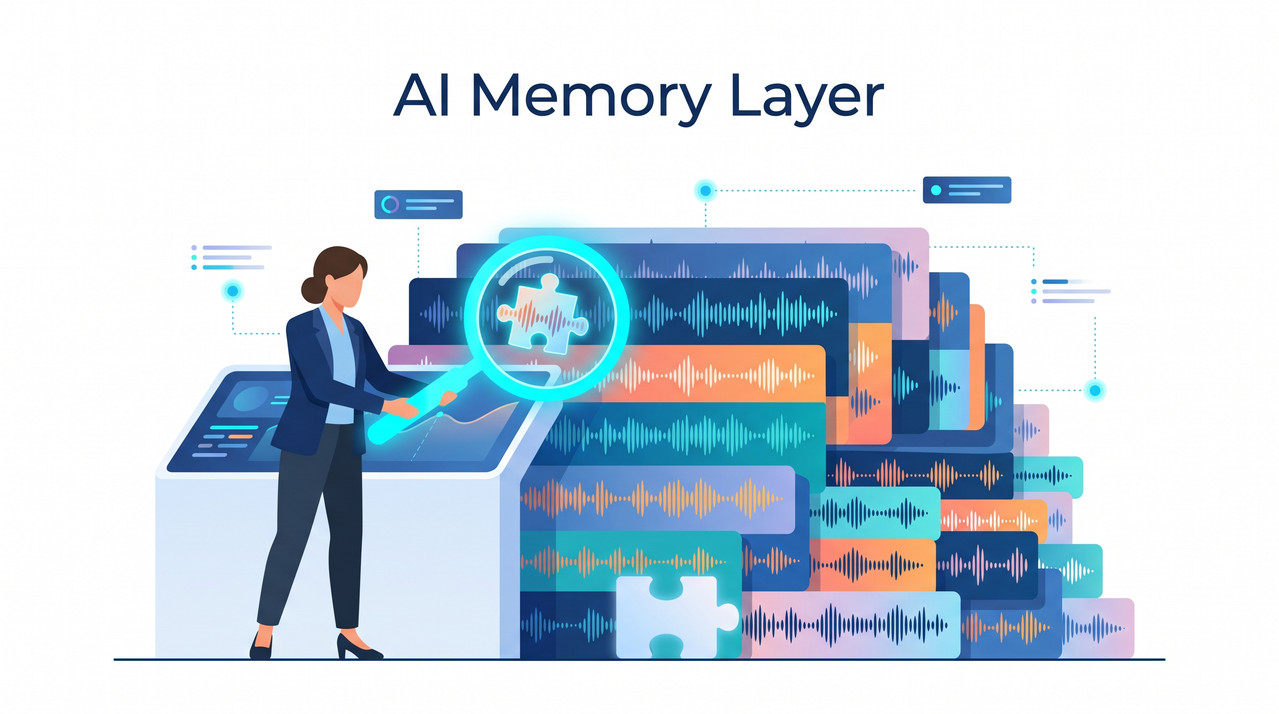
If you are wondering how should I choose an AI meeting-note app to find small details in long meetings, you must move beyond legacy transcription software. The landscape of AI tools has shifted dramatically, and the tools that worked in 2023 will leave you dangerously exposed today. You need a system designed for precision recall.
Quick Answer: Finding Nuance in Long Meetings
Quick Answer
How should I choose an AI meeting-note app to find small details in long meetings? To reliably find small details in dense, hour-plus meetings, you must choose an AI app built with a “memory layer” and semantic search. Basic notetakers generate isolated summaries that aggressively compress information, whereas advanced tools index your entire meeting history by context, letting you retrieve granular technical metrics instantly.
For a deeper dive into resolving software selection issues, you can check out our complete guide on troubleshooting AI deployments.
The Root Cause: Why Standard AI Summaries Fail
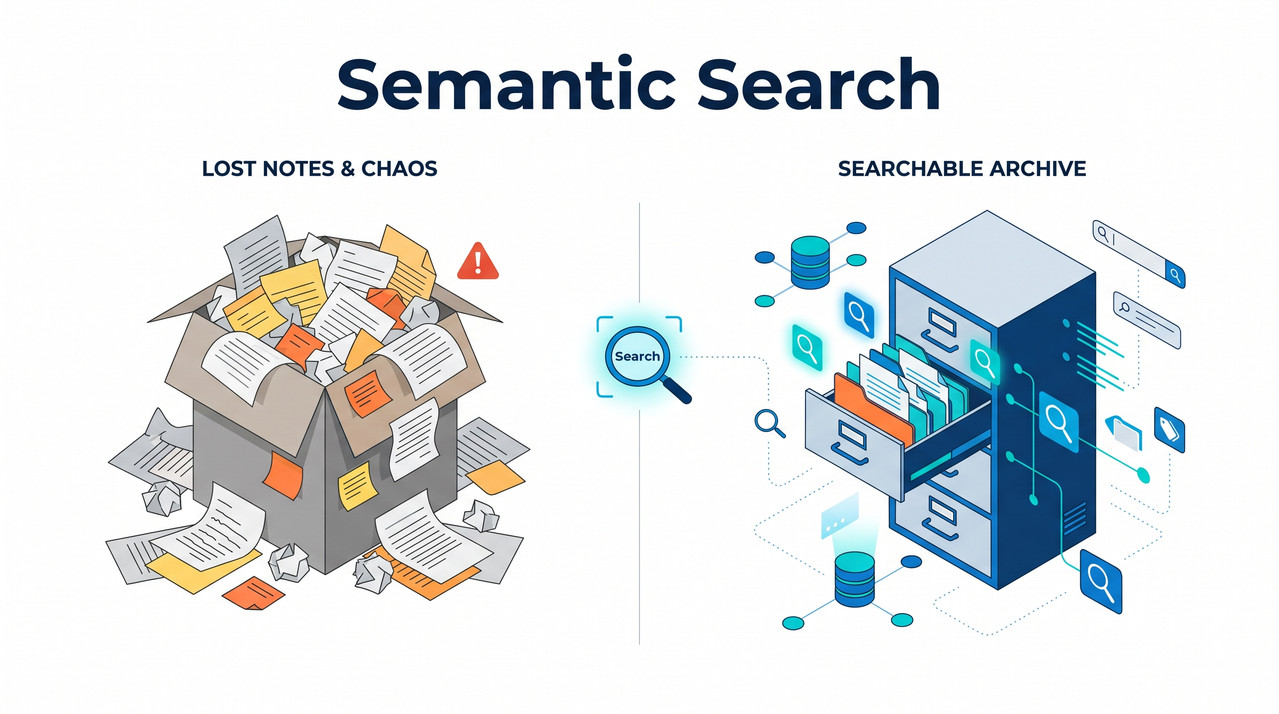
Before we answer how should I choose an AI meeting-note app to find small details in long meetings, we have to look at why current solutions are breaking down. In my tests deploying these systems for enterprise clients, the failure point is almost always the summarization engine itself.
Aggressive Compression vs. LLM Synthesis
Standard tools are designed to compress a 60-minute discussion into a five-bullet structured output. This sounds great for a quick glance, but it effectively erases 90% of the technical nuances and critical micro-decisions discussed deep within the call.
When you compress data that aggressively, you lose the “why” behind a decision. You might get an action item that says “Update server architecture,” but lose the 15-minute debate about why AWS was chosen over Azure for this specific workload.
To prevent this data loss, you need advanced LLM synthesis to preserve these layers. Proper synthesis does not just delete words to make a document shorter; it understands the hierarchy of information.
It keeps the broad strokes for the executive summary but retains the deep technical metrics in a linked, searchable format. When asking how should I choose an AI meeting-note app to find small details in long meetings, ensuring the tool uses synthesis rather than aggressive truncation is step one.
The Danger of Isolated Transcripts
The mistake I see most is treating every meeting as an isolated event. Relying on exact keyword searches in a raw transcript usually leads to coming up empty if you don’t remember the exact phrasing used in the room.
Consider this real test scenario from my recent deployments. A project manager was trying to find a specific budget number mentioned weeks ago. They searched their raw transcripts for “Q3 infrastructure budget reduction” and got absolutely nothing.
Here is what that looks like in practice:
Query: "Q3 infrastructure budget reduction"
Searching transcript: Weekly_Sync_Oct12.txt
Result: 0 matches found.
Error: Exact keyword string not present in document.
(Illustrative example)
The team had actually said, “we need to trim the cloud spend for the third quarter.” Because standard tools lack contextual awareness, the search failed completely.
This is why, when figuring out how should I choose an AI meeting-note app to find small details in long meetings, you must abandon tools that isolate transcripts.
How should I choose an AI meeting-note app to find small details in long meetings (Step-by-Step)
The market is flooded with tools claiming to use AI, but very few are actually designed for granular recall. Based on my hands-on testing, here is the exact step-by-step framework I use to evaluate these tools.
If you want to know how should I choose an AI meeting-note app to find small details in long meetings, follow this methodology strictly.
1. Prioritize Semantic Search over Keyword Matching
Choose tools that index notes by context and meaning. This ensures you can retrieve granular details and perform accurate action item extraction even if stakeholders used different terminology during the call.
As noted by industry experts, prioritizing this kind of contextual indexing is what separates a modern assistant from a legacy dictation tool Vibe.us. Semantic search uses vector databases to understand the relationship between words.
If you search for “budget,” the AI knows to also look for “spend,” “cost,” “financials,” and “burn rate.”
- Bad Example: Searching a raw transcript for exact keywords and coming up empty because the client said “cost reduction” instead of “budget cut.”
- Good Example: Asking a semantic search assistant “What did we decide about the Q3 budget?” and having it instantly surface the exact timestamp and context, regardless of the exact phrasing.
When clients ask how should I choose an AI meeting-note app to find small details in long meetings, my first question is always: “Does it understand synonyms?” If the answer is no, move on.
2. Look for a Cross-Meeting “Memory Layer”
Ensure the app can carry context forward to build a fully searchable meeting archive. The tool must search across your entire organizational history rather than treating each transcript in a vacuum.
A true memory layer transforms a passive recording into an active knowledge graph. If you have a standing weekly meeting with a client for six months, the AI should understand the narrative arc of that project Evernote.
When evaluating how should I choose an AI meeting-note app to find small details in long meetings, test the tool’s ability to recall past events.
Ask the AI, “What were the three roadblocks we identified last month, and did we resolve them?” A basic tool will fail. A tool with a memory layer will cross-reference four different transcripts and give you a synthesized answer.
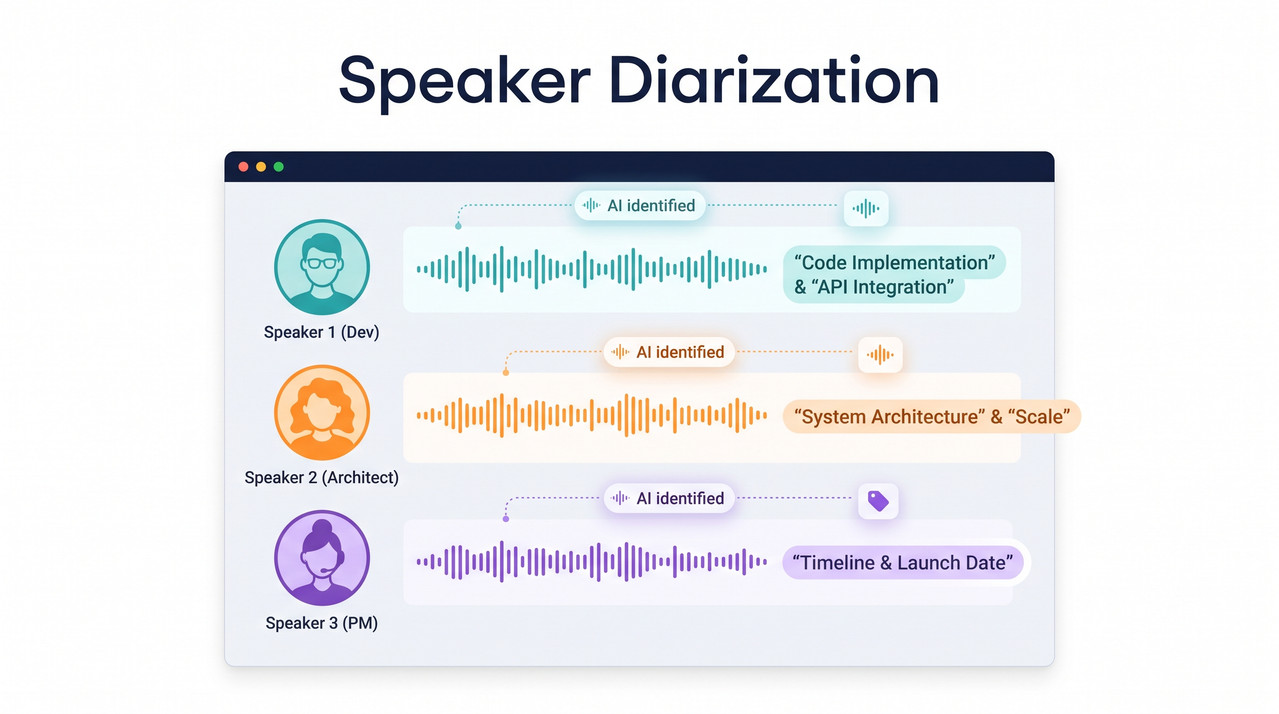
3. Verify Context-Aware Speaker Diarization
Select models that actively use the surrounding conversation for contextual disambiguation. Accurate speaker diarization ensures the AI correctly assigns highly specific technical terms or company jargon to the right stakeholder.
Diarization is the technical term for the AI’s ability to figure out who is talking. In a room with five people, this is incredibly difficult, especially if microphones are picking up cross-talk.
If the AI attributes a critical compliance requirement to the junior designer instead of the legal counsel, your notes are not just useless; they are dangerous.
When determining how should I choose an AI meeting-note app to find small details in long meetings, you have to verify that the tool uses the context of the conversation to identify the speaker, not just the pitch of their voice.
4. Run a Real-World Transcription Accuracy Stress Test
Instead of trusting blanket 99% accuracy claims, test the tool’s indexing against your actual meeting conditions. Evaluate how it handles overlapping speakers, background noise, and your specific industry vocabulary.
Vendor marketing pages always boast near-perfect transcription accuracy, but these tests are run in sterile environments Granola. Your meetings feature people eating lunch, typing loudly on mechanical keyboards, and talking over each other on poor Wi-Fi connections.
To figure out how should I choose an AI meeting-note app to find small details in long meetings, you must run a stress test.
Load a recording of your messiest, most chaotic project sync into the tool. Then, try to extract a single, obscure metric mentioned at the 43-minute mark. If the tool fails your stress test, it will fail in production.
Comparing Architectures: How should I choose an AI meeting-note app to find small details in long meetings using Data
To make this tangible, I have broken down the architectural differences between a standard app and the kind of advanced system you actually need.
When you ask how should I choose an AI meeting-note app to find small details in long meetings, use this table as your exact procurement checklist.
| Feature / Capability | Standard Meeting Bot | Advanced AI with Memory Layer |
|---|---|---|
| Search Architecture | Exact keyword matching only. Fails on synonyms. | Semantic vector search. Understands intent and context. |
| Data Retention | Isolated transcripts. No cross-meeting context. | Persistent memory graph spanning all historical meetings. |
| Summarization Style | Aggressive extractive compression (deletes data). | Deep LLM synthesis (preserves nuance and linked data). |
| Speaker Identification | Basic audio-pitch diarization. Fails on cross-talk. | Context-aware diarization using conversational clues. |
| Detail Retrieval | Manual reading required for micro-decisions. | Instant natural language querying across all past projects. |
If you are serious about solving the problem of how should I choose an AI meeting-note app to find small details in long meetings, you cannot compromise on the right-hand column of this table.
Every feature in the advanced column is designed specifically to prevent data loss. The standard column is designed merely to save you five minutes of typing. There is a massive difference in business value.
Why Technical Professionals Struggle with Tool Selection
In my experience, technical professionals often over-index on integration features rather than core retrieval capabilities. They will ask if it connects to Jira or Slack before they verify if the semantic search actually works.
This is the wrong approach to how should I choose an AI meeting-note app to find small details in long meetings. Integrations are useless if the data being pushed to those platforms is highly compressed, inaccurate, or missing vital context.
I always advise my teams to focus on the data layer first. Can you retrieve a specific detail from a meeting that happened three months ago? Can you do it in under ten seconds?
If the answer is yes, then you have found a tool worth using. If you are still struggling with how should I choose an AI meeting-note app to find small details in long meetings, remember that the goal is perfect recall, not just automated formatting.
The Impact of Missing Small Details
Let’s discuss why this matters so much. Missing a small detail isn’t just an administrative annoyance; it can derail entire project timelines.
Imagine a software development meeting where the client casually mentions that their legacy API only accepts XML, not JSON. If your basic AI summary aggressively compresses that 30-second exchange out of the final notes, your engineering team might spend three weeks building the wrong data pipeline.
When you ask how should I choose an AI meeting-note app to find small details in long meetings, you are really asking how to protect your project margins. A tool with a searchable archive ensures that when the engineers later ask, “Wait, what format did they need?”, you can instantly pull up the exact timestamp of that XML requirement.
Overcoming the Hidden Fears of AI
We also have to address the psychological aspect of using these tools. The hidden fear of looking incompetent because you trusted an AI hallucination is very real. I have felt it myself when a tool confidently summarized a meeting incorrectly.
To combat this, how should I choose an AI meeting-note app to find small details in long meetings? You choose one that provides radical transparency.
The best tools don’t just give you an answer; they give you a clickable citation directly to the audio recording. If the AI says the budget is $50,000, you should be able to click that number and hear the client actually say it.
This eliminates the fear. You are no longer blindly trusting a black box; you are using an intelligent index to quickly navigate to verifiable truth Vibe.us.
Frequently Asked Questions
Understanding how should I choose an AI meeting-note app to find small details in long meetings requires addressing some common misconceptions. Here are the questions I get asked most frequently by IT directors and project managers.
Q1: What is the difference between a standard meeting bot and a memory layer?
A1: A standard meeting bot generates a one-off summary of a single call. Once that summary is generated, the bot essentially “forgets” what happened. A memory layer, on the other hand, connects all your historical transcripts into a unified database. This allows you to ask questions spanning multiple weeks or projects to find hyper-specific details. Instead of searching twenty different documents, you query one intelligent system that remembers every conversation your organization has ever recorded, synthesizing answers across months of data.
Q2: Why does keyword search fail for finding small meeting details?
A2: Keyword search requires you to remember the exact phrasing used during the meeting. If you search for “deployment delay,” but the team actually said “pushing back the launch,” a keyword search will return zero results. Semantic search understands the intent and meaning behind your query, surfacing the right moment even if the team used synonyms, acronyms, or completely different phrasing. It maps the concept of a “delay” to “pushing back,” ensuring you never lose a detail just because you forgot the specific vocabulary used in the room.
Q3: How do I prevent AI hallucinations when searching for meeting metrics?
A3: Choose an AI note app that links its answers directly to clickable timestamps in the original transcript. This allows you to instantly verify the context and ensure the AI didn’t invent the data point. In my IT deployments, I absolutely forbid the use of AI tools that provide summaries without deep-linking back to the source audio. If you cannot click on a generated metric and hear the human being actually say the words, the tool is a liability. Verification is the only true defense against hallucinations.
Q4: Can these AI tools handle overlapping speakers in long discussions?
A4: The best tools utilize advanced speaker diarization to separate voices, analyzing audio channels to distinguish who is speaking. However, you must run a real-world stress test with your team to verify that the transcription accuracy holds up when multiple people talk at once. No AI is perfect when three people shout simultaneously over a bad connection. Advanced tools mitigate this by using contextual clues—understanding that the person talking about legal compliance is likely the lawyer, even if their voice is briefly overlapping with the project manager’s audio feed.
Leave a Reply