
AI Context Windows Explained (2026 Guide)
I’ve spent over three decades in IT, and if there’s one pattern that’s remained constant across every generation of technology I’ve worked with, it’s this: the more impressive a spec sheet number looks, the more likely people are to misunderstand what it actually guarantees. AI Context Windows Explained: Why Long Conversations Break Down is exactly that kind of misunderstanding, and I want to walk through the real mechanism, because nothing about your long AI conversation falling apart means you’re using the tool wrong.
AI Context Windows Explained: Why Long Conversations Break Down means understanding that model accuracy degrades as a conversation grows, long before it reaches its advertised token limit, due to a documented phenomenon called context rot. For example, Anthropic’s own official documentation states plainly that “as token count grows, accuracy and recall degrade,” and independent testing found an AI fabricating an entire hallucinated source at just 65% of its stated context capacity.
If your AI assistant has started contradicting itself or forgetting instructions you gave just a few messages ago, despite running on a model advertised with a “1 million token context window,” I want to be direct with you: nothing is broken, and you’re not misusing the tool. You’re experiencing a well-documented, measurable phenomenon that happens to every user of every major AI model.
What Are AI Context Windows, and Why Do Long Conversations Break Down?
Quick Answer
An AI context window is the total amount of text a model can reference at once, including the entire conversation history re-sent with every message. Long conversations break down because of “context rot” — a documented phenomenon where accuracy and recall degrade as token count grows, well before hitting the advertised limit. Independent testing found measurable errors starting as early as 46,000 tokens, far below marketed maximums of 200,000 or even 1 million tokens.
In my years troubleshooting systems, I’ve learned that the gap between a spec sheet maximum and real-world reliable performance is almost always where the actual engineering problem lives, and context windows are no exception. The number on the box tells you the ceiling. It tells you nothing about how the system behaves as it approaches that ceiling.
Why Does AI Performance Degrade Before Reaching the Context Limit?
Before I get into fixing this, I want to explain the actual mechanism, because once you understand why it happens, the fix becomes obvious rather than counterintuitive.
Context Rot Is an Officially Acknowledged Phenomenon
Anthropic’s own documentation states directly that “more context isn’t automatically better. As token count grows, accuracy and recall degrade, a phenomenon known as context rot.” Claude Platform Docs I find this detail worth sitting with specifically because it’s coming from the company that builds the model, not a frustrated user speculating about what’s going wrong.
The “Lost in the Middle” Effect Explains Why
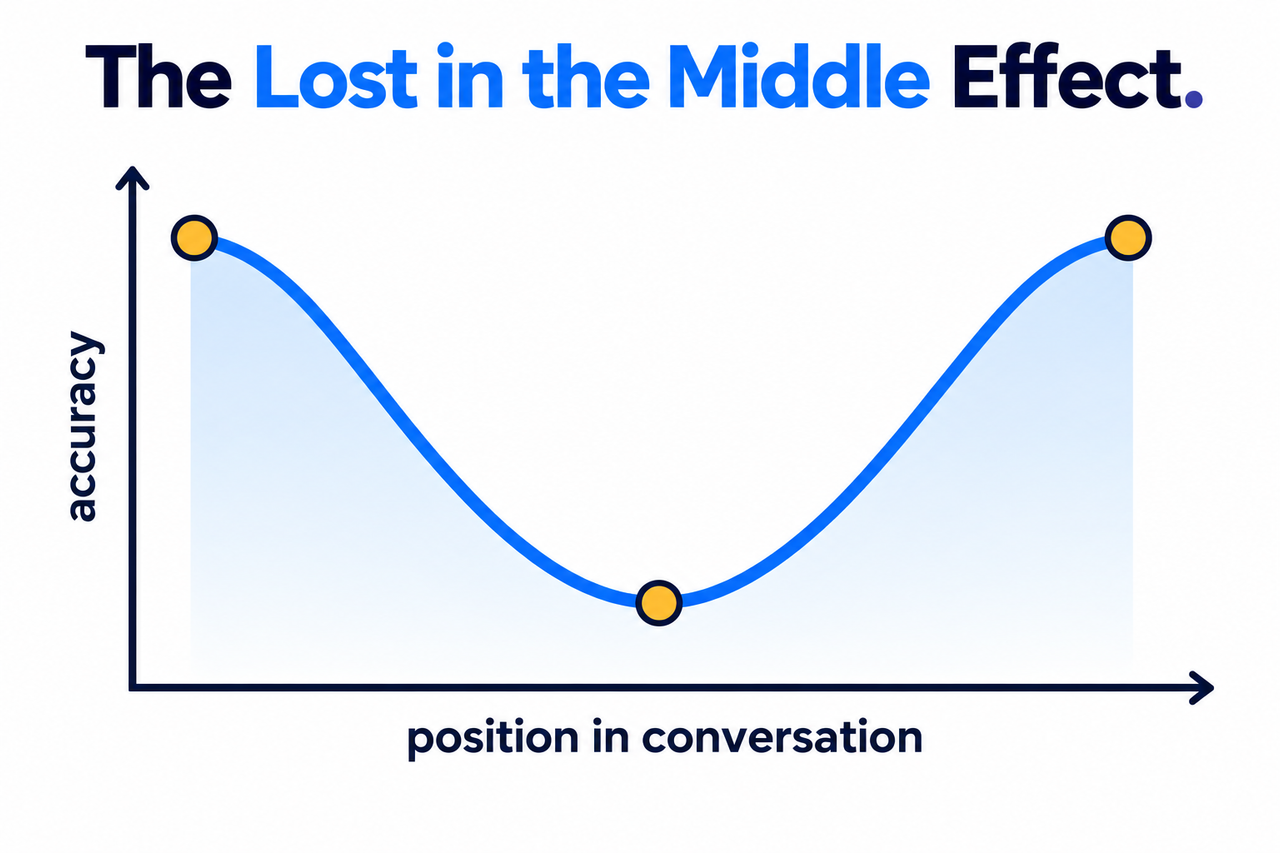
Peer-reviewed research from Stanford and UC Berkeley found that language model performance “is often highest when relevant information occurs at the beginning or end of the input context, and significantly degrades when models must access relevant information in the middle of long contexts, even for explicitly long-context models.” arXiv This creates what researchers describe as a U-shaped performance curve — strong at both ends, weak in the middle.
Your Earliest Instructions Are at the Highest Risk
Because original instructions typically sit at the start of a long conversation, they land in exactly the position most vulnerable to being lost as the conversation grows and that early content shifts further into the statistically weak middle zone. This is precisely why the constraint you set at the very beginning of a long session is often the first thing to quietly disappear.
How Bad Does This Actually Get in Real Testing?
I want to move past the abstract research finding and show you what this actually looks like in a real, documented test, because the numbers here genuinely surprised me the first time I read them. Independent hands-on testing found “a serious context pollution case” at just 46,000 tokens Developer Way — a fraction of what most current models advertise as their maximum.
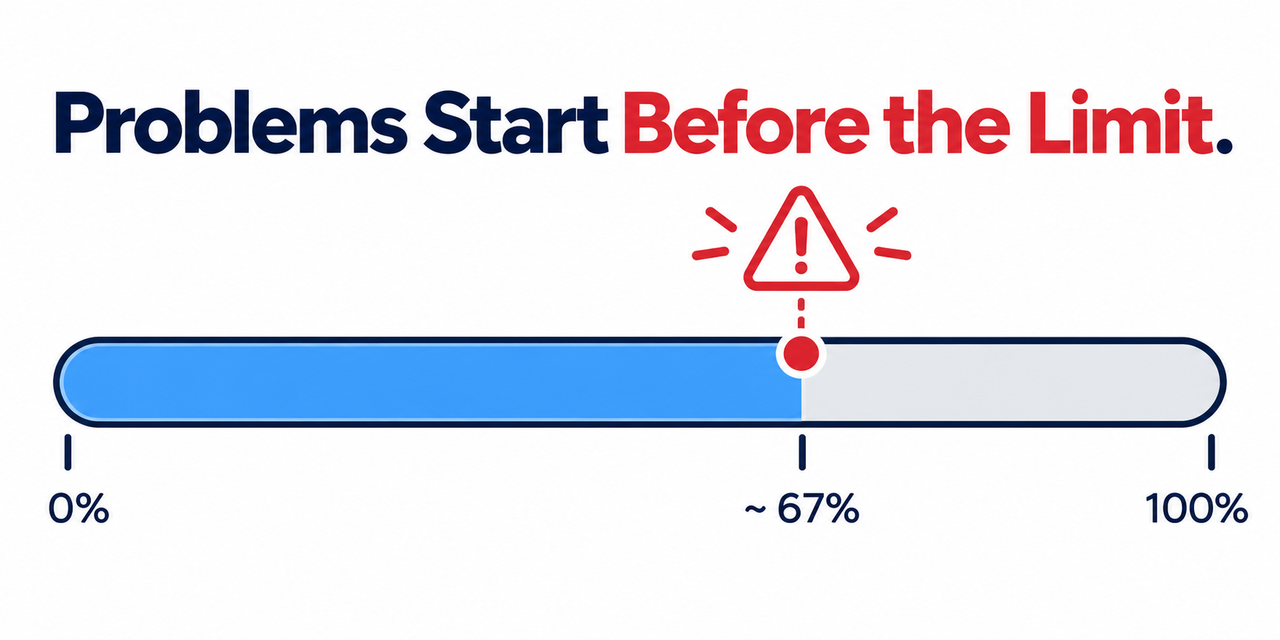
At 130,000 tokens, which was only 65% of that specific model’s 200,000-token limit, the documented results were dramatic: the AI “returned between 16 and 19 article summaries instead of 20,” specifically dropping content “from the middle of the list,” and in one run, it fabricated an entire extra row in its output table — a real article title that existed elsewhere but was never actually included in that conversation at all. Developer Way That’s not a minor quality dip. That’s the model inventing a source and presenting it as if it had been provided.
Documented Test Result at 65% Context Capacity

Expected output: 20 article summaries
Actual output: 16-19 article summaries, content dropped from the middle

Additional finding: one fabricated article title appeared in the
output table that was never part of the conversation's provided
content, apparently pulled from the model's training data.
I want to be clear this isn’t an illustrative example — this is a real documented finding from independent testing, and it’s exactly the kind of failure that would be genuinely dangerous if it slipped into client-facing work without review.
AI Context Windows Explained: Why Long Conversations Break Down (And How to Fix It)
Here’s the sequence I’d walk through with anyone experiencing this exact frustration mid-task.
- Recognize the actual symptom pattern. Contradicting earlier statements or forgetting a constraint from several messages back is documented, expected behavior, not a sign of user error.
- Don’t argue with the model to self-correct. Adding more messages to fix a degraded conversation adds more tokens to an already-strained context, typically making the problem worse.
- Start a new conversation for a new task. Measurable degradation has been documented starting as early as 10,000 tokens on some tasks, long before any advertised maximum.
- Re-state key constraints explicitly in the new conversation. There is no persistent memory outside of what a specific product explicitly engineers, so assume nothing carries over automatically.
- Don’t assume a bigger context window means better results. Independent testing found content dropping and fabricated details appearing at just 65% of a stated context limit.
- Understand what a real context error looks like. Developer-facing tools like Claude’s API return a specific
400 invalid_request_errorwith the message “prompt is too long” when a limit is genuinely exceeded. Claude Platform Docs - Prefer dedicated chat apps for long-running work. Official chat interfaces actively fight context rot with techniques like context compaction that aren’t present in a raw, unmanaged API conversation.
I want to expand on step 2, because it’s the instinct I see people reach for most often, and it’s precisely backward. When the AI starts making mistakes, the natural reaction is to correct it in the same conversation, explain what went wrong, and ask it to try again. Every one of those correction messages adds more tokens to a context that’s already struggling, which can actively deepen the problem you’re trying to solve.
What Does the Real Error Look Like in Practice?
I always prefer quoting a vendor’s own technical documentation directly rather than paraphrasing, especially for something as precise as an error condition. Claude’s official documentation confirms the exact failure mode: “If the input alone already exceeds the model’s context window, the API returns a 400 invalid_request_error (‘prompt is too long’) on every model… If generation then reaches the context window limit, it stops with stop_reason: 'model_context_window_exceeded'.” Claude Platform Docs
HTTP 400 invalid_request_error
Message: "prompt is too long"

OR, mid-generation:
stop_reason: "model_context_window_exceeded"
This is the genuine, hard failure case — the conversation has actually exceeded the technical limit. Context rot, by contrast, is the much more common and much sneakier problem, because it produces degraded quality with no error message at all, well before you’d ever hit this hard limit.
Why Doesn’t the AI Just “Remember” Things the Way a Person Does?
I think this is the conceptual gap that trips up the most people, so I want to address it directly. An AI conversation doesn’t carry memory in any persistent sense the way a human brain does. Every single message you send re-transmits the entire conversation history from the beginning, which means context truly is the only thing the model has access to — there’s no separate recall mechanism operating underneath it.
This explains why context rot feels so counterintuitive at first: you’d expect a system with access to the full conversation history to simply “remember” everything in it equally well. But the attention mechanism that lets a model weigh different parts of its input doesn’t treat every token with equal reliability, and as the volume of re-transmitted history grows, the statistical weight given to any single piece of information — especially something from early in a long conversation — gets diluted.
What’s the Practical Difference Between Context Rot and Hitting the Token Limit?
I think it’s worth drawing this distinction clearly, because they’re genuinely different problems that call for different responses. Hitting the actual token limit produces a hard, visible error — the API refuses the request outright, or generation stops mid-response with a specific status code.
Context rot produces no error at all. The conversation continues normally, the AI keeps responding fluently, and nothing in the interface tells you anything has degraded. The only signal you get is the quality of the output itself declining, which is exactly why this problem catches people off guard: you’re looking for an error message that will never appear, because the system isn’t failing in the technical sense. It’s just performing worse while appearing to function perfectly normally.
| Failure Type | What You See | What’s Actually Happening |
|---|---|---|
| Hard token limit exceeded | Explicit error message or stopped generation | Conversation genuinely exceeds the model’s maximum capacity |
| Context rot | No error at all, just declining quality | Accuracy degrading well before the actual limit is reached |
| Lost in the middle | Forgotten constraints from early in the conversation | Early information statistically weakened as conversation grows |
Bad vs. Good Way to Handle a Long AI Conversation
Let me put these two approaches side by side, because the difference here is the entire difference between fighting a losing battle and solving the actual problem.
Bad: “My AI coding assistant has a 1-million-token context window, so I just kept the same conversation running for eight hours straight across a dozen different features, and I don’t understand why it started contradicting instructions I gave at the very beginning of the session.”
Good: “I noticed the AI started giving inconsistent answers after my conversation covered several unrelated topics, so rather than arguing with it to self-correct, I started a fresh conversation, explicitly re-stated the two or three constraints that actually mattered for my current task, and immediately got more reliable output again.”
The bad approach treats the advertised maximum as a performance guarantee. The good approach treats conversation length as a resource to actively manage, regardless of how large the stated limit happens to be.
How Should You Structure Long-Running Work to Avoid This Problem?
Given everything above, I’d recommend building a habit of segmenting long tasks deliberately rather than letting a single conversation grow indefinitely. If you’re working through a multi-step project — coding several unrelated features, drafting different sections of a long document, or researching several distinct subtopics — treat each distinct chunk of work as its own conversation rather than one continuous thread.
For work that genuinely needs to reference earlier context, consider summarizing the key points from a prior conversation into a short, explicit brief at the start of a new one, rather than relying on the model to carry everything forward from a long prior session. This takes a few extra minutes, but it reliably produces better results than hoping a sprawling, multi-topic conversation will hold its accuracy throughout.
Does This Problem Affect Every AI Model Equally?
I don’t want to leave the impression that this is a flaw unique to one specific AI provider, because the underlying research makes clear this is a structural property of how these models process long inputs, not a bug limited to one company’s implementation. The “lost in the middle” research specifically tested multiple different model architectures and found the same degradation pattern across them, which tells you this is inherent to how attention works across long sequences, not something one provider has simply failed to solve while competitors have cracked it.
That said, I’d expect the exact severity and the specific token count where degradation becomes noticeable to vary somewhat between models and between providers’ different mitigation techniques, since companies are actively working on engineering solutions like improved attention mechanisms and smarter context management on top of the raw architecture. The practical takeaway stays the same regardless of which specific model you’re using: treat conversation length as a resource you actively manage, rather than assuming any particular provider has fully solved this problem simply because their marketing emphasizes a larger maximum token count than a competitor’s.
What Should Developers Specifically Do Differently?
If you’re building an application on top of an AI API rather than using a consumer chat interface directly, I think this problem deserves even more deliberate engineering attention, since you’re often the one responsible for managing conversation state rather than relying on a product team’s built-in mitigations. I’d recommend implementing your own conversation summarization logic once a thread crosses a reasonable token threshold, condensing earlier exchanges into a compact summary rather than carrying the full verbatim history forward indefinitely.
I’d also recommend actively monitoring token usage per conversation and triggering a deliberate reset or summarization step at a threshold well below the advertised maximum, rather than waiting for the hard API error to tell you a limit has been exceeded. Building in this kind of proactive context management is exactly the kind of system design decision that separates a production-ready AI application from one that degrades unpredictably under real user load, and it’s a far better position to be in than discovering the problem through confused user complaints after launch.
For a broader look at troubleshooting common AI tool limitations and getting more reliable results, see our complete guide to troubleshooting AI tools.
Frequently Asked Questions
Does a bigger context window mean the AI will never forget anything?
No — official documentation confirms accuracy and recall degrade as token count grows, a phenomenon called context rot, meaning problems can appear well before a conversation reaches its advertised maximum. Claude Platform Docs
Why does the AI forget instructions I gave at the start of a long conversation?
Peer-reviewed research shows information in the middle of a long context is retrieved less reliably than information at the very beginning or end, and as a conversation grows, your original instructions effectively shift into that weaker middle position. arXiv
Should I keep correcting the AI when it starts making mistakes in a long conversation?
No — adding more messages to argue with the model adds more tokens to an already-strained context and typically worsens the problem rather than fixing it.
At what point should I start a new conversation instead of continuing an old one?
Independent testing has documented measurable degradation starting as early as 10,000 tokens on some tasks, so starting fresh once a conversation shifts to a new topic is a reasonable habit well before any advertised limit. Developer Way
What’s the actual error message when an AI conversation exceeds its context limit?
Developer tools like Claude’s API return a 400 invalid_request_error with the message “prompt is too long,” or stop generation mid-response with a model_context_window_exceeded status. Claude Platform Docs
Can the AI accidentally make up information in a long conversation?
Yes — independent testing documented a case where an AI fabricated an entire source title that was never part of the conversation, apparently pulled from its training data and blended in as if it had been provided. Developer Way
Leave a Reply