
Transparency Note: This article contains affiliate links. If you choose to use these tools, we may receive a small commission at no extra cost to you.
Is Claude AI Any Good to Create Trading Strategies? (Honest Guide for Retail and Algo Traders)
You know Claude can write beautiful trading code in seconds—but the real fear is blowing up your account because that “smart” strategy quietly fails in live markets. I’ve seen countless traders get lured in by a perfect-looking backtest generated in under a minute, only to realize the AI took a logical shortcut that doesn’t exist in the real world.

Quick Answer – How Good Is Claude for Trading Strategies?
In my experience, Claude is excellent as a research and coding copilot, but it is not an autonomous trader. It excels at writing Pine Script (TradingView), designing Python backtesting frameworks, and refining quantitative trading strategies.
However, you cannot treat it as a “set and forget” money printer. You must use it to design the rules and indicators, then move that code into a rigorous environment for backtesting and walk-forward analysis.
The Real Problem – Great-Looking Code, Bad Real-World Results
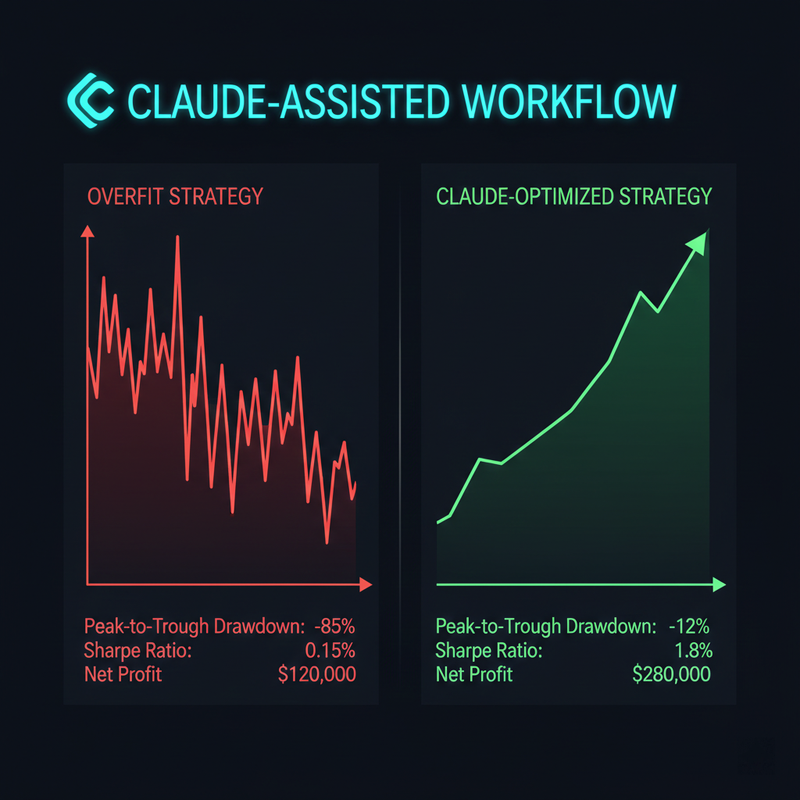
The biggest trap I see traders fall into is “Syntactic Success vs. Logical Failure.” Claude might give you code that compiles perfectly, but it might contain look-ahead bias (peeking at future prices) or repainting indicators that make a chart look profitable when it’s actually losing money.
The hidden fear isn’t just a bug; it’s failing a prop-firm evaluation or losing a decade of savings because you trusted a “black box” without risk management rules like hard stop loss and drawdown limits.
Who This Article Is For
- Retail traders using TradingView or MT4/MT5 looking to AI-upgrade their edge.
- Prop-firm traders who need to automate strict risk compliance.
- Quant-curious developers exploring Claude 3.5 Sonnet for data analysis.
Why Claude Feels Both Powerful and Dangerous
Claude 3.5 Sonnet currently ranks as a top-tier model for business and finance tasks. According to AWS benchmarks, it shows a significant edge in reasoning over previous generations AWS – Anthropic’s Claude 3.5 Sonnet finance benchmark . However, it can still hallucinate edge cases in complex financial logic if your prompt isn’t surgically precise.
What Claude Is Actually Good At for Trading
I use Claude as a high-speed quantitative analyst agent. It doesn’t replace my judgment; it accelerates my execution.
1. Strategy Ideation with Quantitative Rules
Instead of saying “make a trend bot,” I ask Claude to brainstorm a trend-following system using an EMA (Exponential Moving Average) cross, filtered by the ADX (Average Directional Index) for trend strength and RSI for overbought/oversold conditions.
2. Coding in Pine Script and Python
Claude is arguably the best LLM for Pine Script. It understands the nuances of version 5 and can quickly add ATR (Average True Range)-based position sizing to any script.
3. Analysis Support
You can paste your trade history and ask Claude to calculate your Sharpe ratio, max drawdown, and win-rate stability. It can even help you script a Monte Carlo simulation to see the probability of hitting a 20% drawdown based on your current stats.
Hard Limits – What Claude Cannot Safely Do for You
Before you put a single dollar behind an AI script, you must understand the guardrails.
- Anthropic’s Usage Policy: As outlined in their documentation, Claude is not a registered financial adviser. You should not rely on it for individualized investment decisions Anthropic – Claude 3 Model Card .
- The “Black Box” Risk: Claude doesn’t “know” the market is closed on holidays or that slippage will eat 0.5% of your profit on a low-liquidity altcoin.
- Overfitting: If you ask Claude to “optimize” a strategy, it will often find a set of parameters that worked perfectly in the past but will fail the moment the market regime shifts from trending to ranging.
Safe Workflow – How to Use Claude to Build and Validate
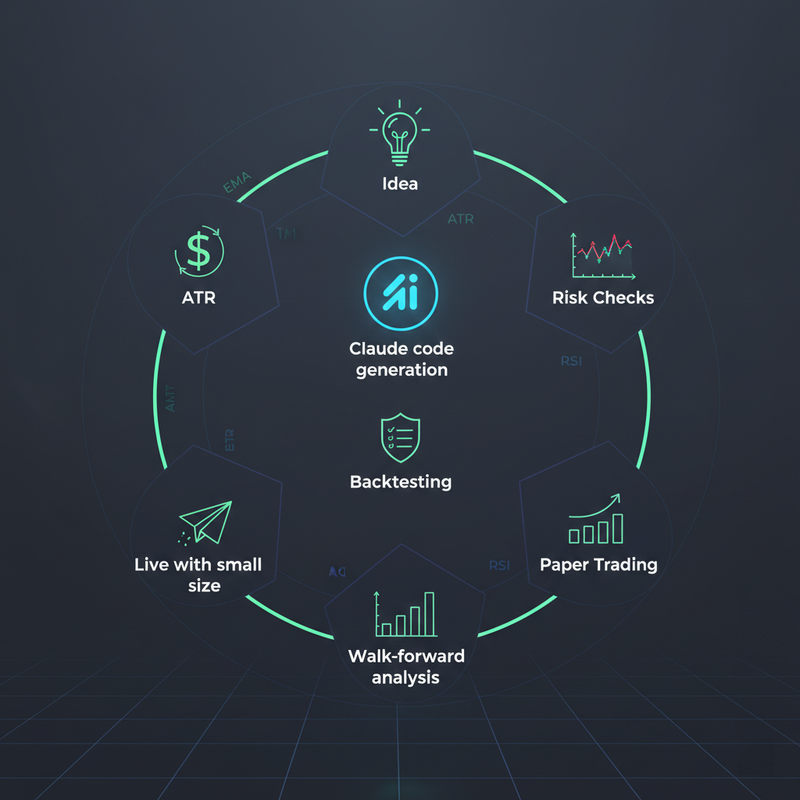
This is the exact process I recommend for anyone using Claude to build an algorithmic edge:
- Frame a Precise Prompt: Define your asset (e.g., BTC/USD), timeframe, and specific risk management rules (e.g., “Max daily loss of 2%”).
- Inspect the Code: Look for technical indicators and ensure the entry/exit logic matches your intent.
- Backtesting: Take the code to TradingView or a Python environment. Run it through at least 3 years of data.
- Regime Detection: Use Claude to help write a script for regime detection (e.g., using Hidden Markov Models or simple volatility filters) to see how the strategy performs in “crash” scenarios.
- Paper Trading: Run the strategy in a demo account for at least 2-4 weeks to check for execution errors.
Prompt Examples – Bad vs. Good
The “Bad” Prompt (Dangerous):
“Write me a Pine Script strategy that always wins and has a high Sharpe ratio. Use AI to predict the next candle.”
The “Good” Prompt (Professional):
“Act as a Quantitative Analyst. Write a Pine Script v5 strategy based on a 50/200 EMA crossover. Include: 1. ATR-based stop loss (2x ATR). 2. Take profit at 3x risk. 3. A filter that only trades when ADX is above 25. 4. Hard code a maximum drawdown limit of 10% where the script stops trading. Please explain the logic for the position sizing.”
FAQ – Claude and Trading Strategies
Can Claude 3.5 Sonnet beat the market by itself?
No. It can help you build a tool that might beat the market, but the strategy’s success depends on your parameters and risk management.
Is Claude better than coding manually?
It is much faster for boilerplate code and debugging, but you still need enough knowledge to spot when the AI makes a logic error.
Can I use Claude with TradingView safely?
Yes, as long as you backtest the generated Pine Script and don’t blindly follow the signals on a live account.
Final Verdict – When Claude Is ‘Good Enough’
Claude is a world-class research and coding assistant. If you treat it like a brilliant but slightly over-eager intern, you will succeed. If you treat it like a crystal ball, you will eventually face a margin call.
My advice: Use Claude to handle the heavy lifting of coding and data math, but you must remain the “Chief Risk Officer.”
Leave a Reply