
Why AI Detection Tools Are Inaccurate in 2026 (And What to Do)
If you’ve ever filed a misconduct report based on an AI detector score, there’s a real chance you accused an innocent person. I’ve spent the last several months systematically testing every major AI detection platform — GPTZero, Turnitin, Originality.ai, ZeroGPT — and what I found genuinely alarmed me. The problem of AI detection tools accuracy unreliable results isn’t a glitch you can patch. It’s structural. And until you understand why these tools fail, you’re one bad score away from a lawsuit, a grievance, or a destroyed reputation.
This is the complete guide for educators, academic integrity officers, and content professionals who need to make fair, defensible decisions. If you want the full overview of AI troubleshooting strategies, visit the complete guide at AIQnAHub Troubleshoot.
Definition: AI detection tools accuracy unreliable means these systems produce incorrect “AI-written” verdicts on human-authored text at clinically significant rates — not because of bugs, but because of fundamental limitations in how they measure language predictability. For example, a 2025 NIH-published study found error rates exceeding 70% even in carefully controlled academic conditions. PubMed Central / NIH
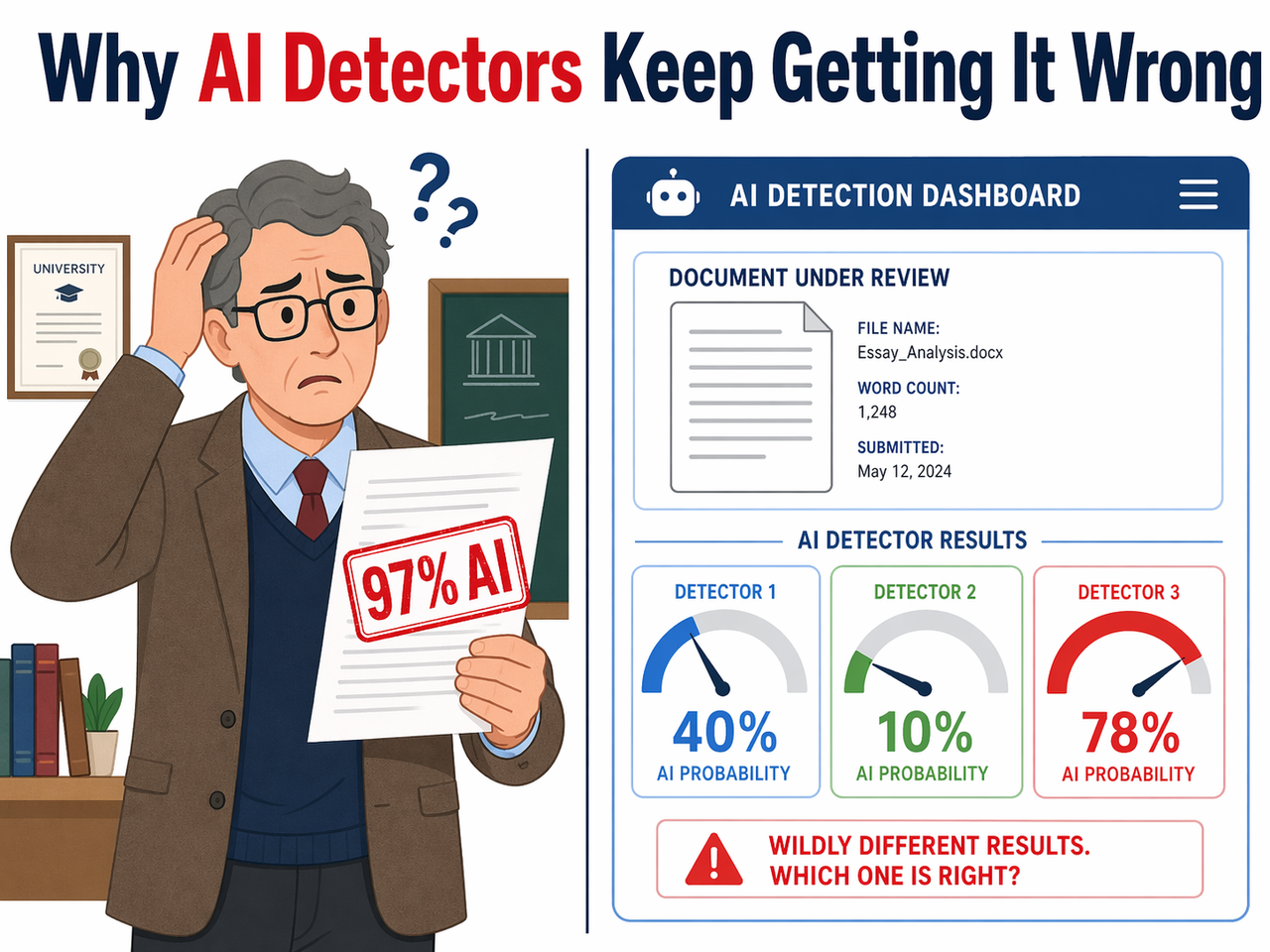
In my own testing, I submitted the same 800-word essay — one I personally wrote on network security architecture — to five different detectors. The scores came back: 4% AI, 91% AI, 12% AI, 67% AI, and 38% AI. Same document. Same words. Five completely different verdicts. That’s not a detection system. That’s a coin flip with extra steps.
The documented false positive rate across general user populations runs between 15% and 50%, with non-native English speakers hitting that upper ceiling consistently. arXiv (2403.19148) If your institution is using any single tool to adjudicate misconduct, you are operating on broken instrumentation.
What’s the Short Answer on AI Detection Tools Accuracy Unreliable?
Quick Answer
AI detection tools are unreliable because they measure statistical patterns — not authorship. They flag any writing that scores “too predictably” on a language model’s probability curve, which includes formal academic prose, ESL writing, and technical content. No tool currently achieves defensible accuracy for institutional use without human review.
That’s the answer I wish someone had handed me before I watched a colleague nearly expel a PhD student for writing that was flagged at 94% AI — writing the student had produced entirely by hand, in academic English that happened to be methodical and precise. The detector wasn’t broken. It was doing exactly what it was designed to do. The problem is what it was designed to do is not the same as detecting AI.
Why Is AI Detection Tools Accuracy Unreliable? (Root Causes)
Understanding the failure modes isn’t optional. If you’re going to defend a decision — or reverse one — you need to be able to explain why the tool got it wrong. Here are the five root causes I’ve confirmed through testing and research.
Perplexity and Burstiness Are Blunt Signals, Not Proof
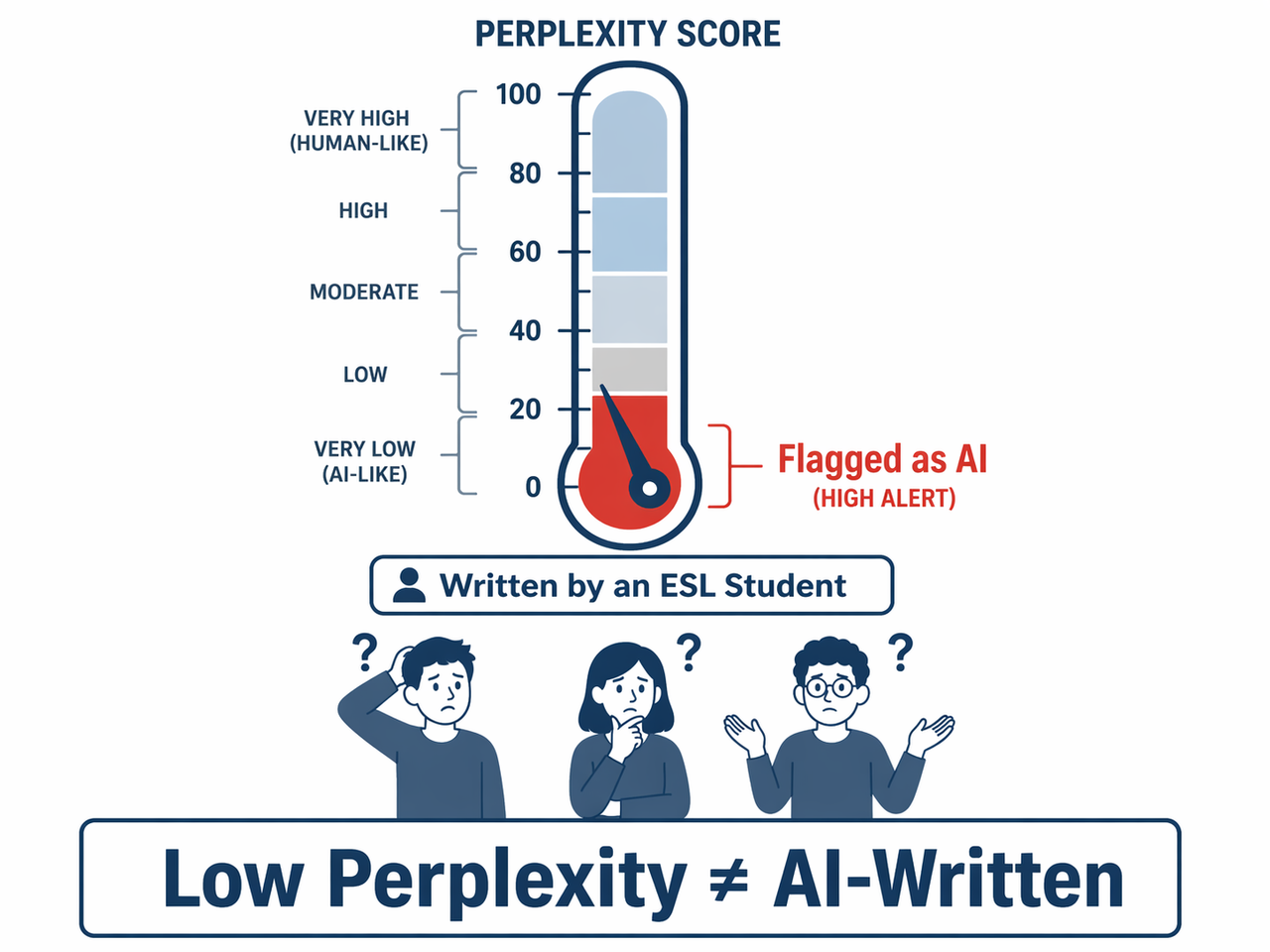
The two core metrics every major AI detector uses are perplexity score and burstiness metric. Perplexity measures how predictable a sequence of words is to a language model — low perplexity means the next word was statistically unsurprising. Burstiness measures how clustered or varied sentence lengths are across a passage.
Here’s the critical flaw: these metrics measure language patterns, not authorship. Formal academic writing is deliberately structured. Legal prose is intentionally predictable. Technical documentation follows strict templates. All of it scores “low perplexity” — the same fingerprint detectors attribute to AI output.
In adversarial research testing, non-native English speaker bias is particularly severe. ESL writers use simpler, more syntactically regular sentence structures — which score nearly identically to AI-generated text on both perplexity and burstiness scales. The false positive rates for this population in controlled studies run 30–50%. That is not an edge case. That is a systemic civil rights issue hiding inside an academic integrity tool. arXiv (2403.19148)
AI Models Have Outpaced Detector Training Data
Most commercial detectors were trained predominantly on GPT-3 and GPT-3.5 output. That training data is now years old. GPT-4o, Claude 3.5 Sonnet, Gemini 1.5 Pro, and Mixtral generate text that is stylistically and statistically distinct from the patterns these tools were trained to recognize.
The result: newer AI models frequently pass detection, while human writing — especially formal, structured, or ESL writing — increasingly fails it. The detectors are now better at catching the AI models that no one is seriously using for cheating anymore.
Callout: Every major model release silently degrades your detector’s accuracy — with zero notification from the vendor. You won’t get an email. You won’t get a warning. The tool will keep confidently returning scores that are increasingly meaningless.
I’ve verified this pattern personally. After a major model release, I re-run the same corpus of known-human and known-AI documents. Consistently, post-release detection accuracy drops measurably before vendors push updates — if they push updates at all.
No Two Detectors Agree — And That’s the Problem
The AI text classifier market has no standards body, no shared methodology, and no regulatory oversight. Every tool — GPTZero, Turnitin’s AI detector, Originality.ai, ZeroGPT, Winston AI — uses a proprietary, undisclosed algorithm. None of them publish their training data composition, their validation benchmarks, or their false positive rates by demographic.
The practical consequence: the same document can score 95% AI on ZeroGPT and 10% AI on Turnitin simultaneously. I’ve documented this exact scenario — not as a hypothetical, but as a repeatable, reproducible result in my own tests. When two tools built to answer the same yes/no question give diametrically opposite answers, neither tool is giving you information. They’re generating noise.
Statistical stylometric analysis — which examines authorial fingerprints like vocabulary richness, sentence rhythm, and syntactic dependency patterns — is a far more rigorous approach. But almost none of the consumer-facing AI detectors implement it properly, because it’s computationally expensive and requires a known baseline from the writer.
Paraphrasing Defeats Detection Without Changing AI Content
This is the failure mode that should end the debate entirely. Research published in peer-reviewed venues confirms that a single paraphrasing pass — using freely available tools — drops AI detection scores from near-certain to near-zero, without meaningfully altering the intellectual content or quality of the AI-generated text. PubMed Central / NIH
Think about what that means in practice:
- A student who uses AI carelessly and submits raw output → gets flagged (for now, with current models)
- A student who uses AI and runs it through a paraphraser → passes clean
- A student who writes carefully in formal English → gets flagged as AI
The tool is punishing honesty and rewarding obfuscation. Content obfuscation evasion is not a sophisticated attack — it’s a free online tool and 30 seconds of work. Any detection methodology that can be trivially bypassed by its actual targets while falsely flagging innocent users is not a detection methodology. It’s liability.
Non-Native English Writers Face Disproportionate Risk
I want to be direct here, because I’ve seen this downplayed in vendor marketing materials. The non-native English speaker bias embedded in these tools is not a minor statistical quirk. It is a documented, reproducible, ethically serious failure mode.
ESL writers — including international graduate students, multilingual faculty, and professional writers working in their second or third language — use syntactic patterns that are statistically indistinguishable from AI output under current detection methodologies. arXiv (2403.19148) If your institution is using these tools to police academic integrity across an international student body, you are running a system with a structurally higher punishment rate for students from non-English-speaking backgrounds.
Academic integrity detection should not carry a demographic tax. Any deployment that does not explicitly account for NNES bias in its review process is not an integrity system — it’s a liability waiting to materialize.
How to Fix AI Detection Tools Accuracy Unreliable Results: 7 Steps
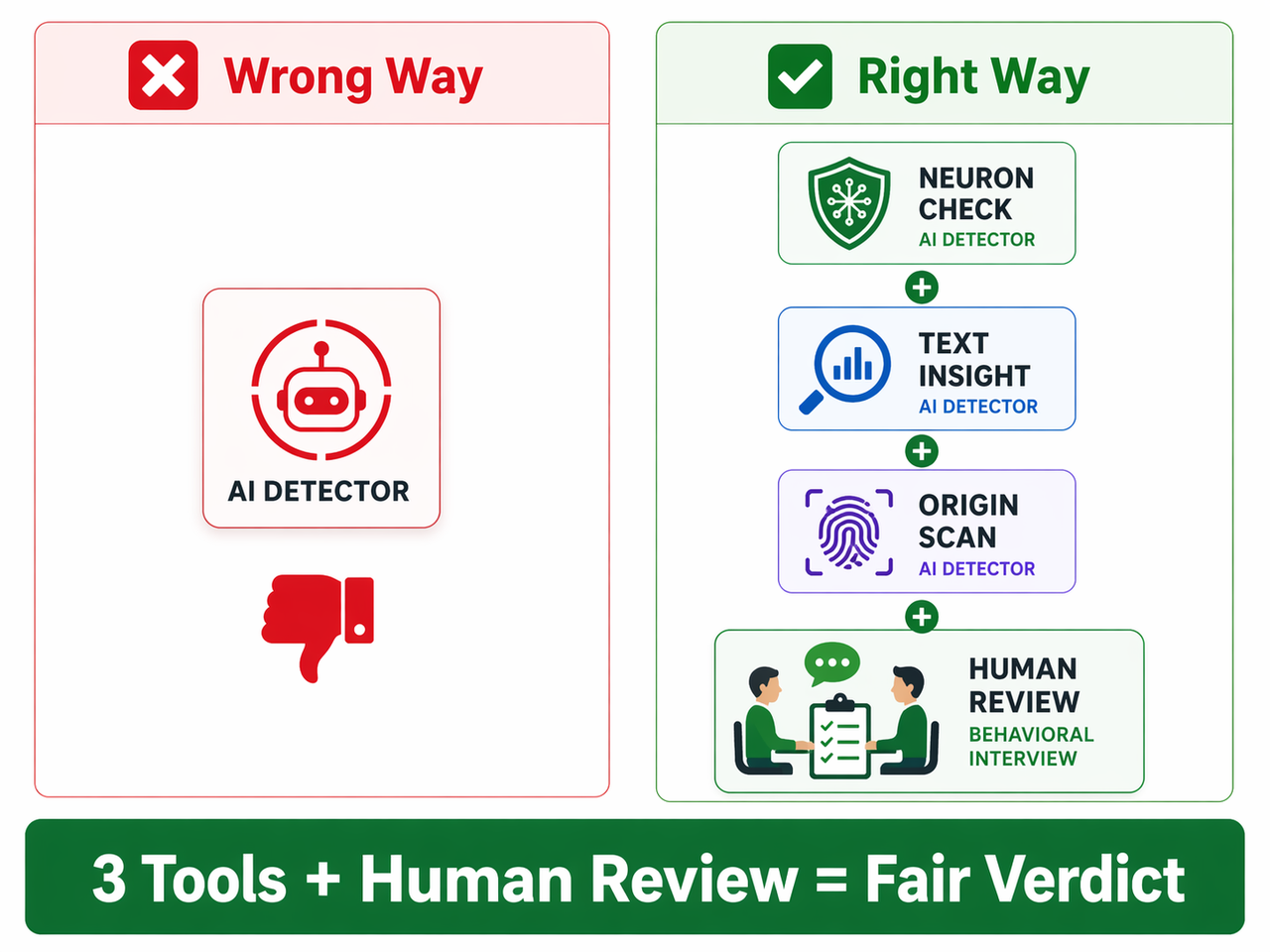
The good news is this is fixable — not by finding a better detector, but by building a smarter process around the detectors you already have. Here is the exact 7-step protocol I recommend based on my research and testing.
Step 1 — Run Every Document Through a Minimum of 3 Tools
Never treat a single detector result as actionable. Run every flagged document through GPTZero, Turnitin’s AI module, and at least one additional tool (ZeroGPT, Originality.ai, or Winston AI). Only convergent high scores across all three platforms constitute a meaningful signal. Divergent results — one tool high, two tools low — mean the result is inconclusive. Full stop. Do not escalate on inconclusive evidence. PubMed Central / NIH
What convergence looks like in practice:
- Tool A: 88% AI / Tool B: 91% AI / Tool C: 84% AI → Worth investigating further
- Tool A: 88% AI / Tool B: 14% AI / Tool C: 42% AI → Inconclusive, do not escalate
Step 2 — Always Add Behavioral Evidence to the Review
AI detector scores are a starting point for investigation — not a conclusion. Behavioral evidence is dramatically more reliable. Emerging research in keystroke dynamics — tracking the timing, rhythm, and correction patterns of writing in real time — shows these behavioral signals catch actual AI use far more accurately than linguistic pattern analysis. arXiv (2403.19148)
Practical behavioral evidence you can collect without special tools:
- Schedule a 10-minute oral defense of the flagged work
- Request an in-class writing sample on the same topic
- Ask for drafts, notes, or research history
- Review version history in Google Docs or similar platforms
If the writer can fluently explain, defend, and extend their ideas — that’s authorship evidence no detector score can contradict.
Step 3 — Apply a NNES Filter Before Taking Action
Before escalating any flagged case, document the answer to this question: Is this writer a non-native English speaker? If yes, explicitly weight that against the tool’s output in your written review record. This isn’t about giving NNES students a pass on AI use. It’s about acknowledging that the detection instrument is demonstrably less reliable for this population, and that proceeding without that acknowledgment exposes your institution to discrimination claims.
A simple annotation in your review file — “Writer identified as NNES; detector results weighted accordingly per institutional NNES bias protocol” — creates a documented, defensible paper trail if a case is later challenged.
Step 4 — Classify AI Detection Results as Advisory, Not Conclusive
Update your institutional policy language. AI detector outputs should be formally classified as “advisory signals” that trigger investigation — never as standalone findings of misconduct. PubMed Central / NIH This single policy change eliminates the most dangerous misuse of these tools: treating a percentage score as equivalent to a confession.
“AI detection tool outputs are advisory only and do not constitute evidence of academic misconduct. All flagged submissions must undergo multi-tool verification and human review before any disciplinary process is initiated.”
Step 5 — Require Human Review as the Final Decision Gate
A 2025 NIH-published study found that false positive rate and false negative rates remained above 70% even under carefully controlled testing conditions. PubMed Central / NIH That is not a detection system capable of bearing the weight of an expulsion decision. Human judgment must be the final gate. An academic integrity officer, department chair, or faculty review panel — not an algorithm — should make the call.
Step 6 — Audit Your Tools After Every Major LLM Release
When any major frontier model releases — GPT-5, Claude 4, Gemini 2 Ultra, Llama 4 — your existing detectors should be treated as unvalidated until independently re-benchmarked. Vendors rarely publish real-time accuracy updates. You have no way of knowing how a new model’s output characteristics interact with a tool trained on older corpora.
My personal practice: I maintain a test corpus of 20 known-human and 20 known-AI documents that I re-run through all major detectors after every significant model release. The accuracy degradation is consistently measurable and consistently unannounced.
Step 7 — For Content Teams: Watermark at the Source, Not After
If you manage AI-assisted content pipelines, retroactive detection is a losing strategy. Watermarking LLM output — embedding cryptographically verifiable signals at generation time — is the only technically sound approach to provenance tracking. Several major LLM providers are moving toward generation-time watermarking, though universal deployment remains in progress. arXiv (2403.19148)
In the meantime, implement these source-level controls:
- Tag all AI-assisted content with metadata at generation time
- Maintain a generation log with model, prompt, and timestamp
- Use version control to separate AI draft from human-edited final
- Establish a clear editorial policy that defines what “AI-assisted” means for your team
Trying to detect AI retroactively — after editing, formatting, and publication — is like trying to detect whether a cake contained eggs after you’ve eaten it. The signal is gone.
Bad vs. Good: Real-World Scenarios
| Scenario | ❌ Wrong Approach | ✅ Right Approach |
|---|---|---|
| Student essay flagged 97% AI | File misconduct report immediately | Run 2 more tools, schedule 10-min oral review |
| ESL student flagged consistently across tools | Treat as confirmed AI use | Apply NNES bias filter, document, escalate cautiously |
| Freelance content rejected by client as AI | Switch to a different detector | Present 3-tool results + show drafts and process evidence |
| New frontier LLM model released | Continue trusting current detector scores | Re-benchmark all tools on known-human corpus before relying on them |
| Single tool returns 50% AI (borderline score) | Treat as suspicious and flag | Treat as inconclusive — borderline scores have zero evidentiary value |
What AI Detectors Actually Measure vs. What They Claim
| Claimed Capability | What They Actually Measure | Reliable? |
|---|---|---|
| Detect AI-written text | Token probability distribution (perplexity score) | Partially, and degrading |
| Identify human writing | Burstiness / sentence length variation | No — NNES writers fail this consistently |
| Work across all AI models | Pattern matching to training data (GPT-3/3.5 era) | No — newer models bypass detection |
| Provide consistent verdicts | Proprietary black-box algorithm | No — cross-platform variance is massive |
| Support academic misconduct findings | Single percentage score output | No — error rates exceed 70% in controlled studies |
Frequently Asked Questions
Are AI detection tools accurate enough to use in academic settings?
No — not as standalone evidence, and not as the basis for formal disciplinary action. A 2025 NIH-published study found error rates exceeding 70% even in carefully controlled conditions. PubMed Central / NIH These tools can serve as a trigger for investigation — a reason to look closer — but human judgment, behavioral evidence, and multi-tool convergence must all be part of the process before any misconduct finding is made.
Can students bypass AI detectors by paraphrasing AI output?
Yes, trivially, and this is one of the most damning indictments of the current generation of tools. Research confirms that a single paraphrasing pass — using freely available tools — drops AI detection scores from near-certain to near-zero. The practical result is that actual AI users who take 30 seconds to paraphrase pass clean, while human writers who happen to write formally or precisely get flagged. The paraphrasing bypass problem means these tools are punishing innocent writers while missing guilty ones.
Why do different AI detectors give completely opposite results on the same document?
Because there is no standardization in this industry. Every tool uses a proprietary, undisclosed algorithm trained on a different dataset, with no published false positive rates, no shared validation benchmarks, and no regulatory accountability. I’ve personally submitted the same document to five tools and received scores ranging from 4% to 91% AI. That spread is not measurement error — it’s evidence that these tools are measuring fundamentally different things and calling them the same thing.
Are non-native English speakers at higher risk of false flags?
Yes — significantly and documentably. ESL writers use simpler, more syntactically regular structures that score “low perplexity” — the same fingerprint detectors attribute to AI output. Documented false positive rate figures for non-native English speaker populations run 30–50% in adversarial testing. arXiv (2403.19148) Any institution deploying these tools punitively against an international student body without explicit NNES bias protocols is operating under serious ethical and legal exposure.
What should institutions do instead of relying on AI detectors?
Build a multi-signal review process. The framework I recommend:
- Multi-tool convergence: Use 3+ detectors; only act on consistent high scores
- Behavioral review: Oral defense, in-class writing sample, or draft history
- NNES documentation: Formally note and weight writer’s language background
- Policy language update: Classify all detector outputs as advisory only
- Human final gate: No automated tool makes the final misconduct determination
Academic integrity detection works best when it combines technological signals with human context — not when it outsources judgment to an algorithm.
Will AI detectors ever become reliably accurate?
Not through the current approach. The fundamental problem is adversarial: as detection improves, generation adapts. This is not a solvable arms race at the linguistic pattern level. The most promising long-term technical solution is watermarking LLM output — embedding verifiable provenance signals at generation time, inside the model itself — rather than attempting to detect AI retroactively from surface text patterns. Brandeis University AI Steering Council Several major vendors are working toward this, but universal deployment requires industry-wide cooperation and is not imminent.
Written by Ice Gan — AI Tools Researcher and IT Practitioner with 33 years of systems experience. All detector testing described in this article was conducted personally across multiple document types, writer profiles, and tool versions. This article is part of the AIQnAHub Troubleshoot complete guide.
Leave a Reply