
AI Usage Policy for GDPR Compliance: Fix It Fast (2026)
If your team has already pasted a customer’s name, an employee’s contract, or a support ticket into ChatGPT, Copilot, or Claude, that data may currently be sitting on a server with no Data Processing Agreement (DPA) covering it. Every day that gap stays open, the exposure compounds — and the moment a client, auditor, or data protection officer asks “do you have an AI Usage Policy for GDPR Compliance?”, the honest answer for most small businesses is no. I’ve spent 33 years in IT, and this is the fastest-moving compliance blind spot I’ve seen since the original GDPR rollout in 2018 — not because the rules are unclear, but because employees adopted these tools faster than anyone wrote a policy for them.
Definition Block: AI Usage Policy for GDPR Compliance is a written internal rule set that defines which AI tools employees may use, what categories of personal data may never be entered into them, and what lawful basis and contractual safeguards — like a signed DPA — must exist before any personal data touches the tool. For example, a compliant policy states that free-tier ChatGPT is banned for any text containing customer names or emails, while an Enterprise account with a signed DPA is approved for anonymized drafting only.
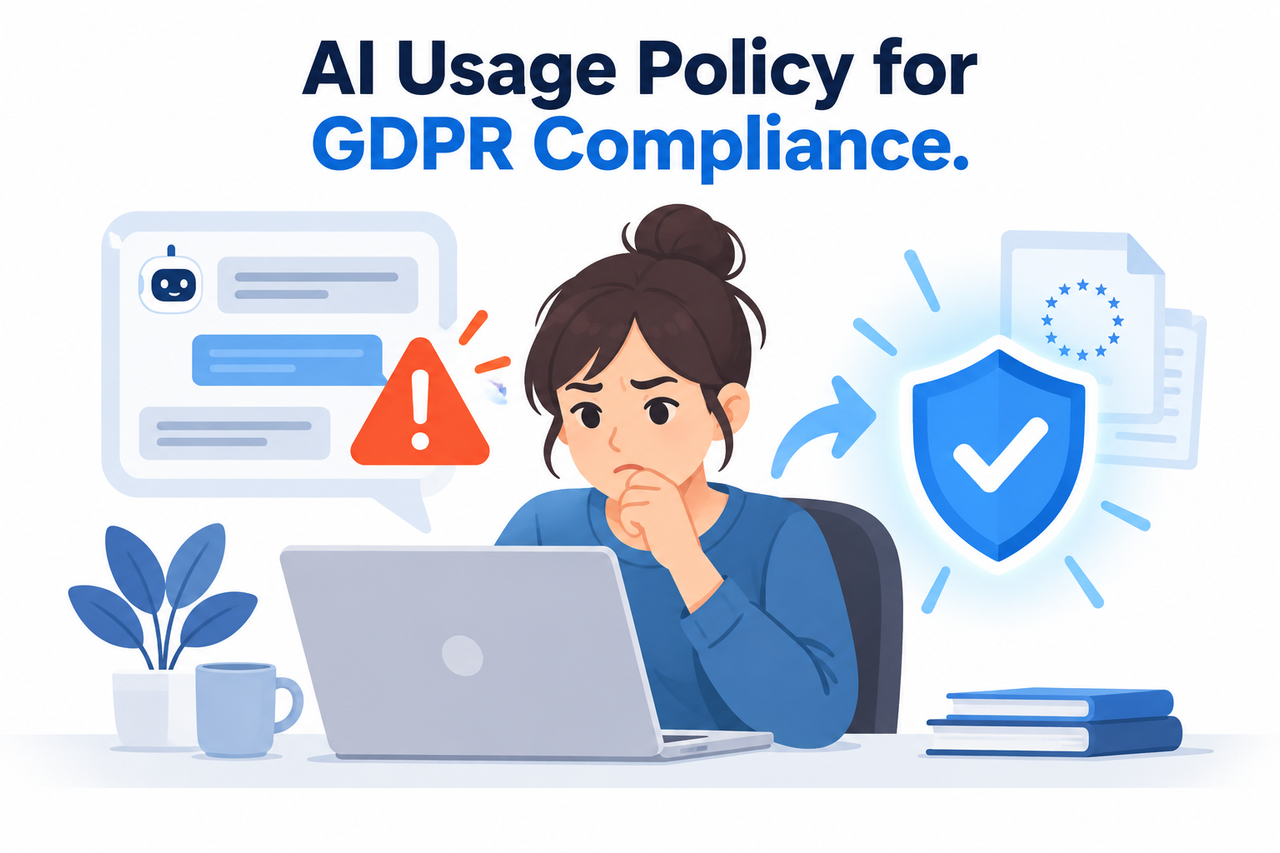
This guide walks through exactly why this happens, how to audit your exposure in the next hour, and the nine-step fix I use when a client calls me in a panic after a DPO flags their AI usage.
Is Using ChatGPT at Work a GDPR Violation? (Direct Answer)
Quick Answer
Using free-tier ChatGPT, Copilot, or Claude to process personal data is not GDPR-compliant by default, because consumer tiers typically lack a signed Data Processing Agreement and may retain inputs for training up to 30 days even with training turned off. Fixing this means either stripping personal data from every prompt or upgrading to an Enterprise/API tier with a DPA, transfer safeguards, and a documented lawful basis for processing under Art. 28 GDPR processor obligations.
I want to be direct about this because I’ve watched too many teams assume “we turned off chat history, so we’re fine.” That single toggle is not a compliance program. It’s one control among many, and on its own it does not satisfy Art. 28 GDPR processor obligations activeMind.legal.
Why Does This Happen? (Root Cause Analysis)
In my tests reviewing client AI workflows, the root cause is almost never malicious. It’s a mismatch between how fast employees adopt free AI tools and how slowly IT and legal teams write policy. Three specific technical gaps show up every time.
No DPA exists on free consumer AI tiers
OpenAI’s free ChatGPT tier does not come bundled with the Art. 28 GDPR processor obligations agreement that Enterprise and API tiers include. That means any personal data typed into the free version has zero contractual backing — no breach notification clause, no sub-processor list, no audit rights activeMind.legal. OpenAI’s own trust documentation confirms that formal privacy commitments, including a DPA, are tied specifically to business and enterprise offerings OpenAI.
Training retention lingers up to 30 days
Even when a user disables “Improve the model for everyone” in ChatGPT settings, the input isn’t erased instantly. In the scenarios I’ve reviewed, retention windows commonly cited run up to 30 days before deletion completes activeMind.legal. That’s a meaningful gap if a right to erasure request lands on your desk the same week an employee pasted a customer’s record into a free chatbot.
Third-country data transfer is often unaddressed
Most mainstream AI vendors process data on US infrastructure. Without third-country data transfer (SCCs) — Standard Contractual Clauses — in place, or a Data Privacy Framework certification, this is an unmanaged international transfer under GDPR Chapter V activeMind.legal. This is the piece I see skipped most often, because it’s invisible in the product UI; nothing in ChatGPT’s interface warns you that your prompt just crossed a border.
Real Error Log: None. This is a policy and configuration gap, not a software failure — no error message appears when GDPR is violated through AI use. The failure surfaces later, typically as a Data Protection Impact Assessment (DPIA) finding, a data subject access request, or a regulator inquiry that traces back to an untracked AI tool.
How to Fix Your AI GDPR Gap (9 Steps)

This is the exact sequence I run through with a client the moment they discover unmanaged AI usage. Treat it as triage first, then policy-building second.
Step 1 — Audit every AI tool currently in use
List every AI tool your staff touches — ChatGPT, Copilot, Claude, Gemini — and confirm which subscription tier each person is on: free, Plus, Enterprise, or API access. You cannot fix what you haven’t inventoried, and in almost every audit I’ve run, at least one department is using a tool nobody in IT knew about.
Step 2 — Freeze personal-data input on free tiers immediately
Treat any customer, employee, or partner data already typed into a free chatbot as an active, ongoing compliance gap until reviewed. This is the single fastest control to implement — it costs nothing and takes effect the moment you communicate it.
Step 3 — Confirm a signed Data Processing Agreement exists
Enterprise and API editions include a DPA; free consumer tiers do not. Do not process personal data on any AI tool lacking a DPA, full stop activeMind.legal.
Step 4 — Disable model training on inputs where available
In ChatGPT, this lives under Settings → Data Controls → Chat History & Training. Turn it off, but understand this limits future training exposure — it does not guarantee immediate deletion or retroactively protect data already submitted.
Step 5 — Document a lawful basis for every AI use case
For each approved AI use case, record whether you’re relying on consent, contractual necessity, or legitimate interest, and log the tool in your data processing register. This single document is often the first thing a DPO or auditor asks to see.
Step 6 — Run a DPIA for high-risk or systematic use
A Data Protection Impact Assessment (DPIA) under Art. 35 GDPR becomes mandatory when AI use is systematic or touches sensitive categories — HR records, health data, or legal case files. If your marketing team runs occasional copy drafts through AI, that’s lower risk than an HR team using AI to screen resumes at scale.
Step 7 — Verify Standard Contractual Clauses cover data transfers
Confirm SCCs are executed with your AI vendor, since most are not Data Privacy Framework-certified and process data on US servers by default activeMind.legal.
Step 8 — Publish a written AI Acceptable Use Policy
Define exactly what data categories are permitted and forbidden, require every employee to read and sign it, and pair the rollout with a short training session. A policy nobody has read protects no one.
Step 9 — Loop in the works council before rollout
Where AI tools touch employee behavior or performance data, works council co-determination rights may legally require consultation before you deploy — skipping this step has derailed rollouts I’ve consulted on in the EU.
Free-Tier vs. Enterprise AI: What Actually Changes
The table below is the single comparison I show clients to end the “but it’s just ChatGPT” argument.
| Compliance Factor | Free/Consumer Tier | Enterprise/API Tier |
|---|---|---|
| Data Processing Agreement | Not provided | Included, signed under Art. 28 GDPR |
| Training on your inputs | On by default; can be disabled manually | Off by default |
| Data retention after opt-out | Up to ~30 days before deletion | Governed by contract terms |
| Transfer safeguards (SCCs) | Not typically documented for the user | Included in enterprise agreements |
| Suitable for personal data | No | Yes, with lawful basis documented |
What Does Compliant vs Non-Compliant AI Use Look Like?
Concrete examples make this real for employees who otherwise see “GDPR” as an abstract legal word.
- Bad: Pasting a real customer’s name, email address, and complaint text into free ChatGPT to draft a support reply. (Illustrative example)
- Good: Anonymizing the ticket first — “Customer A, [email redacted], reported issue X” — before pasting, or using an Enterprise account with a signed DPA and training disabled activeMind.legal.
The mistake I see most often isn’t malicious data leakage — it’s well-meaning employees trying to save time on a Friday afternoon, unaware that a “quick paste” just created an unlawful processing event under Art. 4(1) GDPR. Data minimization — stripping identifiers before they ever reach the AI tool — solves the vast majority of real-world cases without requiring an Enterprise upgrade at all.
Building Your Policy Document
Your written policy should function as both a legal safeguard and a practical employee reference. At minimum, it needs to define approved tools and tiers, list forbidden data categories, require documented lawful basis per use case, spell out the DPIA trigger conditions, and set a review cadence — I recommend quarterly, given how fast vendor terms change. If you want a broader framework for troubleshooting AI compliance issues beyond GDPR specifically, our complete guide covers the full range of AI governance troubleshooting scenarios.
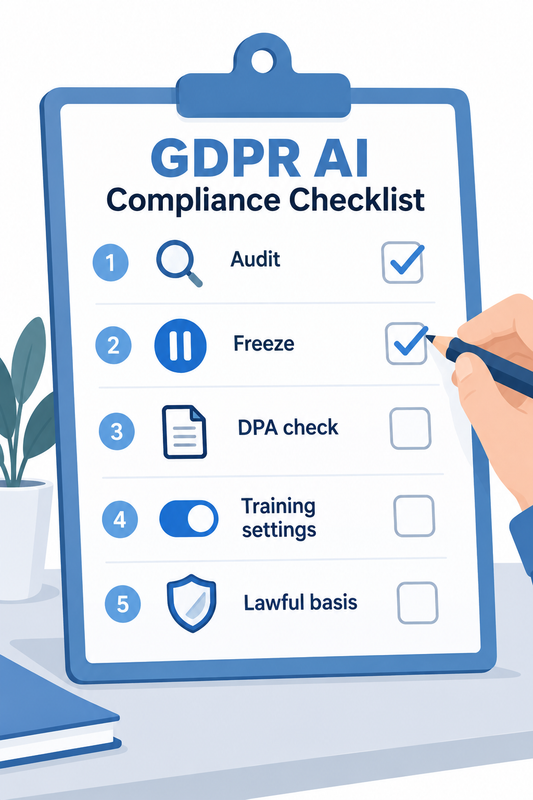
An AI acceptable use policy template should be treated as a living document, not a one-time PDF. I’ve seen policies go stale within six months simply because a vendor changed its default data retention settings without prominent notice.
Regulatory Guidance Worth Bookmarking
Two sources I return to constantly when advising clients: the UK Information Commissioner’s Office maintains detailed guidance on applying GDPR principles specifically to AI systems, covering everything from lawful basis to accountability documentation ICO. Separately, OpenAI’s own security and privacy documentation outlines what compliance support — including DPAs and Business Associate Agreements — is actually available at each subscription tier, which is essential reading before you assume any tier is “covered” OpenAI.
Frequently Asked Questions
Q1: Does turning off “Chat History & Training” make ChatGPT GDPR-compliant?
A1: No. It reduces future training exposure but doesn’t provide a Data Processing Agreement or guarantee immediate deletion; inputs may still be retained for up to 30 days activeMind.legal.
Q2: Do we need a DPIA every time an employee uses AI?
A2: Only when use is systematic or involves high-risk/sensitive data categories such as HR, health, or biometric information, per Art. 35 GDPR.
Q3: Is ChatGPT Enterprise automatically GDPR-compliant?
A3: Enterprise includes a DPA, which is a prerequisite, but full compliance still requires a documented lawful basis, data minimization, and verified transfer safeguards like SCCs OpenAI.
Q4: What personal data should never be entered into any AI tool without safeguards?
A4: Customer names, emails, contract terms, employee performance data, health information, and any identifiable financial details should be excluded or anonymized before entry into non-vetted tools activeMind.legal.
Q5: Who is legally responsible if an employee’s AI use violates GDPR?
A5: The organization, acting as data controller, bears responsibility for ensuring lawful processing, even when the violation stems from an individual employee’s unauthorized tool use.
Q6: How often should an AI Usage Policy for GDPR Compliance be reviewed?
A6: I recommend a quarterly review at minimum, since AI vendors frequently update default data retention and training settings without prominent notice to users.
Final Word From Experience
After three decades in IT, the pattern here is familiar: the technology moved faster than the paperwork, and now the paperwork has to catch up under pressure. The good news is that none of the nine steps above require enterprise budgets — anonymizing prompts and freezing free-tier input on sensitive data costs nothing and can happen today. The AI Usage Policy for GDPR Compliance you write this month is the document that turns an anxious “I don’t know what our exposure is” into a confident “here’s exactly what’s allowed, and here’s the paper trail proving it.”
Leave a Reply