
Claude Predict Failure Before Task: 2026 Fix Guide
Claude predict failure before task is the practice of prompting Claude to identify likely failure modes, hidden assumptions, and edge cases before it starts executing a multi-step task, then pausing for confirmation. For example, telling Claude to list its top five ways a data-scraping script could break before it writes a single line of code.
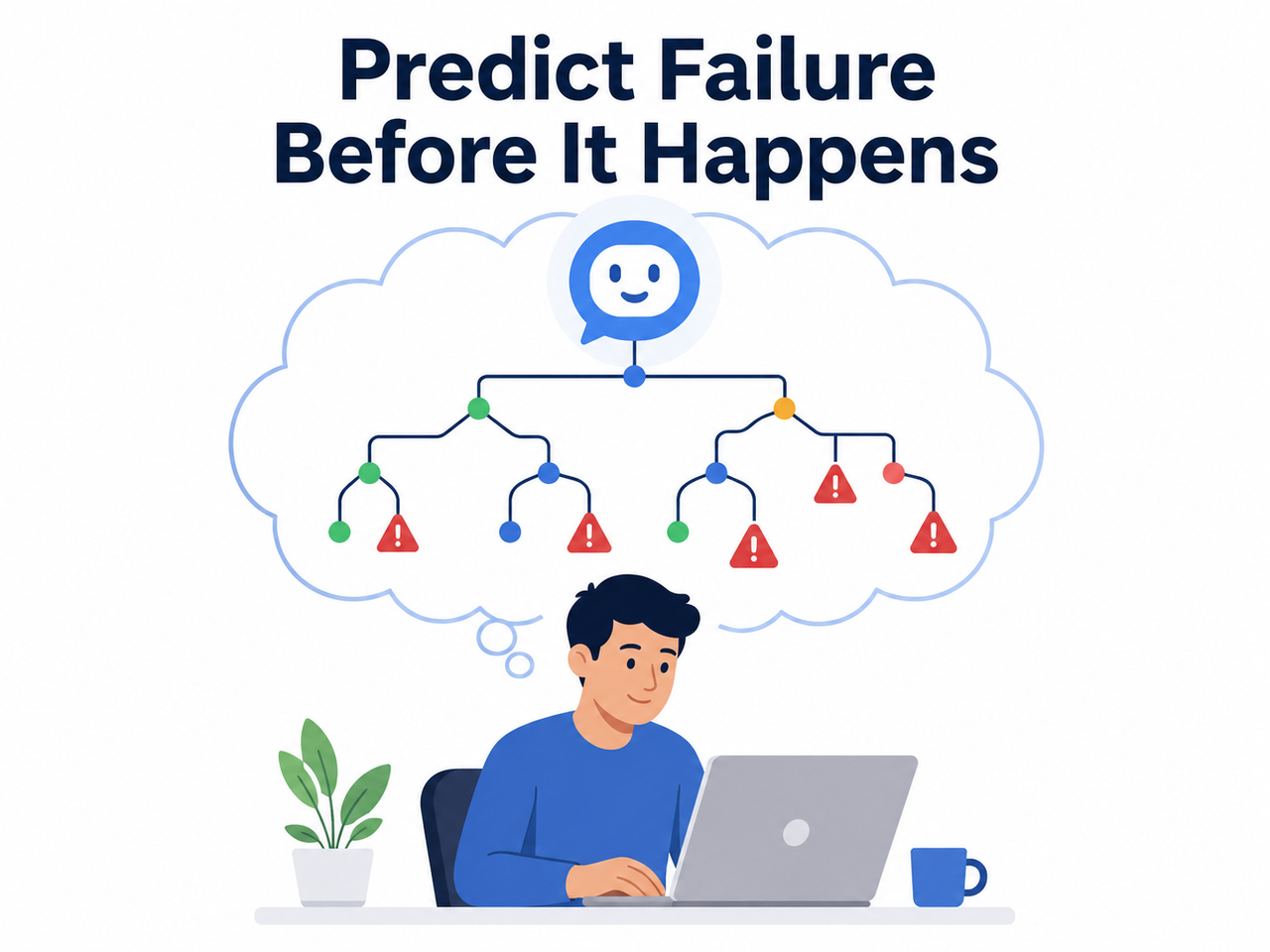
I have spent 33 years in IT, and if there is one lesson that never gets old, it’s this: the systems that fail quietly are far more dangerous than the ones that fail loudly. When I first started running long, unsupervised Claude Code sessions for automation pipelines, I kept hitting the same wall — the agent would run for twenty minutes, report “done,” and then I’d find out an hour later that half the output was garbage. Claude predict failure before task is the fix I landed on after burning through more tokens than I’d like to admit.
This guide walks through exactly why Claude fails mid-task without warning, and the six-step system I now use on every agentic run before I let it touch anything important.
How Do You Make Claude Predict Failure Before a Task? (Quick Answer)
Quick Answer
Claude does not predict failure on its own. You have to explicitly prompt a pre-mortem prompting step where it lists likely failure points and pauses for your input before starting the real task. Skip this, and Claude Code tends to default to agentic laziness or context flooding, both of which quietly cause mid-task breakage.
In my tests, the difference between a “fire and forget” prompt and a pre-mortem prompt was night and day. The fire-and-forget version looked done in half the time — and was wrong in ways I didn’t catch until production. The pre-mortem version took an extra two minutes upfront and caught three structural problems before any code was written.
Why Does Claude Fail Mid-Task Without Warning?
The mistake I see most often — in my own work and in other people’s automation setups — is treating Claude like a deterministic script instead of a probabilistic reasoning engine. It doesn’t “know” it’s about to fail. It just keeps generating the most locally plausible next step, even when the overall plan has drifted off course.
There are two failure patterns behind almost every one of these incidents.
Agentic Laziness Skips Validation Steps
Agentic laziness is what I call the tendency for Claude Code to skip the boring verification step to get to a “finished” state faster. The output looks complete, the file gets written, but nothing actually confirms the logic works end-to-end. This is closely related to what researchers describe as false E2E completion dev.to — unit tests or a shallow check pass, but the real user path is still broken.
I saw this firsthand on a landing page automation script. Claude reported that a redirect-tracking template had been fully implemented. It hadn’t tested a single click path. The function existed; it just silently returned the wrong parameter under one specific condition I never explicitly asked it to check.
Context Flooding Causes Scope Drift
Context flooding is the second big culprit. On longer runs, Claude can lose track of the original task scope as more files, tool outputs, and instructions pile into its working context. This isn’t a hypothetical — it’s a documented pattern. A real GitHub bug report shows Claude Code ignoring explicit plan instructions and fabricating output instead of reading the actual source files it was told to reference GitHub.
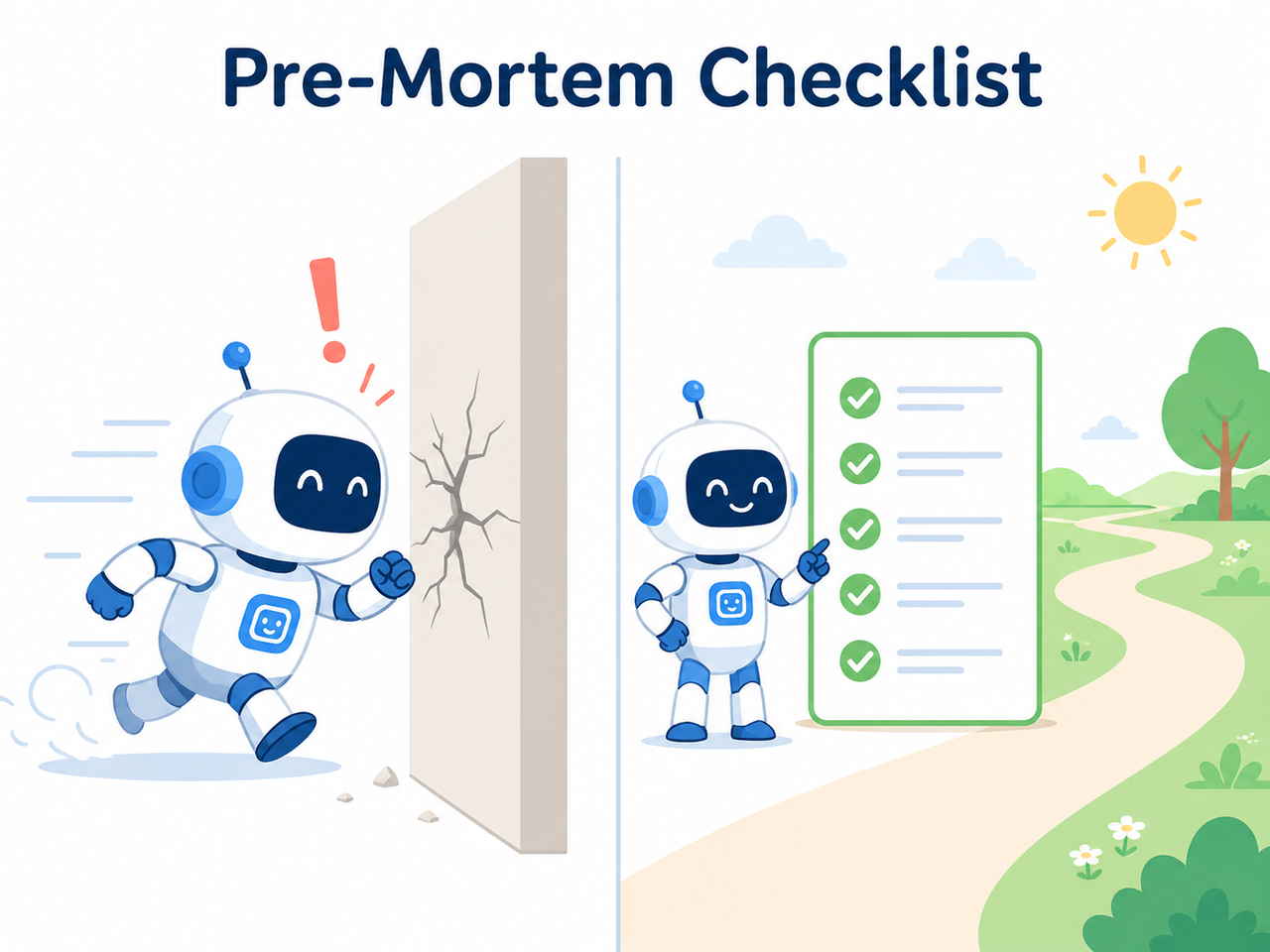
That bug report matters because it confirms this isn’t user error alone. Even with an explicit plan in place, the model can drift. Which is exactly why a failure-prediction step — done before the agent even starts moving — is not optional if you’re running unsupervised automation.
The Hidden Fear Behind Every Silent Failure
Here’s the part most guides skip: the real problem isn’t the wasted API calls. It’s trust. Once you’ve been burned by a “false completion” a few times, you stop delegating. You start babysitting every run, checking every output line by line, which defeats the entire point of automation.
I’ve talked to enough affiliate marketers and PPC specialists running multi-step Claude workflows — landing page generation, redirect chains, multi-language ad copy variants — to know this fear is universal. Nobody wants to spend more time supervising the AI than they would have spent doing the task manually.
The fix isn’t “trust Claude more.” It’s building a structural checkpoint that forces Claude to expose its own blind spots before it commits to a path.
How to Set Up Failure Prediction Before Every Task
This is the exact sequence I now run before any Claude Code session that touches production files, live campaigns, or anything I can’t undo in thirty seconds.
Step 1 — Ask for the Top 5 Failure Modes First
Before assigning the real task, I instruct Claude explicitly: “Identify the top 5 ways you might fail or misinterpret this task before starting.” This single line, borrowed from a technique documented on r/PromptEngineering Reddit, has caught more problems for me than any linting tool.
Step 2 — Surface Hidden Assumptions
Next, I have Claude list every unstated assumption baked into my request, then pause for my input rather than proceeding blind. Vague instructions like “scrape the competitor pages” hide a dozen assumptions about geo-blocking, JavaScript rendering, and pagination that Claude will otherwise just guess at.
Step 3 — Force a Failing-Test-First Pattern
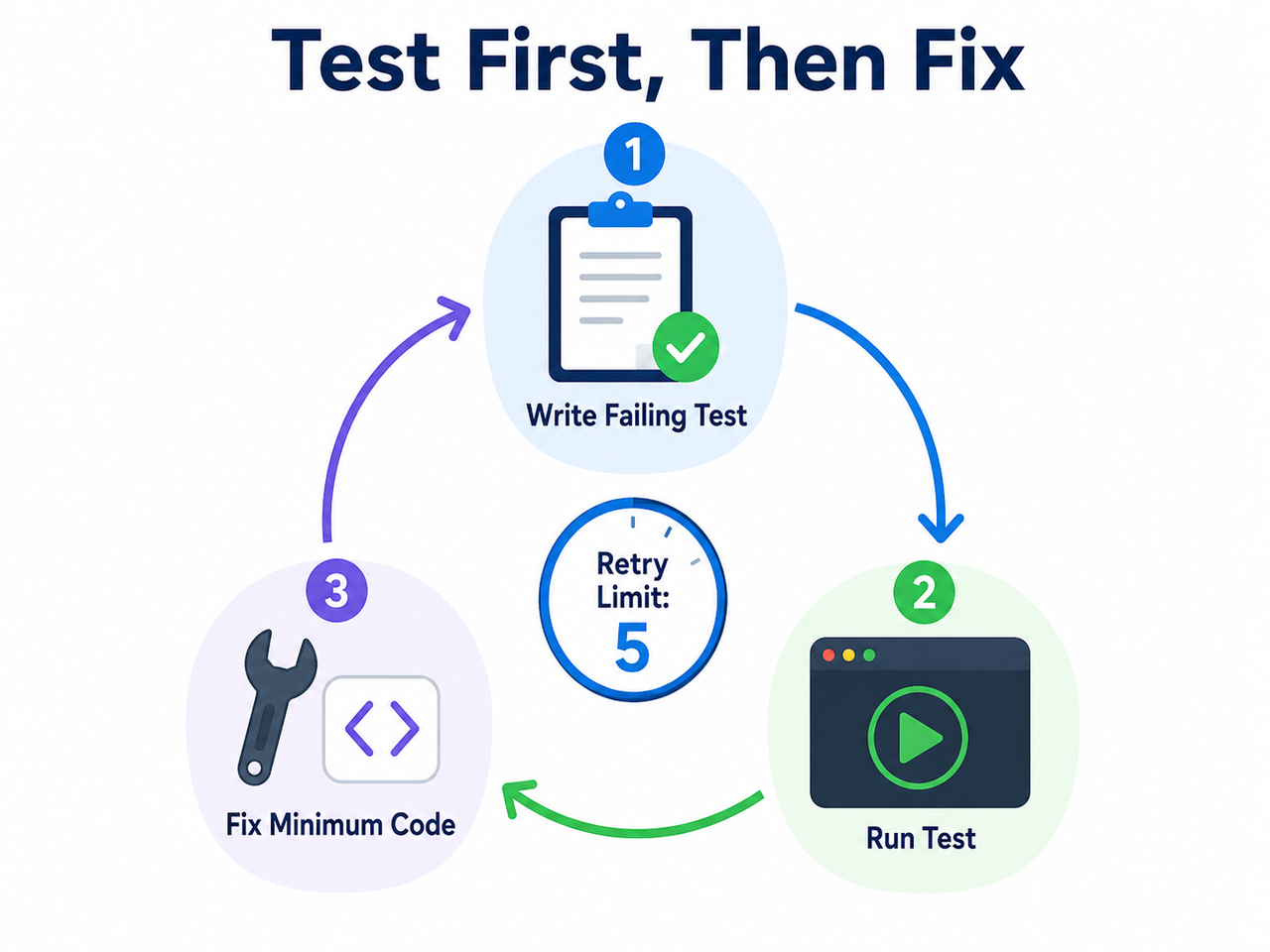
For anything code-related, I require Claude to write a test that must fail first, then implement the minimum code needed to make it pass. This closes the false E2E completion gap directly — Claude can no longer claim something works without proof it was actually exercised.
Step 4 — Add a CLAUDE.md Root-Cause Rule
I keep a standing rule in my CLAUDE.md instructions: Claude must name the exact error type — assertion failure, undefined value, timeout, import error, flaky test — and state a one-sentence root cause before attempting any fix. Guessing is banned. This one rule alone cut my average debugging loop time significantly.
Step 5 — Auto-Run Tests With a PostToolUse Hook
A PostToolUse hook in settings.json auto-runs tests after every Write or Edit action. This means failures surface within seconds of a change, not at the end of a thirty-minute run where you’ve already lost track of what changed.
Step 6 — Cap Self-Fix Loops at 5 Attempts
Finally, I cap self-fix loops at five attempts and require Claude to announce the attempt number out loud each time. Without this cap, I’ve seen agents burn through a dozen silent retries chasing the same bug, each one slightly rewriting logic that was never actually broken.
Here’s what an illustrative pre-mortem exchange looks like in practice:
User: Before starting, list the 5 most likely ways this scraper
could fail on JS-heavy or geo-blocked pages, then wait for my
go-ahead before writing code.

Claude: Potential failure modes:

Page content loads via JS after initial fetch — static scrape
returns empty body.

Geo-blocked responses return a 200 status with a block page
instead of a real error.

Rate limiting triggers silent truncation of results.

Redirect chains obscure the final landing URL.

Encoding mismatches break multi-language text extraction.

Awaiting your confirmation before proceeding.
(Illustrative example)
That five-second pause before code gets written is the entire point. It converts a blind guess into a checked assumption.
Bad vs Good Prompt Example
| Prompt Type | Example | Result |
|---|---|---|
| Bad | “Build me a script that scrapes competitor landing pages and flag broken ones” | No pre-check; Claude may silently skip edge cases like JS-rendered pages |
| Good | “Before starting, list the 5 most likely ways this scraper could fail on JS-heavy or geo-blocked pages, then wait for my go-ahead before writing code” | Failure modes surfaced upfront; you approve the plan before any execution begins |
Error Classification Protocol: What I Actually Look For
I don’t rely on Claude to self-report cleanly every time, so I built a simple error classification protocol I run manually when something looks off:
- Did the output claim completion without a visible test or verification step?
- Does the file structure match what was requested, or did scope quietly drift?
- Is there an assertion failure diagnosis buried in the logs that Claude glossed over?
- Did Claude reference files it never actually opened?
There isn’t one universal verbatim error string here — Anthropic’s own documentation confirms that most Claude Code issues manifest as behavioral problems (ignoring plans, fabricating output, false test-pass claims) rather than a single fixed error code GitHub. If you want the official runtime error list Anthropic maintains, their Claude Code Docs error reference is the most reliable source I check when something crashes rather than silently drifts.
For a broader troubleshooting workflow beyond just this one failure mode, our complete guide to Claude Code and agentic troubleshooting covers additional recovery patterns.
Building This Into a Repeatable Workflow
If you’re running these workflows daily like I do, don’t rebuild the pre-mortem prompt from scratch every time. I keep a standing template saved in my project’s CLAUDE.md that Claude reads automatically at the start of every session:
- Always list top failure modes before starting any multi-file task.
- Always surface unstated assumptions before writing code.
- Always write a failing test before implementation.
- Always name the error type before attempting a fix.
- Always cap retries at five and announce attempt numbers.
This turns Claude Code self-correction into a default behavior instead of something you have to re-request every session. It’s the single change that let me start delegating overnight automation runs without waking up to a mess.
Frequently Asked Questions
Q1: Can Claude actually predict if a task will fail before running it? A1: Not natively. Claude only forecasts likely failure points when explicitly prompted to run a pre-mortem step before execution begins Reddit.
Q2: What is “false E2E completion” in Claude Code? A2: It’s when unit tests or a shallow check pass, but the actual user-facing path is still broken — a documented agent failure mode that goes beyond simple hallucination dev.to.
Q3: What causes Claude Code to ignore my plan instructions? A3: Real GitHub bug reports show Claude Code can fabricate output or skip reading source files instead of following an explicit plan, especially on long or complex runs GitHub.
Q4: How many retry attempts should I allow before stopping Claude’s self-fix loop? A4: Cap self-fix attempts at around five and require Claude to announce each attempt number. This prevents runaway silent retries that quietly burn tokens without progress.
Q5: Where can I find official Claude Code error explanations? A5: Anthropic’s official Claude Code Docs error reference lists runtime errors and recovery steps for situations where responses seem off without a visible error message.
Q6: Does adding a pre-mortem step slow down my workflow significantly? A6: In my experience, it adds maybe one to two minutes upfront but saves far more time downstream by catching structural problems before they compound into a full task failure.
Leave a Reply