
Find Missing CSV IDs Reliably With AI (2026)
How can I reliably find CSV rows missing a specified number or form identifier using AI is a data-reconciliation task best solved with executed, inspectable code. For example, finding accounts without ABC352 requires checking each account’s complete form list, not searching for gaps in a numerical sequence.
A confident-looking list of missing forms can create more work than an obvious error. You might contact the wrong customers, overlook incomplete accounts, or submit an inaccurate exception report.
My recommendation is to make verification part of the task itself: define what “missing” means, have the AI execute the comparison, and check the resulting records against the source.
One correction matters before we begin. Finding accounts without a particular form and finding missing sequential numbers are different problems. They need different rules, even though both can use set comparisons.
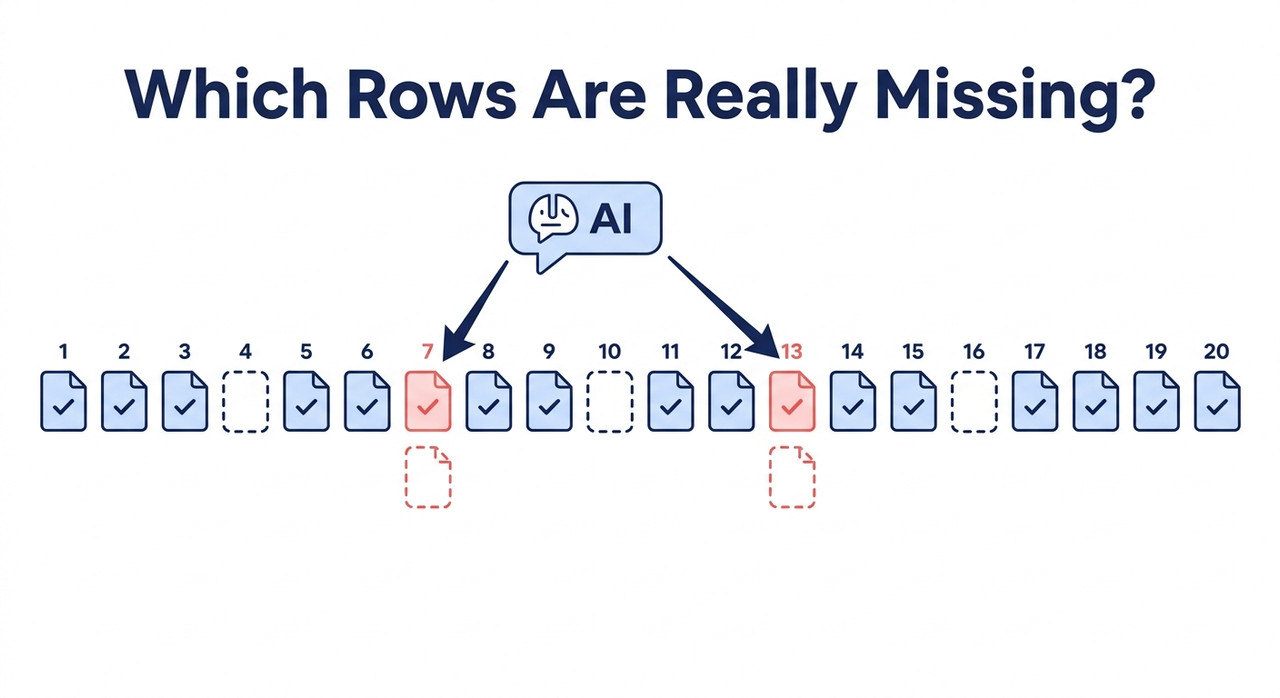
How can I reliably find CSV rows missing a specified number or form identifier using AI?
Quick Answer
Ask an AI with code execution to load the CSV, preserve identifiers as strings, and apply an explicit matching rule. For a specified form, compare eligible accounts with accounts containing that exact identifier. For sequence gaps, compare observed IDs with an approved expected range. Inspect the code, reconcile counts, and verify flagged records.
This is not about finding a magical prompt that makes every answer trustworthy. It is about giving the AI a job whose intermediate steps and final output can be inspected.
I would use the AI to explain the file structure, propose the comparison, and write the code. I would use the executed results—not the chatbot’s reassurance—as the evidence.
What does “missing” mean in your CSV?
Before uploading the file, write a one-sentence acceptance rule. Most requests fall into one of three categories.
| Your actual question | Appropriate check | Important distinction |
|---|---|---|
| Which rows have an empty form identifier? | Check null, empty, or whitespace-only values | An empty field is not the same as an absent account-level form |
| Which accounts lack ABC352? | Compare eligible accounts against accounts with an exact ABC352 match | An account can have several rows, including both target and non-target forms |
| Which invoice numbers are absent from an expected sequence? | Compare an approved expected set against observed IDs | Missing numbers do not necessarily correspond to existing CSV rows |
The last distinction is easy to miss. An absent invoice number has no source row to return. The output is a missing-identifier report, not a filtered selection of existing rows.
For account-level form identifier verification, however, the output usually needs the account ID, account name, and evidence explaining why that account was flagged.
Keep ABC352 intact when checking for that form
If the requirement is “find accounts without ABC352,” compare the complete identifier ABC352.
Do not extract 352 and search for numerical gaps. That would answer a different question and could confuse ABC352 with another series, such as XYZ352.
Numeric extraction is appropriate only when the business rule explicitly defines a sequential numbering system. Even then, preserve prefixes and separate independent series.
Define which accounts are eligible before checking absence
An account should not be marked incomplete simply because it lacks a form it was never required to submit.
I would establish the eligible population first. For example, the requirement might apply only to active accounts, a particular product, or a defined reporting period.
If the CSV contains only submitted forms, it may omit accounts with no submissions whatsoever. A separate account roster is then necessary to find all eligible accounts missing the form.
Why can a confident AI answer still be wrong?
The supplied research includes a closely matched community report. A user asked ChatGPT to find accounts missing a particular form and reported substantial mistakes across different model and data-format configurations. Reddit r/PromptEngineering
That is useful evidence of a real failure scenario, but it is not an independently reproduced benchmark. It does not establish a universal error rate for every model, file, or prompt.
Treat generated explanations differently from executed comparisons
A chatbot can produce an orderly explanation without showing a complete computation. The important question is not whether the answer sounds systematic, but whether the comparison actually ran on the intended data.
Requesting Python execution gives you an inspectable procedure. It does not automatically make the procedure correct: the AI can still choose the wrong column, apply the wrong filter, or misunderstand which accounts require the form.
I therefore separate two questions:
- Did the tool execute the code successfully?
- Did that code implement the correct business rule?
Both must be answered before trusting the exception list.
Use hallucination research within its actual scope
Nature’s paper, “Detecting hallucinations in large language models using semantic entropy,” examines a particular category of errors called confabulations: fluent claims that are wrong and arbitrary.
The authors explicitly distinguish those errors from systematic reasoning failures and state that their method does not guarantee factuality. It is relevant background on why fluent output needs scrutiny, not a direct validation of a CSV reconciliation method. Nature
That limitation matters. I would not cite the paper as proof that every missing-form mistake comes from tokenization, arithmetic weakness, or one specific architectural cause.
How can I reliably find CSV rows missing a specified number or form identifier using AI without confusing rows and accounts?
Use the following workflow. It distinguishes row-level checks, account-level absence, and sequence gaps before any result is presented as complete.
Step 1 — Write the matching rule before opening the chatbot
Define the target identifier, the entity being checked, and any eligibility conditions.
For example:
Find active accounts in the supplied account roster that have no record of an exact ABC352 form identifier in the submissions CSV during the reporting period.
This is much safer than “find missing forms,” because it makes the population and the absence condition explicit.
Also specify whether case matters and whether surrounding spaces should be ignored. Do not let the AI silently decide that punctuation, leading zeros, or prefixes are unimportant.
Step 2 — Check the CSV structure and preserve identifiers
Ask the AI to report the filenames, column names, parsed row counts, and relevant field types before filtering.
Treat account numbers and form identifiers as strings unless there is a specific reason not to. An identifier such as 000352 may not be equivalent to 352.
Review the actual file structure:
- One account per row with a list of forms in a cell.
- One account-form submission per row.
- Separate account and submission files.
Those layouts require different implementations. A row count alone cannot tell you which one you have.
Step 3 — Require executed code and visible assumptions
Use an AI environment that can run code, or have it generate a script that you execute in an approved local environment.
Ask it to show the loading, normalization, matching, grouping, and export logic. If code execution is unavailable, the assistant should say so rather than presenting an inferred list as a computed result.
Here is a reusable starting prompt:
Inspect the uploaded CSV before answering.

Identify the account key, the form identifier field, and whether
forms appear in separate rows or as a list within each cell.

Use executed Python code, not a visual scan of the file.

Target form: ABC352
Matching rule: exact identifier after trimming surrounding spaces.
Preserve prefixes and leading zeros.

Determine which eligible accounts have no target-form match.
Report parsed rows, eligible accounts, accounts with the target,
accounts missing the target, and unresolved records.

Show the code and export the complete exception report.
Do not claim completeness if the eligible account roster is absent.
(Illustrative example)
This prompt is a specification, not a guarantee. Review the assumptions the AI reports before allowing it to continue.
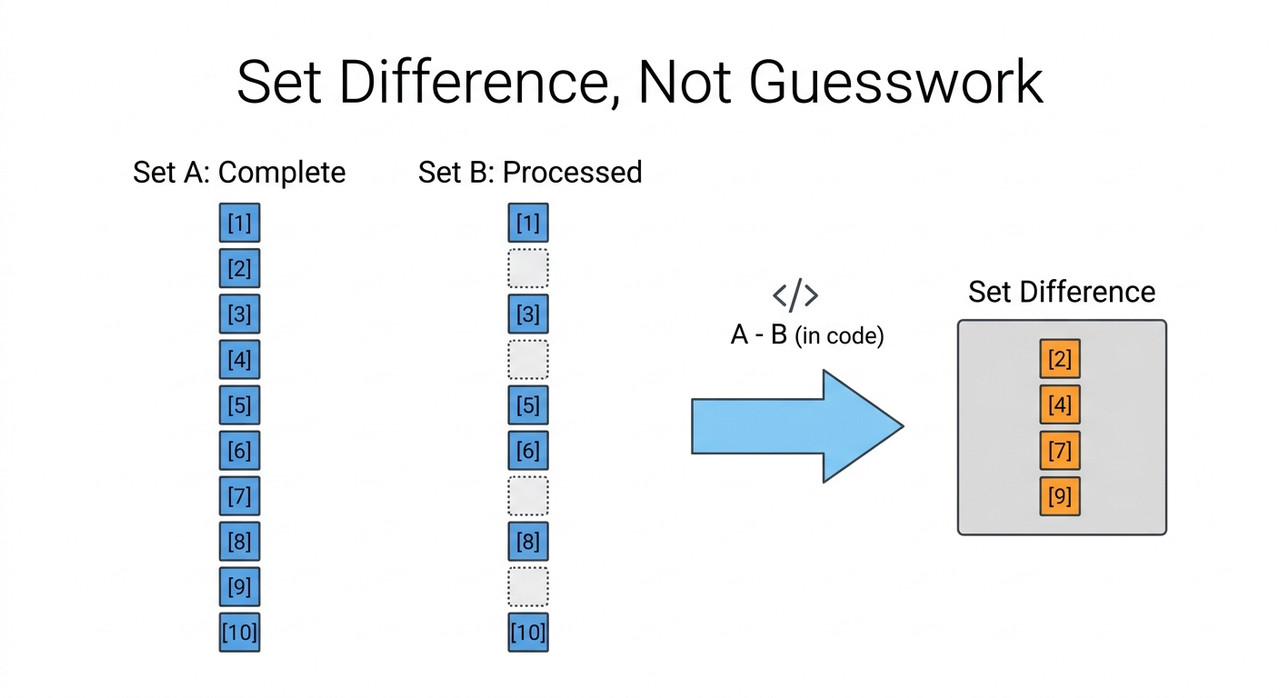
Step 4 — Use account-level set difference for missing forms
For a long-format submissions file, identify accounts with an exact target-form match. Then subtract those account IDs from the eligible account roster.
The conceptual comparison is:
missing_accounts = eligible_accounts - accounts_with_target_form(Illustrative example)
This avoids a common mistake: filtering every row whose form is not ABC352.
Suppose account A has both ABC351 and ABC352. A row-level “not ABC352” filter returns its ABC351 record, even though account A has the required form.
Account-level absence means no qualifying target match exists anywhere among that account’s relevant submissions.
Step 5 — Parse list cells into exact identifiers
If a cell contains ABC351, ABC352, ABC353, split it using the file’s actual separator and trim the resulting tokens.
Then test whether the target is an exact member of that collection.
A broad substring search can confuse ABC352 with ABC3520. Conversely, splitting on the wrong separator can leave several identifiers joined together and create false missing results.
I would ask the AI to display a few original cells alongside their parsed token lists. Review semicolons, line breaks, quotation marks, and empty cells before trusting the transformation.
Step 6 — Use expected ranges only for genuine sequence gaps
For invoice number gaps or missing sequential IDs, use the authorized expected sequence.
Stack Overflow documents the classic set-difference approach: construct the expected integers and subtract those present. Its example identifies 12 and 19 as missing from a sequence running from 10 through 20. Stack Overflow
observed = {10, 11, 13, 14, 15, 16, 17, 18, 20}
expected = set(range(10, 21))
missing = sorted(expected - observed)
(Illustrative example adapted from the documented technique)
Do not automatically assume every integer between the observed minimum and maximum should exist.
A system may reserve ranges, cancel numbers, or use separate sequences by branch or year. An observed minimum and maximum also cannot reveal missing values outside those boundaries.
Step 7 — Separate unresolved records from confirmed exceptions
Blank account IDs, malformed form lists, and unexpected identifier formats deserve their own report.
Do not silently discard those records, and do not automatically classify them as verified missing forms.
I would request three outputs:
- Confirmed accounts with the target form.
- Confirmed accounts without the target form.
- Records requiring review because the rule could not be applied safely.
This prevents data-quality problems from disappearing inside a clean-looking final count.
Step 8 — Reconcile the population and inspect both outcomes
For a fully resolved account population, eligible accounts should divide into accounts with the target and accounts without it.
If some accounts remain unresolved, include that category in the reconciliation and make the categories mutually exclusive.
Spot-check both flagged and unflagged accounts against their complete source records. Checking only flagged results can reveal false positives but miss accounts incorrectly classified as complete.
A small sample is useful for detecting problems. It is not proof that every classification is correct.
Step 9 — Export the evidence before using the report
Request the complete results as a CSV rather than relying on a displayed preview.
Include the account key, applied rule, reporting period, status, and a useful source reference. Save the executed script and count summary alongside the output.
For compliance or client-facing work, use the organization’s review and approval process. Executed code improves auditability, but incorrect requirements or incomplete source data can still produce an incorrect report.
What does a practical missing-form script look like?
The following example assumes two files:
accounts.csv, containing the eligibleaccount_idvalues.submissions.csv, containingaccount_idandform_id.
It assumes one form identifier per submission row. It is not appropriate unchanged for a cell containing a comma-separated list of forms.
import pandas as pd

target = "ABC352"

accounts = pd.read_csv(
"accounts.csv", dtype=str, keep_default_na=False
)
submissions = pd.read_csv(
"submissions.csv", dtype=str, keep_default_na=False
)

accounts["account_id"] = accounts["account_id"].str.strip()
submissions["account_id"] = submissions["account_id"].str.strip()
submissions["form_id"] = submissions["form_id"].str.strip()

if accounts["account_id"].eq("").any():
raise ValueError("Eligible account roster contains blank account IDs")

if submissions["account_id"].eq("").any():
raise ValueError("Submissions contain blank account IDs")

eligible = set(accounts["account_id"])
with_target = set(
submissions.loc[
submissions["form_id"].eq(target), "account_id"
]
)

present = eligible & with_target
missing = eligible - with_target

assert not (present & missing)
assert present | missing == eligible

report = pd.DataFrame({
"account_id": sorted(missing),
"missing_form": target
})

report.to_csv("missing_form_report.csv", index=False)

print({
"eligible_accounts": len(eligible),
"accounts_with_target": len(present),
"accounts_missing_target": len(missing),
"submission_rows": len(submissions)
})
(Illustrative example; not executed against a user dataset)
Notice what the script does not do. It does not invent an account roster from the submissions, strip the letters from ABC352, or interpret a non-target submission as evidence that an account is missing the target.
The assertions verify the partition of the supplied eligible population. They do not establish that the roster is complete or that every submitted form was included in the export.
Before production use, add the actual eligibility and date rules. Review duplicate accounts, submissions for unknown accounts, and any required treatment of blank form identifiers.
What did the real user-reported test find?
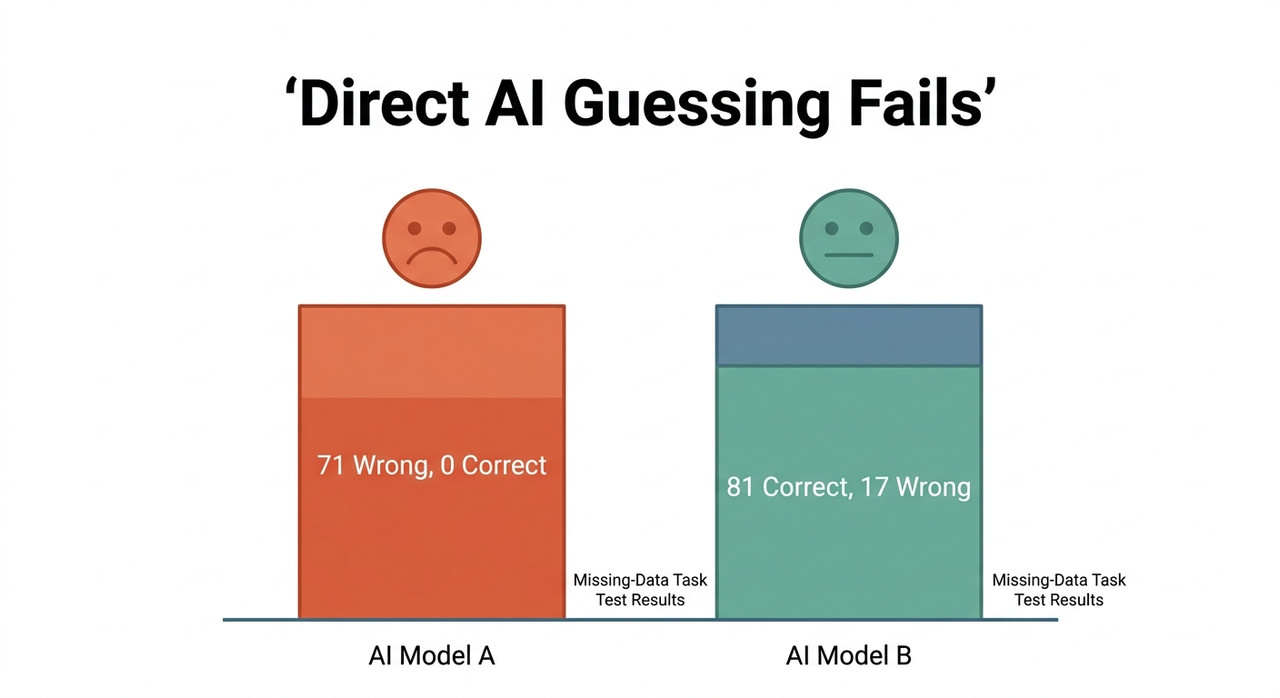
The Reddit author described trying to identify accounts missing ABC352. They reported 183 accounts missing forms, with about 150,000 rows in an expanded layout and about 5,000 rows when forms were combined within cells. Reddit r/PromptEngineering
Their reported results included this wording:
Model 4.1 had 71 hallucinations and 0 correctly identified.
Model o3 had 81 correctly identified and 17 hallucinations.
This is a user-reported result, not a system error log or a test I performed. The author’s term “hallucinations” describes their assessment of incorrect results. Reddit r/PromptEngineering
The distinction between layouts is important. Earlier summaries of this scenario can misleadingly suggest that every configuration processed the same 150,000-row representation. The author actually described different representations and submission arrangements.
I would use the report to motivate verification—not to advertise a universal accuracy percentage or claim that one model always fails.
The author also reported different results after changing the data layout and splitting submissions into four parts. Because several conditions changed, that comparison does not isolate formatting as the sole cause.
How should you measure whether the missing list is correct?
When a reviewed reference list is available, assess false positives and false negatives separately.
A false positive is an account reported missing the form when it actually has it. A false negative is an account genuinely missing the form that the report fails to flag.
Useful metrics include:
- Precision: correct missing-account flags divided by all missing-account flags.
- Recall: correctly flagged missing accounts divided by all genuinely missing accounts.
- Unresolved population: accounts that could not be classified under the agreed rules.
These measures answer different operational questions. High precision reduces unnecessary follow-up; high recall reduces overlooked exceptions.
For the user-reported o3 counts, 81 correct flags and 17 incorrect flags describe the quality of returned flags, while the stated 183 genuinely missing accounts describes the reference population. Do not collapse those denominators into one vague “error rate.” Reddit r/PromptEngineering
For your own workflow, retain the reviewed reference list and calculation method. Otherwise, an impressive percentage is difficult to interpret or reproduce.
What mistakes should you avoid with alphanumeric identifiers?
The biggest mistake is treating a form label as a number when the letters carry meaning.
ABC352, XYZ352, and ABC0352 may be different identifiers. Do not merge them unless your documented business rules explicitly permit that normalization.
I would also avoid silently converting blank values into ordinary text or assuming every identifier can be interpreted numerically.
For genuine CSV gap detection across numbered series, separate the series first. Only then compare the numeric component against that series’ authorized expected values.
The Stack Overflow range method is useful for consecutive integers, but its assumptions do not automatically apply to arbitrary form codes. Stack Overflow
For large, sparse numbering spaces, ask whether constructing the entire expected range is necessary. The same discussion also presents adjacent-gap approaches, which can avoid materializing a huge set merely to describe gaps.
What is the difference between a bad request and a reliable workflow?
Bad request:
Scan this spreadsheet and list everyone missing ABC352.
This leaves the account population, field structure, matching rule, date range, and verification requirements undefined.
Better request:
Use the eligible account roster and the submissions export. Execute code that identifies accounts with no exact ABC352 submission during the specified period. Preserve identifiers as strings, show the comparison logic, report unresolved records, reconcile the account counts, and export the complete exception list.
The improvement is not simply adding “be accurate.” It is making the task testable.
I would still review the generated code. A deterministic calculation consistently applies its instructions, including incorrect ones. Reliability depends on matching those instructions to the actual requirement.
How should you handle sensitive or audit-related CSV data?
Before uploading account or client records, follow your organization’s rules for approved tools, access, and data handling.
Where possible, use stable account keys rather than unnecessary personal details. Keep the mapping to customer names in the approved system if it is not needed for the comparison.
Retain the original export unchanged. Save a separate working copy, the rule used, and the generated exception report so another reviewer can reconstruct the process.
For broader AI troubleshooting topics, see the complete guide.
The goal is not to replace judgment with a script. It is to create a traceable process in which requirements, transformations, and exceptions remain visible.
Frequently Asked Questions
Can AI reliably find accounts missing a particular form?
AI can help write and execute an explicit comparison, but its direct textual answer is not sufficient evidence. Define the eligible account population, use exact identifier matching, inspect the code, and validate the exported results.
Is searching for missing ABC352 the same as finding a missing number?
No. Missing ABC352 usually means an account lacks that exact form. Missing number 352 from an authorized sequence is a different task. Extracting the digits from a form label can destroy information needed for the correct comparison.
Should I filter every row where the form is not ABC352?
Not when checking whether an account lacks ABC352 across multiple submissions. An account can have both target and non-target records. Determine which accounts have any qualifying target submission, then compare that group against the eligible roster.
Can I use the smallest and largest observed IDs as the expected range?
Only if the requirement is specifically to find internal gaps within that range. That approach cannot identify missing endpoints outside the observed values and may incorrectly flag legitimate unused numbers. The documented set-difference technique assumes an appropriate consecutive integer range. Stack Overflow
Does seeing Python code prove the answer is correct?
No. The code must be executed, implement the correct rule, and operate on complete, properly parsed data. Review the inputs and exported records as well as the code. A successful run does not prove that the underlying roster or submissions export is complete.
Is there a real error message for this problem?
There may be no technical error at all. The cited Reddit example reports incorrect missing-account results rather than a formal application error. Treat that as a user-reported failure scenario, not a standardized benchmark or a guaranteed outcome. Reddit r/PromptEngineering
Does hallucination detection replace reconciliation?
No. The Nature research addresses a specific category of confabulations and explicitly does not guarantee factuality. For this task, an auditable comparison against the correct account population is more directly relevant than asking the chatbot whether it feels confident. Nature
Leave a Reply