
Expert Persona Prompt Ineffective? Fix It in 2026
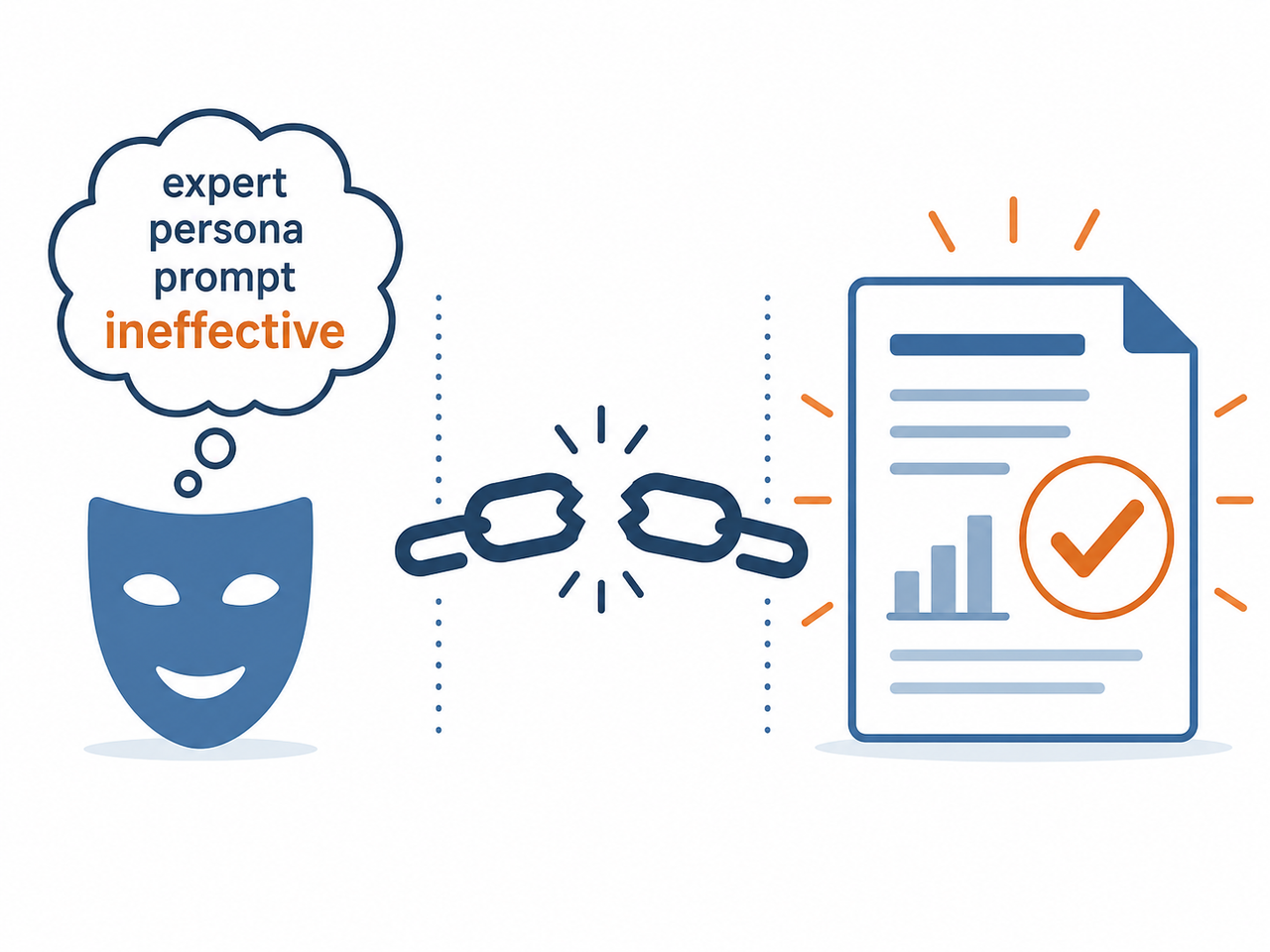
If you have spent the last few weeks stacking credentials into your system prompt — “You are a senior Google Ads strategist with 15 years of experience” — and you are still getting shallow, inconsistent, or flat-out hallucinated answers, I want you to stop blaming your workflow. In my 33 years in IT, I have watched dozens of “best practice” techniques get adopted as gospel before anyone actually tested them, and expert persona prompt ineffective is quickly becoming one of those cases. This isn’t a you-problem. It’s a documented limitation of how large language models actually use role instructions.
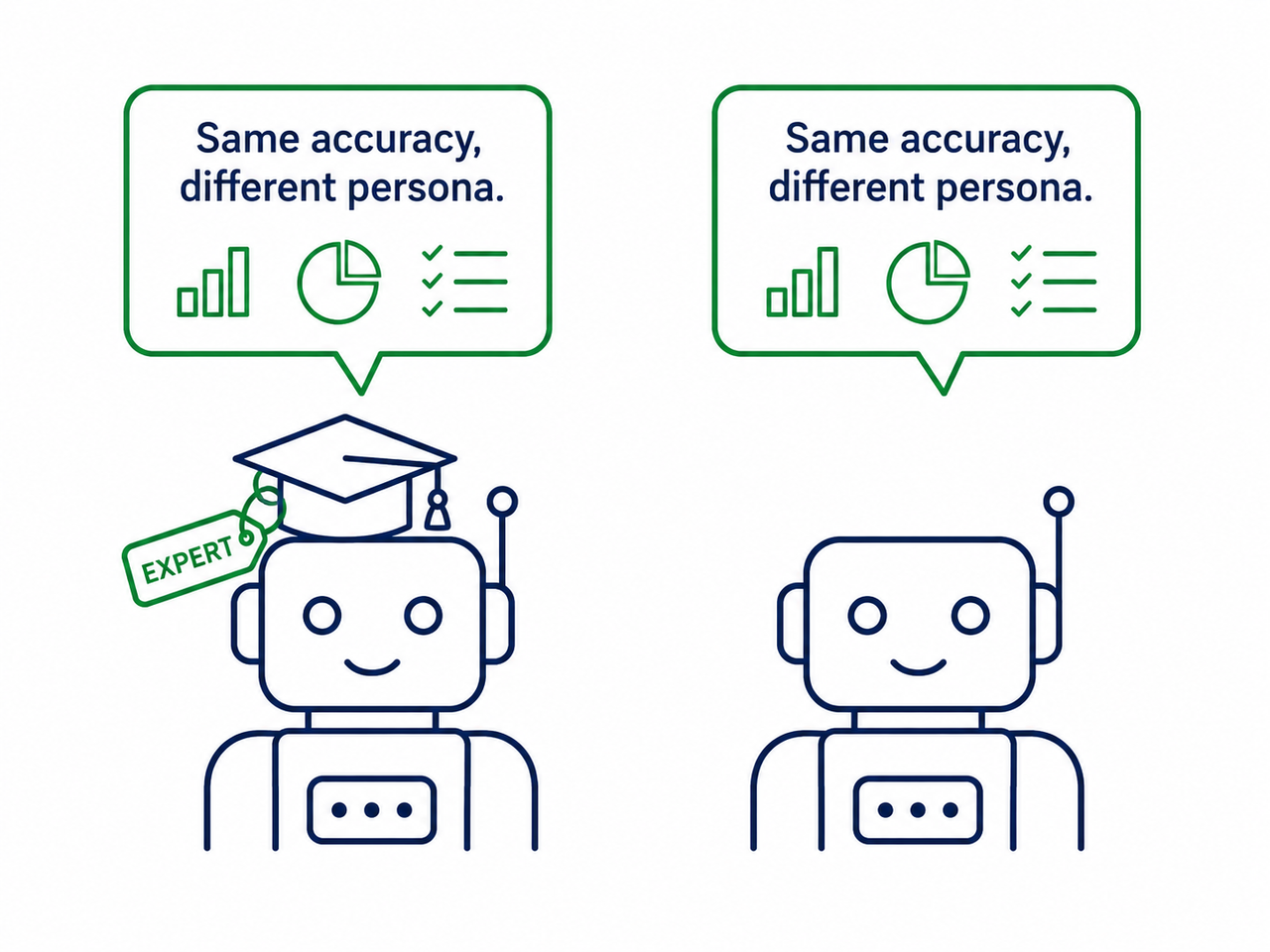
expert persona prompt ineffective is the phenomenon where assigning an LLM a role or title (for example, “You are a PPC expert”) fails to improve factual accuracy or reasoning quality compared to a plain, unlabeled prompt. In one controlled test, GPT-4 and Claude 3.5 showed no reliable accuracy gain on GPQA benchmark questions when given expert personas versus none.
I’ve tested this myself across my own affiliate campaign workflows, where I lean heavily on Claude and GPT for landing page copy and compliance checks. When I first stacked a “senior conversion rate optimization expert” persona onto my prompts, I expected sharper, more authoritative output. What I got instead was longer, more confident-sounding text that wasn’t actually more accurate. That gap between confidence and correctness is exactly what the research below explains.
Why Is My Expert Persona Prompt Not Working? (Quick Answer)
Quick Answer
Expert persona prompts don’t add real knowledge to the model — they only shift tone and framing. On reasoning, factual, or coding tasks, the “expertise” label produces no measurable accuracy benefit, and can sometimes underperform a neutral prompt by amplifying false confidence instead of correctness. If your task is knowledge-heavy, the persona is not your lever.
This is the single most important thing to internalize before you spend another hour tweaking your persona wording. The lever you actually need to pull is instruction specificity, not role-play.
What’s the Root Cause of Persona Prompt Failure?
The mistake I see most often — in my own early prompts and in templates shared across marketing communities — is treating a persona label as if it were a knowledge injection. It isn’t. A system prompt that says “you are an expert” doesn’t grant the model access to any new training data or reasoning capacity it didn’t already have. It just changes the style of the response.
Personas don’t unlock hidden knowledge
Researchers at Wharton’s GAIL lab specifically tested this assumption: does telling a model “you are an expert” make it perform better on hard academic benchmarks? They found no accuracy gain across GPQA-style benchmarks when adding expert labels to state-of-the-art models. Wharton GAIL Research The model already “knows” what it knows — the label doesn’t change that.
Role prompts can actively hurt reasoning tasks
This is the part that surprised me most. It’s not just that personas are neutral — in some cases they are actively harmful. Testing on open models showed role prompting underperformed plain prompts on the majority of reasoning datasets tested (7 of 12). Jdhwilkins If your PPC compliance checks or bid strategy logic depend on multi-step reasoning, a persona label can be working against you.
Confidence amplification masks errors
Here’s the part that should worry any performance marketer running compliance-sensitive copy through AI: persona framing tends to make outputs sound more assertive, without making them more accurate. That’s confidence amplification, and it’s dangerous precisely because a wrong answer delivered with authority is harder to catch in a quick QA pass than an obviously hedged one. Wharton GAIL Research
Quick reference: where personas help vs. where they fail
| Task Type | Does Persona Help? | Why |
|---|---|---|
| Tone/style writing (ad copy, landing page voice) | Yes | Persona shifts word choice and framing, which is exactly what tone tasks need |
| Audience-targeted communication | Yes, when paired with audience context | Framing “who you’re writing for” changes structure and vocabulary usefully |
| Factual Q&A / knowledge recall | No | Label doesn’t add training data the model doesn’t already have |
| Multi-step reasoning / logic problems | No, can hurt | Underperformed plain prompts on majority of tested reasoning datasets |
| Compliance-sensitive answers (policy, legal, PPC rules) | No | Confidence amplification risk without accuracy gain |
How Do You Fix an Ineffective Expert Persona Prompt?
Once I accepted that my persona-heavy templates weren’t the accuracy boost I thought they were, I rebuilt my prompt library around a simple diagnostic process. Here’s the exact sequence I now run before shipping any AI-generated output into a live campaign.
- Diagnose the task type first. If it’s a reasoning, factual, or coding task, drop the persona entirely and test a neutral, plainly-instructed prompt as your baseline. Learn Prompting
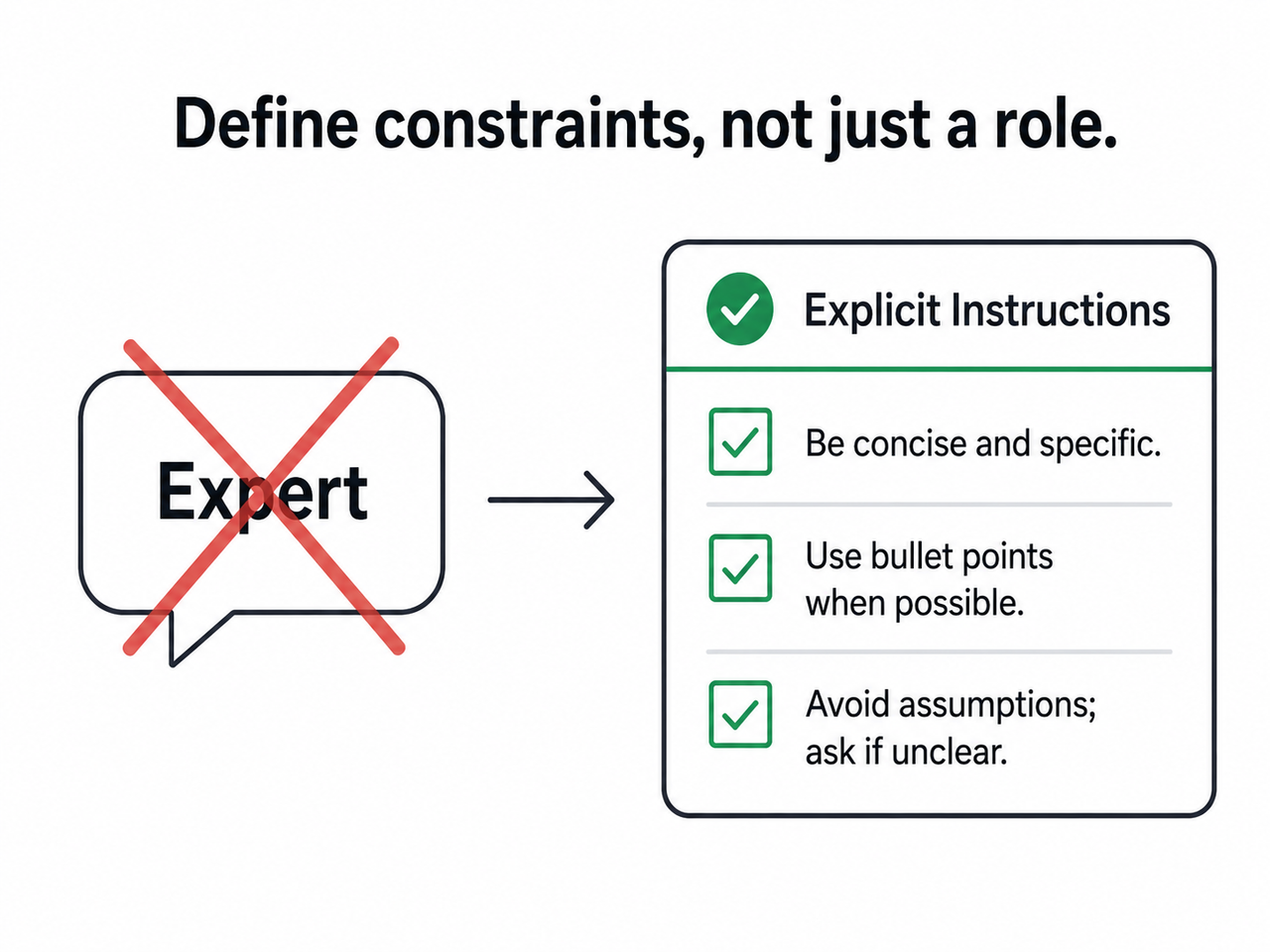
- Replace the role label with explicit success criteria, constraints, and output format. Anthropic’s own context engineering guidance recommends defining the “right altitude” of instructions rather than leaning on a role label. Anthropic Engineering
- Keep personas only when framing audience or tone, e.g., “a CRO consultant writing for non-technical clients,” rather than just naming an expertise level.
- Avoid low-knowledge personas like “explain like I’m a beginner.” These consistently degrade output quality, even on style tasks where personas normally help.
- Run an A/B test. Same prompt, with persona and without, scored against a fixed rubric. This is the only way to empirically confirm whether a persona helps for your specific use case.
- Independently verify high-stakes answers. For anything touching PPC policy compliance or financial claims, don’t trust persona-driven confidence as a proxy for correctness. Wharton GAIL Research
I want to flag something important here: none of this means persona prompting is “dead.” It means you need to match the technique to the task, the same way you wouldn’t run a broad match keyword strategy on a bottom-of-funnel conversion campaign. Persona prompting is a framing tool, not a knowledge tool.
There is no crash log here — this is a quality failure
Unlike a broken API integration or a malformed JSON tracking template, this isn’t the kind of problem that throws an error message. There’s no stack trace to paste into a support ticket. The failure mode is silent: the output looks fine, reads confidently, and might even be longer and more detailed than a plain-prompt response — it’s just not more accurate. That silence is exactly why so many people miss it for months.
Bad vs. Good Persona Prompt Examples
Let me show you the actual before-and-after I use now when auditing my own templates.
Bad prompt (relies on label alone for accuracy):
You are a world-class Google Ads expert with 20 years of experience.
Answer the following PPC question accurately.
(Illustrative example) This tells the model who to “act as,” but gives it zero constraints on sourcing, zero flags for uncertainty, and no structural requirement. The model will happily generate a confident-sounding answer whether or not it’s correct.
Good prompt (defines audience, constraints, and success criteria):
You are writing PPC guidance for a non-technical small business owner.
Constraints: cite only official Google Ads policy, flag any uncertain claims,
and structure the answer as numbered steps.
(Illustrative example) Notice the difference: the “good” version still uses persona-like framing, but the actual work is being done by the constraints — cite official policy, flag uncertainty, use a specific structure. That’s what actually changes output quality, not the label itself. Anthropic Engineering
Applying This to Multi-Language and Multi-Market Campaigns
If you’re running campaigns across multiple markets and languages — which is common in affiliate and performance marketing — this problem compounds. A persona prompt that seems to “work” in English testing may produce inconsistent quality when the same persona label is translated or applied to a different language context. In my own multi-country PPC workflows, I now treat every language variant as its own A/B test rather than assuming a persona that tested well in one market will transfer cleanly to another.
This is also where zero-shot reasoning tasks — like classifying ad policy violations or extracting structured data from competitor landing pages — are most vulnerable. These are exactly the tasks where role prompting has been shown to underperform, so I’ve moved my compliance-checking prompts entirely away from persona framing and toward explicit rubrics and constraint lists.
Building This Into a Repeatable Process
Since I’m someone who documents everything as a reusable template, here’s how I’ve restructured my own prompt engineering checklist after running these tests:
- Tag every prompt template by task type (creative/tone vs. factual/reasoning) before deciding whether a persona belongs in it.
- Maintain two versions of any critical prompt — persona and non-persona — and re-run the A/B comparison whenever you switch models.
- Log outputs from both versions against a fixed rubric (accuracy, completeness, compliance) rather than relying on a gut read of “this sounds more expert.”
- Treat any persona-driven output touching Google Ads policy or financial claims as a draft requiring independent verification, never a final answer.
If you want a broader framework for troubleshooting AI prompting issues beyond this specific case, the complete guide on our Troubleshoot pillar page covers related failure patterns across model behavior, context handling, and output consistency.
Frequently Asked Questions
Q1: Does adding an expert persona ever improve LLM accuracy? A1: Controlled studies found no reliable accuracy gain from expert personas on knowledge or reasoning benchmarks like GPQA in models such as GPT-4 and Claude 3.5. Wharton GAIL Research
Q2: When should I still use a persona prompt? A2: Use personas for tone, style, or audience-framing tasks — like adjusting writing style for a target reader — not for boosting factual or reasoning performance. Learn Prompting
Q3: Can a persona prompt make output worse? A3: Yes. Testing on open models showed persona-based prompts underperformed plain prompts on the majority of reasoning datasets tested, and personas can also amplify false confidence in incorrect answers. Jdhwilkins
Q4: What should replace a persona label in my system prompt? A4: Explicit success criteria, constraints, and output format specifications. Anthropic’s context-engineering guidance recommends this approach over relying on a role label alone. Anthropic Engineering
Q5: How do I test whether my persona prompt actually helps? A5: Run an A/B comparison of the same prompt with and without the persona, scored against a fixed rubric, to empirically confirm any benefit for your specific use case. Jdhwilkins
Q6: Is this problem specific to one AI model? A6: No. The pattern has shown up across multiple model families and benchmarks, which suggests it’s a structural limitation of how persona instructions are processed rather than a quirk of any single model. Wharton GAIL Research
Q7: Should I remove all personas from my existing prompt library? A7: Not entirely — audit each template by task type first. Keep personas where they genuinely aid tone and audience framing, and strip them from anything factual, reasoning-heavy, or compliance-related. Learn Prompting
Leave a Reply