
How to Get ChatGPT to Complete Multi-Step Instructions Without Drifting (2026)
I’ve spent over three decades in IT, and one lesson has held true across every era of automation I’ve worked with: the longer and more complex a task, the more checkpoints you need, not fewer. How to Get ChatGPT to Complete Multi-Step Instructions Without Drifting matters because I keep seeing people build genuinely well-thought-out workflows, hand the entire sequence over in one instruction, and then feel personally at fault when the model skips a step partway through.
How to Get ChatGPT to Complete Multi-Step Instructions Without Drifting is the practice of structuring long or sequential tasks so the model completes each step fully rather than skipping, truncating, or silently abandoning parts of the sequence. For example, sending one bounded sub-step at a time with an explicit checkpoint confirmation prevents the drift that happens when an entire multi-step task is handed over in a single instruction.
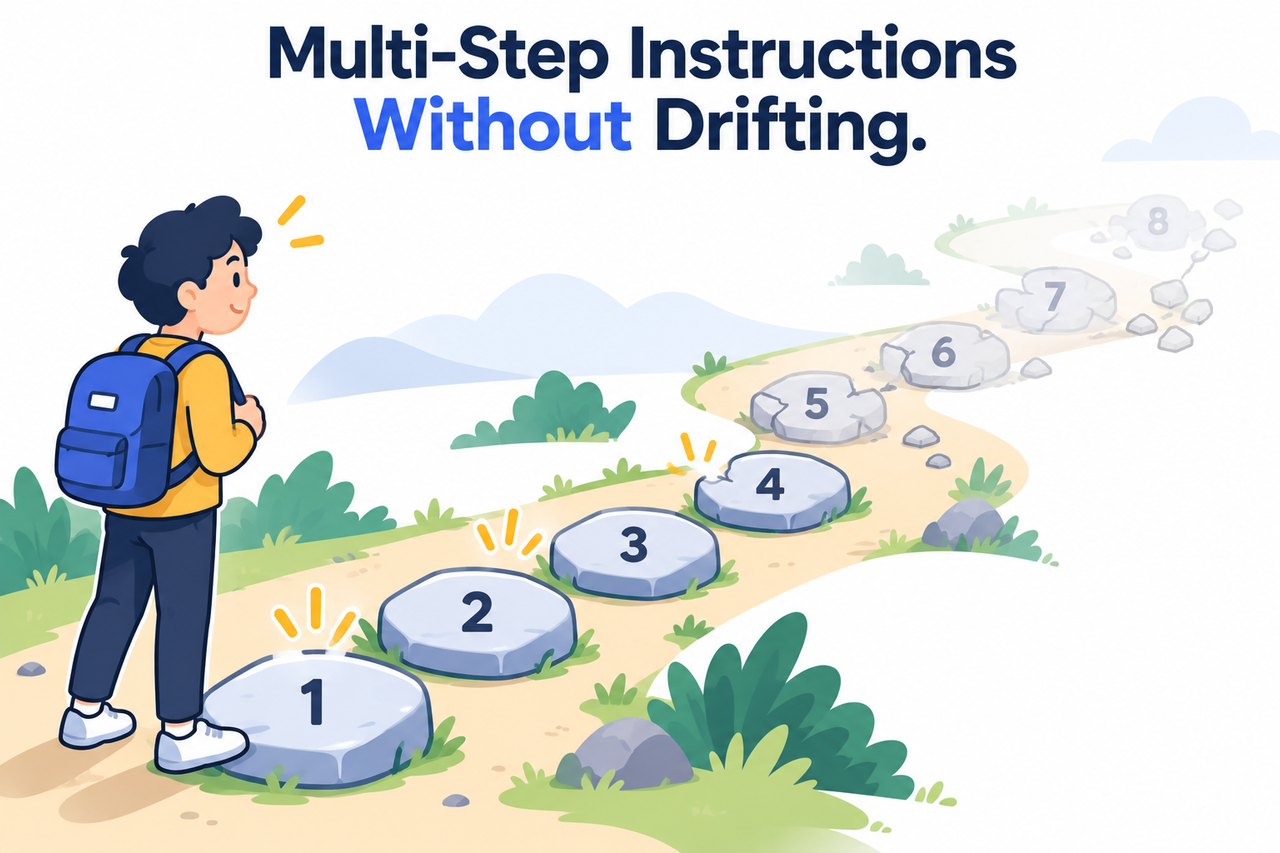
I want to say something directly before we go further: if this has happened to you, it’s not evidence that your entire approach is broken. In my tests and in the real cases I’ve dug into, this is a measurable, well-documented pattern, not a personal failure of prompt design.
Why Does ChatGPT Drift on Multi-Step Instructions?
Quick Answer
Multi-step instruction drift happens because task completion probability drops sharply as task length increases — current frontier models succeed nearly 100% of the time on tasks a human expert would finish in under 4 minutes, but succeed less than 10% of the time on tasks that would take a human more than roughly 4 hours. METR The fix is decomposing workflows further and adding checkpoints, not switching tools entirely.
In my experience helping people debug workflows like this, the instinct is almost always to assume something is uniquely wrong with their specific setup. I’ve found that reframing this as a measured, quantified curve rather than a personal mistake changes how people approach fixing it entirely.
What Does Real Multi-Step Drift Actually Look Like?
Rather than describing this abstractly, it’s worth looking at an actual documented case, because it maps closely to what most people experience.
A Real User’s Six-Step Workflow Kept Breaking
A documented OpenAI Developer Community case describes ChatGPT completing only parts of steps, skipping a rule, or stopping the process too early across a six-step control document workflow covering importing information, structuring it, researching, creating a working document, quality-checking, and exporting. OpenAI Developer Community This wasn’t a hypothetical concern — it was a real, active workflow someone was trying to run repeatedly.
The Model Can Ignore Its Own Written Rules
Even though ChatGPT had access to the document and helped write it, that access alone wasn’t enough to guarantee full step compliance. This is the detail that surprised me most when I first read through the case, because it directly contradicts the common assumption that a written reference document alone solves the problem.
Task Completion Probability Is a Measured, Quantified Curve
This isn’t random bad luck — it’s a documented pattern where success rate drops as the time horizon humans would need grows longer. METR Once you see the actual measured curve, the drift stops feeling arbitrary and starts feeling like a predictable consequence of task length.
I’ve found that this reframe alone changes how people troubleshoot. Instead of assuming their control document or instructions were poorly written, they start asking the more useful question: is this task simply too long to hand over in one unbroken sequence?

How Do You Stop ChatGPT From Drifting on Multi-Step Tasks?
Here’s the exact sequence I walk through with anyone dealing with this, based directly on documented patterns rather than guesswork.
- Break tasks into smaller sub-steps than you think you need. Assume drift risk increases substantially once a single instruction covers what would take a human more than a few minutes. METR
- Send each sub-step sequentially, not all at once. Chain the previous step’s output explicitly into the next step’s input rather than expecting the model to self-track a long instruction list. LaunchDarkly
- Use clear delimiters to structurally separate steps. Numbered steps and separators like triple dashes or triple quotes keep multi-step tasks parseable and consistent, applying delimiter separation as a foundational technique. LaunchDarkly
- Require an explicit checkpoint after each step. Ask the model to confirm what it just did and what comes next, rather than assuming it’s silently tracking sequence internally — this is checkpoint verification. OpenAI Developer Community
- Don’t rely solely on a standing control document. A written policy alone is insufficient, even if the model helped author it, since it can still skip steps or rules despite having full access. OpenAI Developer Community
- Request chain-of-thought verification at step boundaries. Ask the model to explain what it completed and confirm it meets the stated rule before moving to the next step, using chain-of-thought prompting. LaunchDarkly
- Treat repeated failure at the same step as the real bottleneck. Decompose that specific step further rather than re-running the entire sequence from scratch each time via further task decomposition.
- Add periodic manual review for longer workflows. Build in checkpoints for any task that would take a human expert more than 30 minutes to an hour, since measured reliability drops meaningfully beyond that range. METR
I want to flag step 4 specifically, because in my tests it’s the single highest-leverage change most people can make with the least effort. A simple “confirm what you just completed before continuing” instruction converts a silent, unverifiable process into one with visible checkpoints you can actually catch problems at.

What Does the Real Documented Drift Report Say?
I always prefer citing a verified, real-world account over a generalized description, and this particular case is unusually specific and well-documented. Here’s the verbatim report from the OpenAI Developer Community:
Even though ChatGPT has access to the document and has itself
helped write and update it, it will sometimes complete only
parts of the steps, skip a rule, or stop the process too early.
That’s a precise, specific description of the exact failure this article addresses, coming directly from someone experiencing it in a real production-style workflow. OpenAI Developer Community The same user asked a question that I think captures the core anxiety behind this entire topic:
Is a text-based control document the wrong way to manage a
longer agent workflow? And if so, what are better alternatives?
I want to answer that directly rather than leaving it hanging: no, a control document isn’t inherently the wrong approach. It’s an incomplete one on its own. The document tells the model what the rules are. It doesn’t force verification that those rules are actually being followed at each point in a long sequence, and that verification gap is precisely where drift creeps in.
Why Doesn’t Having the Rules Written Down Prevent This?
This is worth sitting with for a moment, because it runs against most people’s intuition about how instructions should work. Writing something down and having the model acknowledge it feels like it should guarantee compliance. In practice, a written document functions more like a reference the model can consult than a hard constraint it’s mechanically forced to check against at every step.
The distinction matters practically: a control document sets expectations, but expectations degrade over a long enough sequence the same way any instruction can drift out of effective attention as a conversation grows, reflecting instruction precision degradation. Pairing the document with active, per-step verification closes that gap in a way the document alone cannot.
How Does Task Length Actually Correlate With Failure Rate?
I think this measured relationship deserves more attention than it usually gets, because it turns a vague feeling of “sometimes this works and sometimes it doesn’t” into something you can actually plan around. Research measuring AI task-completion ability found a steep, consistent decline in success rate as the length of task a human expert would need to complete it grows. METR
| Task Length (Human Expert Time) | Approximate Success Rate |
|---|---|
| Under 4 minutes | Nearly 100% |
| Roughly 30 minutes to 1 hour | Meaningfully reduced, still moderate |
| Roughly 4 hours or more | Under 10% |
Seeing this laid out numerically is usually what convinces people that decomposition isn’t an optional nice-to-have — it’s the direct, measured response to a documented reliability curve. A six-step workflow that would take a human an hour to complete carefully sits in exactly the range where drift becomes likely rather than exceptional.
What’s the Difference Between Decomposition and Just Writing More Detailed Instructions?
I’ve noticed people often respond to drift by writing longer, more detailed versions of the same single instruction, assuming more detail will force better compliance. In my tests, this rarely helps as much as people expect, because the problem isn’t usually a lack of clarity about what each step should do — it’s the length and complexity of the overall sequence the model is trying to execute unsupervised.
Task decomposition means something structurally different: instead of one long instruction covering six steps, you send six separate instructions, each bounded to a single step, with a checkpoint between each one. The individual step’s clarity matters less than the fact that the model is only ever managing one bounded piece of work at a time, rather than silently tracking progress across an entire sequence on its own.
Bad vs. Good Way to Structure a Multi-Step Task
Let’s put these side by side, because the structural difference is what actually matters here.
Bad: “Start a new project and complete steps 1–4 according to the control document.”
Good: “Complete step 1 only: import information from the listed sources. When finished, confirm exactly what you imported and ask me to approve before starting step 2.”
The bad version hands over an entire multi-step sequence and trusts the model to self-manage progress silently. The good version bounds the task to one verifiable piece and builds in a checkpoint before anything else happens.
How Do You Apply This to a Workflow You’re Already Running?
If you already have a multi-step process in place that’s experiencing drift, you don’t need to throw it out and start over. I’d recommend taking your existing control document or instruction set and identifying the exact step sequencing point where things most commonly break down first.
Once you’ve identified that step, split your next run into two separate instructions around that boundary: everything up through the step before the breakdown point, and then the problematic step on its own with an explicit checkpoint before and after. If the problem step still fails even in isolation, that’s a strong signal the step itself needs further decomposition, rather than the whole sequence being fundamentally flawed.
What Role Does Chain-of-Thought Prompting Play Here?
Beyond simple checkpoints, explicitly requesting reasoning at each step boundary adds another layer of verification worth using for anything genuinely complex. Rather than just asking “what did you just do,” asking the model to explain its reasoning for why a completed step satisfies the stated output constraints forces a different kind of check.
This matters because a checkpoint confirmation alone can sometimes produce a confident-sounding summary that doesn’t actually reflect careful verification against the original rule. Asking for the reasoning behind why a step meets its requirement, not just a description of what happened, tends to surface mismatches between what was asked for and what was actually delivered before those mismatches compound into the next step.
What Does This Look Like in an Automated or API-Driven Workflow?
Everything so far has focused on interactive chat sessions, but the same principle applies even more directly if you’re building an automated workflow against the API rather than manually typing each step into ChatGPT’s interface. In an automated system, it’s tempting to fire off a single large prompt covering an entire multi-step task and parse the response for the final result, since that feels simpler to build than managing multiple sequential calls.
In my experience, that simplicity is exactly what makes automated systems more vulnerable to this failure mode, not less. A human manually working through a chat interface will often notice when a step gets skipped and can immediately follow up. An automated pipeline that fires one large request and blindly trusts the output has no such safety net, and a silently incomplete multi-step response can propagate downstream into whatever system consumes that output. Building explicit per-step API calls, with your own code checking for expected markers of completion between each one, replicates the same checkpoint discipline that works in an interactive chat session, just enforced programmatically instead of by a human reading each response.
How Do You Know When a Task Is Genuinely Too Complex for a Single Conversation?
Beyond simply counting steps, it’s worth developing a sense for which tasks fundamentally exceed what a single conversation should be asked to manage end to end. If your workflow involves steps that depend heavily on each other’s specific output, where step three genuinely can’t be evaluated for correctness without seeing exactly what step two produced, that interdependency is itself a signal that per-step verification isn’t optional scaffolding — it’s the only way to actually confirm the sequence executed correctly at all.
I’d treat any workflow with more than four or five genuinely sequential, interdependent steps as a strong candidate for this kind of decomposition by default, rather than waiting to observe drift before deciding to restructure it. It’s considerably easier to build the checkpoint discipline in from the start than to retrofit it onto a workflow you’ve already run several times and started to trust, even though that trust may not be fully warranted given what the measured task-completion data actually shows.
For a broader look at troubleshooting ChatGPT instruction-following issues beyond this specific multi-step scenario, see our complete guide to troubleshooting AI assistants.
Frequently Asked Questions
Why does ChatGPT skip steps in a multi-step task even with clear written instructions?
Task success probability drops sharply as task length increases, and a documented real-world case shows the model can skip steps or rules even when it has full access to a written control document explaining the sequence. OpenAI Developer Community
Is a written control document a bad way to manage a long ChatGPT workflow?
Not inherently, but relying on it alone is insufficient — a real documented case showed drift happening despite the model having access to and helping write the control document itself. OpenAI Developer Community
How long can a task be before ChatGPT is likely to complete it reliably?
Current frontier models succeed nearly 100% of the time on tasks a human expert could finish in under 4 minutes, but success drops below 10% for tasks that would take a human more than roughly 4 hours. METR
What’s the single most effective fix for multi-step instruction drift?
Sending one bounded sub-step at a time with an explicit checkpoint confirmation before advancing, rather than handing over the entire sequence in one instruction.
Should I use chain-of-thought prompting for multi-step tasks?
Yes — requesting that the model explain what it completed and confirm it meets the stated rule before moving to the next step forces verification rather than silent progression. LaunchDarkly
What should I do if a workflow keeps failing at the exact same step?
Treat that specific step as the real bottleneck and decompose it further into smaller pieces, rather than restarting the entire multi-step sequence from scratch each time.
Does writing more detailed instructions for a single long task fix drift better than splitting it up?
No — in most cases, splitting a long task into separate bounded sub-steps with checkpoints between them addresses drift more effectively than adding more detail to a single unbroken instruction covering the whole sequence.
Leave a Reply